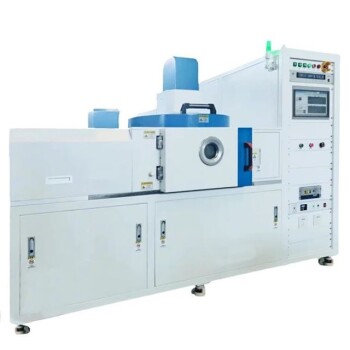
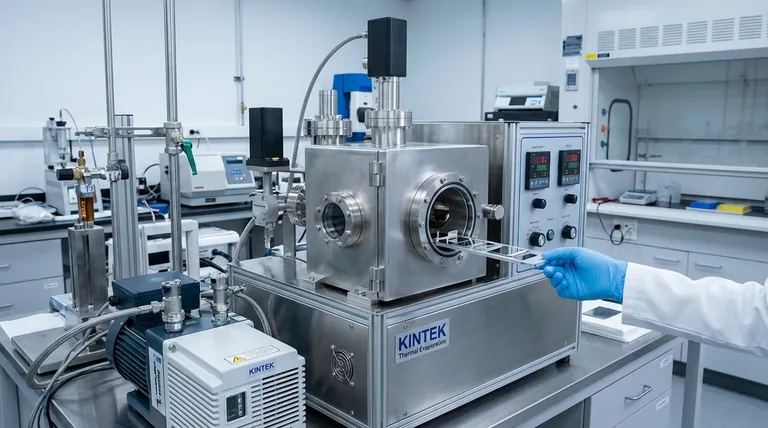
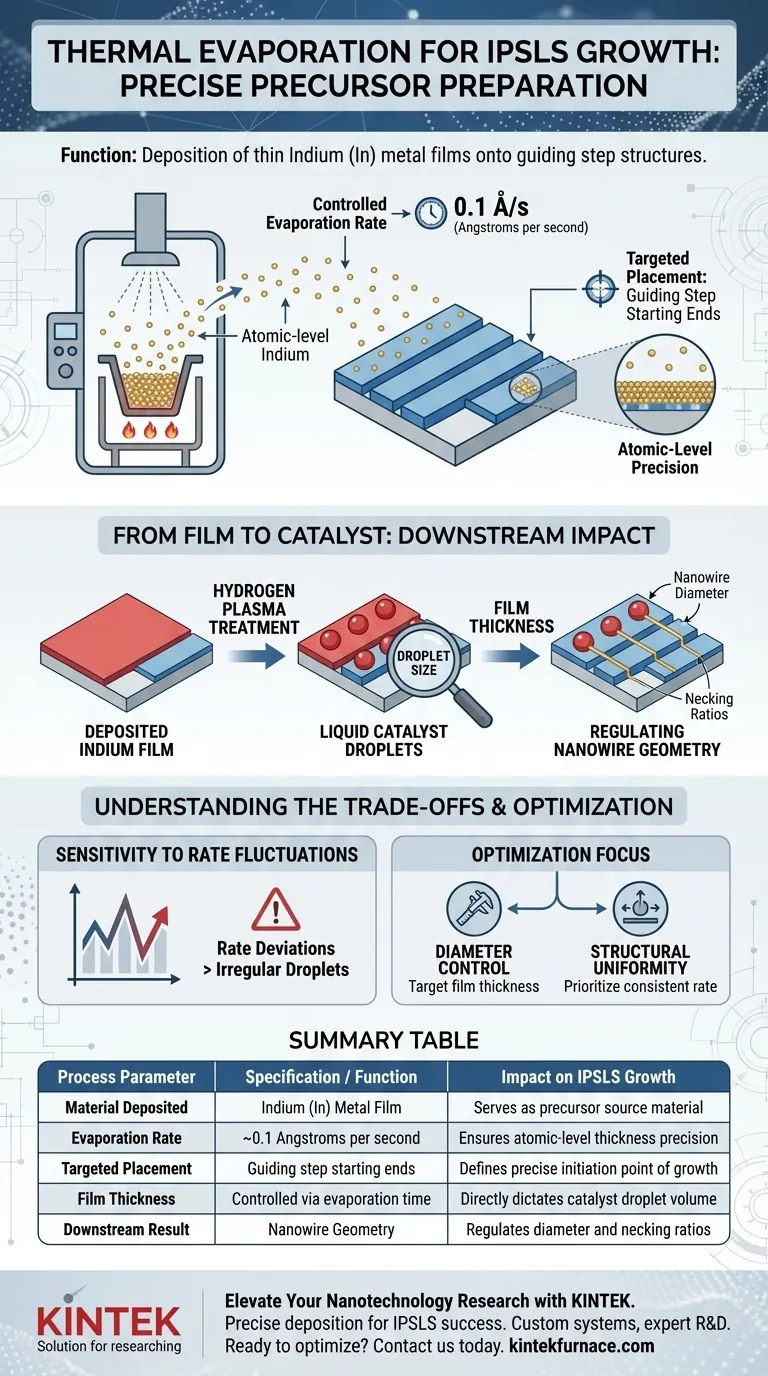
The primary function of a thermal evaporation system in this context is to deposit thin Indium (In) metal films onto the starting ends of guiding step structures. This is a high-precision process that establishes the precursor material necessary for subsequent In-Plane Solid-Liquid-Solid (IPSLS) growth.
The system does not merely coat the substrate; it acts as a precise volume controller. By strictly regulating the evaporation rate, the system defines the initial Indium film thickness, which directly dictates the size of the catalyst droplets and the resulting nanowire geometry.
The Mechanics of Precursor Deposition
Controlled Evaporation Rate
The thermal evaporation system operates by maintaining a specific, low evaporation rate of approximately 0.1 Angstroms per second.
This slow rate is critical for achieving uniformity. It allows for the deposition of the Indium film with atomic-level precision, ensuring the layer is exactly the required thickness.
Targeted Placement
The deposition is not random; it is spatially targeted at the starting ends of the guiding step structures.
This placement ensures that the Indium source material is located exactly where the growth process is intended to initiate, preventing unwanted nucleation elsewhere on the substrate.
From Film to Catalyst: The Downstream Impact
Determining Droplet Size
The physical thickness of the deposited Indium film is the primary variable that determines the volume of the catalyst.
Upon subsequent hydrogen plasma treatment, this solid film dewets and balls up. The volume of material provided by the evaporation system dictates the exact size of the liquid catalyst droplets formed during this phase.
Regulating Nanowire Geometry
There is a direct causal link between the precursor preparation and the final product structure.
The size of the catalyst droplet regulates the nanowire diameter. Furthermore, the initial film thickness is a key parameter for controlling necking ratios, defining the structural integrity and shape of the nanowire as it grows.
Understanding the Trade-offs
Sensitivity to Rate Fluctuations
The reliance on a rate of 0.1 Angstroms per second implies a high sensitivity to process variations.
If the evaporation rate fluctuates, the film thickness will deviate from the target. This deviation propagates through the process, resulting in catalyst droplets that are either too large or too small for the intended guiding structures.
The Dependency on Plasma Treatment
It is important to note that the thermal evaporation system prepares the potential for the catalyst, not the catalyst itself.
The system relies entirely on the subsequent hydrogen plasma treatment to convert the film into functional droplets. If the evaporation system deposits an irregular film, the plasma treatment will amplify these irregularities rather than correct them.
Optimizing Precursor Preparation
To ensure successful IPSLS growth, you must view the thermal evaporation step as the geometric definition phase of your experiment.
- If your primary focus is Nanowire Diameter Control: Calibrate the thermal evaporation system to deposit the exact film thickness corresponding to your target droplet volume.
- If your primary focus is Structural Uniformity: Prioritize the stability of the evaporation rate at 0.1 Angstroms per second to ensure consistent film thickness across all guiding steps.
Success in IPSLS growth begins with the rigorous control of the initial Indium deposition.
Summary Table:
| Process Parameter | Specification / Function | Impact on IPSLS Growth |
|---|---|---|
| Material Deposited | Indium (In) Metal Film | Serves as the precursor source material |
| Evaporation Rate | ~0.1 Angstroms per second | Ensures atomic-level thickness precision |
| Targeted Placement | Guiding step starting ends | Defines the precise initiation point of growth |
| Film Thickness | Controlled via evaporation time | Directly dictates catalyst droplet volume |
| Downstream Result | Nanowire Geometry | Regulates diameter and necking ratios |
Elevate Your Nanotechnology Research with KINTEK
Precise precursor deposition is the foundation of successful In-Plane Solid-Liquid-Solid (IPSLS) growth. At KINTEK, we understand that atomic-level precision is non-negotiable for your laboratory's success.
Backed by expert R&D and manufacturing, KINTEK offers a comprehensive range of Muffle, Tube, Rotary, Vacuum, and CVD systems, along with specialized high-temp lab furnaces—all fully customizable to meet your unique thin-film and thermal processing needs. Whether you are aiming for perfect nanowire geometry or consistent catalyst formation, our systems provide the stability and control your research demands.
Ready to optimize your deposition process? Contact us today to speak with our technical experts about a tailored solution for your lab.
Visual Guide
References
- Lei Wu, Linwei Yu. Step-necking growth of silicon nanowire channels for high performance field effect transistors. DOI: 10.1038/s41467-025-56376-x
This article is also based on technical information from Kintek Furnace Knowledge Base .
Related Products
- RF PECVD System Radio Frequency Plasma Enhanced Chemical Vapor Deposition
- Custom Made Versatile CVD Tube Furnace Chemical Vapor Deposition CVD Equipment Machine
- Multi Heating Zones CVD Tube Furnace Machine for Chemical Vapor Deposition Equipment
- Cylindrical Resonator MPCVD Machine System for Lab Diamond Growth
- 915MHz MPCVD Diamond Machine Microwave Plasma Chemical Vapor Deposition System Reactor
People Also Ask
- What is RF in PECVD? A Critical Control for Plasma Deposition
- What is the role of RF power in PECVD and how does the RF-PECVD process work? Master Thin Film Deposition Control
- What are the applications of plasma enhanced chemical vapor deposition? Key Uses in Electronics, Optics & Materials
- What are the key advantages of PECVD technology? Achieve Low-Temperature, High-Quality Thin Film Deposition
- How are deposition rates and film properties controlled in PECVD? Master Key Parameters for Optimal Thin Films