The gold (Au) catalyst layer serves as the fundamental director of the entire growth process. Upon heating, this thin layer breaks down into discrete, nano-sized metallic droplets that act as specific nucleation centers. These droplets absorb zinc vapor until they reach a supersaturated state, at which point they precipitate zinc oxide, effectively guiding the growth of the material into a one-dimensional nanowire structure.
The gold layer functions not just as a reaction site, but as a physical template for the nanowire's geometry. By controlling the initial size of the gold droplets, you directly dictate the diameter of the resulting zinc oxide nanowires.
The Mechanism of Guided Growth
The transformation from a thin gold film to a forest of vertical nanowires relies on the Vapor-Liquid-Solid (VLS) mechanism. The gold layer dictates where and how this transformation occurs.
Formation of Nucleation Centers
The gold layer does not remain a continuous film during the process. Under the high temperatures of the furnace, the layer breaks apart to form nano-sized metallic droplets.
Absorption and Supersaturation
These gold droplets act as a solvent for the vaporized zinc. They act as "traps," absorbing zinc vapor from the gas phase until they become supersaturated.
Unidirectional Precipitation
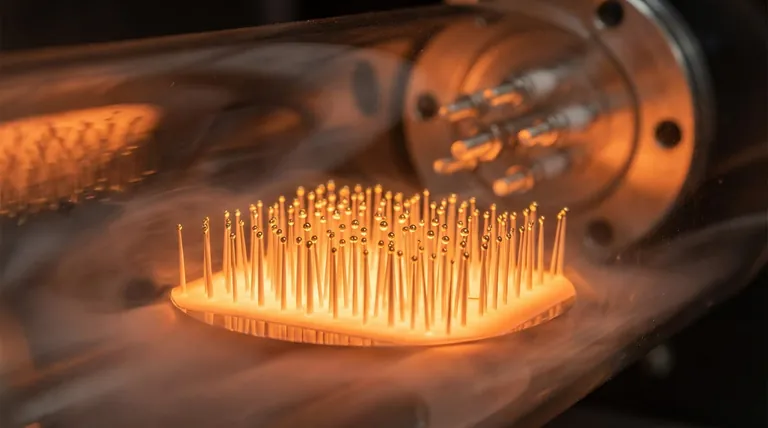
Once supersaturated, the droplet can no longer hold the dissolved material. Zinc oxide precipitates out of the droplet at the liquid-solid interface. This continuous precipitation pushes the gold droplet upward, resulting in the elongation of a one-dimensional nanowire.
Controlling Nanowire Geometry
The physical properties of the gold layer are the primary lever you have for controlling the morphology of the final product.
Diameter Determination
There is a direct correlation between the catalyst size and the product size. The initial diameter of the gold droplet directly determines the final diameter of the zinc oxide nanowire.
The Role of Layer Thickness
To manipulate the wire diameter, you must manipulate the initial gold deposition. A thinner gold film will generally bead up into smaller droplets, producing finer nanowires, whereas a thicker film results in larger droplets and thicker wires.
Understanding the Trade-offs
While the gold catalyst is essential, relying on this mechanism requires precise environmental control to avoid common pitfalls.
Thermal Dependence
The VLS process is highly sensitive to temperature. The furnace must reach a temperature sufficient (often around 900 °C) to facilitate the formation of the alloy droplet and the subsequent oxidation reaction. If the temperature is too low, the gold will not form the necessary liquid alloy state to absorb the vapor.
Alloy Complexity
It is important to note that during growth, the droplet is not pure gold. It becomes a liquid alloy containing the catalyst and the source material. Variations in carrier gas flow (nitrogen or oxygen) or temperature can alter the stability of this droplet, potentially disrupting smooth growth.
Making the Right Choice for Your Synthesis
To achieve high-quality zinc oxide nanowires, you must align your catalyst preparation with your specific structural goals.
- If your primary focus is Ultra-Fine Nanowires: Deposit the thinnest possible continuous layer of gold to ensure the formation of minimal-diameter droplets.
- If your primary focus is Uniform Density: Ensure the thermal distribution in the furnace is perfectly even to prevent irregular droplet coalescence across the substrate.
- If your primary focus is High Aspect Ratio: Maintain stable carrier gas flow and temperature to keep the droplet in a supersaturated state for longer periods, allowing for extended growth.
Mastering the thickness and thermal treatment of the gold catalyst is the single most critical step in achieving precise control over zinc oxide nanowire fabrication.
Summary Table:
| Process Phase | Role of Gold (Au) Catalyst Layer |
|---|---|
| Initial Heating | Breaks down into discrete, nano-sized metallic droplets |
| Nucleation | Acts as specific centers for ZnO crystal formation |
| Growth Stage | Absorbs Zn vapor to reach a supersaturated alloy state |
| Precipitation | Directs unidirectional growth into 1D nanowire structures |
| Geometry Control | Initial droplet size directly determines nanowire diameter |
Achieve unparalleled precision in your ZnO nanowire synthesis with KINTEK’s high-performance thermal solutions. Backed by expert R&D and manufacturing, KINTEK offers advanced Muffle, Tube, Rotary, Vacuum, and CVD systems designed for the rigorous demands of the VLS mechanism. Whether you require ultra-fine diameter control or high-aspect-ratio results, our lab high-temp furnaces are fully customizable to meet your unique material research needs. Optimize your growth process—contact KINTEK today!
References
- Clémence Badie, Sang Sub Kim. Selective Detection of H<sub>2</sub> Gas in Gas Mixtures Using NiO‐Shelled Pd‐Decorated ZnO Nanowires. DOI: 10.1002/admt.202302081
This article is also based on technical information from Kintek Furnace Knowledge Base .
Related Products
- Cylindrical Resonator MPCVD Machine System for Lab Diamond Growth
- MPCVD Machine System Reactor Bell-jar Resonator for Lab and Diamond Growth
- HFCVD Machine System Equipment for Drawing Die Nano Diamond Coating
People Also Ask
- How does MPCVD achieve stable temperature control during diamond growth? Master Precise Thermal Management
- What are the essential components of an MPCVD reactor system? Build a Pristine Environment for High-Purity Materials
- How does pressure affect the MPCVD growth process? Master Plasma Control for Superior Film Quality
- How do carbon-containing groups contribute to diamond growth in the MPCVD method? Unlock High-Quality Diamond Synthesis
- What factors influence the quality of diamond deposition in the MPCVD method? Master the Critical Parameters for High-Quality Diamond Growth