
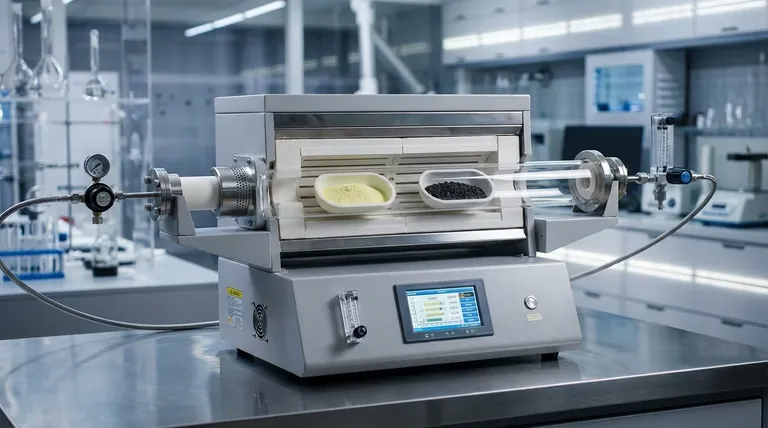
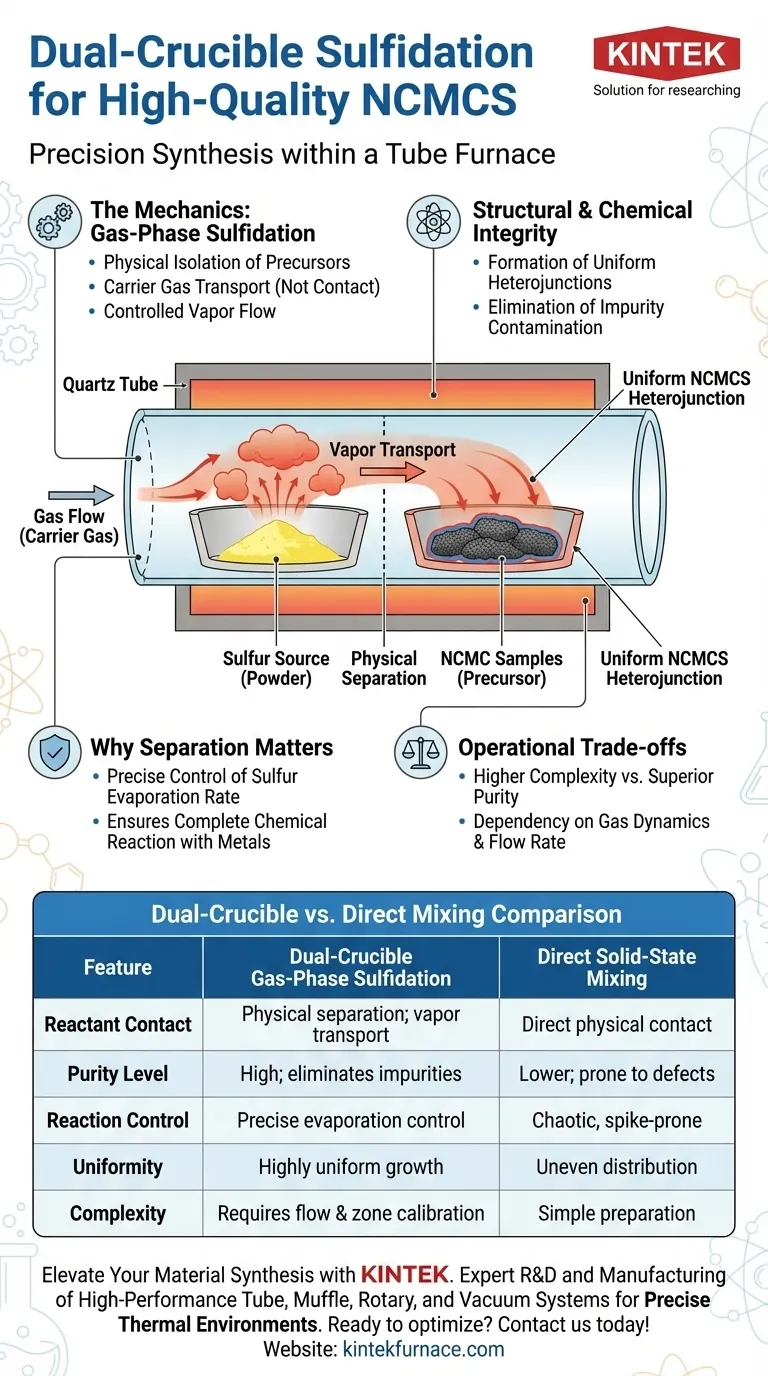
The dual-crucible arrangement is a precise synthesis configuration used to physically separate the sulfur source from the NCMC samples while chemically connecting them through vapor transport. By placing sulfur powder and NCMC samples in distinct ceramic crucibles within a tube furnace, this method utilizes gas flow to carry sulfur vapor over the sample, facilitating a controlled gas-phase sulfidation process rather than a solid-state reaction.
This configuration is the standard for synthesizing high-quality NCMCS because it allows for independent control of the sulfur evaporation rate. This results in the formation of uniform sulfide heterojunctions while eliminating the impurity contamination inevitably caused by direct mixing of raw materials.
The Mechanics of Gas-Phase Sulfidation
Separation of Reactants
The fundamental feature of this arrangement is the physical isolation of the precursors.
Sulfur powder is placed in one ceramic crucible, while the NCMC precursor is placed in another. This prevents the chaotic kinetics associated with direct physical contact between solids.
Vapor Transport Mechanism
Instead of contact heating, the process relies on carrier gas transport.
The heating zone of the tube furnace vaporizes the sulfur. A steady gas flow then transports this sulfur vapor downstream, where it washes over the NCMC sample surface to initiate the reaction.
Why Separation Matters for Material Quality
Precision Control of Evaporation
The dual-crucible setup grants you precise control over the sulfur evaporation rate.
By regulating the heating zone and gas flow, you ensure a steady, consistent supply of reactant. This prevents the "all-or-nothing" reaction spikes common in direct mixing methods.
Ensuring Complete Chemical Reaction
The controlled vapor flow facilitates a thorough reaction with metallic elements.
The sulfur atoms are able to react fully with the nickel and cobalt present in the NCMC sample. This ensures the chemical transformation is complete throughout the material surface.
Structural and Chemical Integrity
Formation of Uniform Heterojunctions
The ultimate goal of this arrangement is structural homogeneity.
The steady supply of gas-phase sulfur promotes the growth of a uniform sulfide heterojunction. This uniformity is critical for the consistent electronic or catalytic performance of the final NCMCS material.
Preventing Impurity Contamination
This method solves the purity challenges of solid-state mixing.
Direct mixing of raw materials often introduces unwanted impurities or defects at the interface. By utilizing gas-phase sulfidation, you effectively eliminate contamination caused by the physical interaction of raw solids.
Understanding the Operational Trade-offs
Complexity vs. Purity
While the dual-crucible method yields superior results, it introduces operational complexity.
Unlike simple mixing, this approach requires careful calibration of gas flow rates and furnace temperature zones to ensure the sulfur vapor reaches the sample at the optimal concentration.
Dependency on Gas Dynamics
The success of the synthesis is heavily dependent on fluid dynamics within the tube.
If the gas flow is too variable, the sulfur distribution may become uneven, potentially negating the uniformity benefits this setup is designed to provide.
Optimizing Your Synthesis Strategy
To determine if this configuration is right for your specific experimental goals, consider the following:
- If your primary focus is High Purity and Uniformity: Adopt the dual-crucible arrangement to ensure a clean heterojunction and avoid physical contamination.
- If your primary focus is Reaction Stoichiometry: Use this setup to precisely control the availability of sulfur vapor relative to the nickel and cobalt content.
- If your primary focus is Rapid, Low-Cost Screening: You might opt for direct mixing, accepting that the resulting material will suffer from lower uniformity and higher impurities.
By decoupling the sulfur source from the substrate, you transform a chaotic mixing process into a controlled surface engineering technique.
Summary Table:
| Feature | Dual-Crucible Gas-Phase Sulfidation | Direct Solid-State Mixing |
|---|---|---|
| Reactant Contact | Physical separation; vapor transport | Direct physical contact |
| Purity Level | High; eliminates raw material impurities | Lower; prone to interface defects |
| Reaction Control | Precise control of sulfur evaporation | Chaotic, spike-prone kinetics |
| Uniformity | Highly uniform heterojunction growth | Uneven structural distribution |
| Complexity | Requires gas flow & zone calibration | Simple preparation |
Elevate Your Material Synthesis with KINTEK
Precision in sulfidation starts with the right equipment. Backed by expert R&D and manufacturing, KINTEK offers high-performance Tube, Muffle, Rotary, and Vacuum systems, all customizable to meet your unique laboratory needs. Whether you are developing NCMCS or advanced heterojunctions, our furnaces provide the stable thermal environments and precise gas flow control essential for high-purity results.
Ready to optimize your synthesis process? Contact us today to discuss your custom furnace requirements with our technical experts!
Visual Guide
References
- Muhammad Ahsan Naseeb, Amir Waseem. Molybdenum carbide supported metal–organic framework-derived Ni, Co phosphosulphide heterostructures as efficient OER and HER catalysts. DOI: 10.1039/d5na00510h
This article is also based on technical information from Kintek Furnace Knowledge Base .
Related Products
- Vacuum Sealed Continuous Working Rotary Tube Furnace Rotating Tube Furnace
- 1400℃ High Temperature Laboratory Tube Furnace with Alumina Tube
- 1700℃ High Temperature Laboratory Tube Furnace with Alumina Tube
- Magnesium Extraction and Purification Condensing Tube Furnace
- High Pressure Laboratory Vacuum Tube Furnace
People Also Ask
- What is the purpose of rotary tube furnaces? Achieve Uniform Heat Treatment for Powders and Granules
- What are the key advantages of using a rotary tube furnace? Achieve Dynamic, Uniform Heating for Powders
- What are the advantages of rotary tube furnaces in fuel compatibility? Boost Efficiency and Cut Costs
- How does the amount of material processed vary between batch and continuous rotary tube furnaces? Scale Your Production Efficiently
- What is the temperature range of some rotary tube furnaces? Achieve Uniform Heating Up to 1200°C



















