Knowledge Why is a two-step process used for waste bone-derived carbon? Unlock Ultra-High Surface Area & Stability
Author avatar

Tech Team · Kintek Furnace

Updated 23 hours ago

Why is a two-step process used for waste bone-derived carbon? Unlock Ultra-High Surface Area & Stability


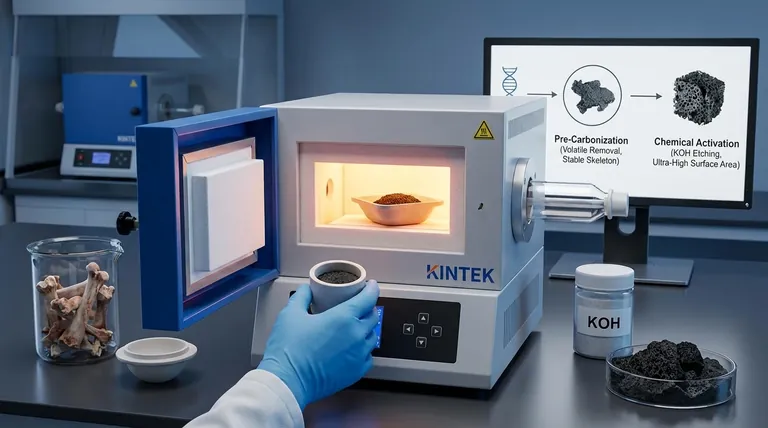
The two-step process is essential for separating structural stabilization from porosity development. By first pre-carbonizing the material, you ensure the removal of volatile organics to create a stable framework. This prepares the waste bone for a subsequent activation step, which specifically targets surface area expansion without compromising the material's foundational integrity.

The primary advantage of this sequential approach is control. It allows you to lock in a stable carbon skeleton first, ensuring that the subsequent chemical etching can generate an ultra-high specific surface area with maximum efficiency.
Why is a two-step process used for waste bone-derived carbon? Unlock Ultra-High Surface Area & Stability

The Function of Pre-Carbonization

Eliminating Volatile Components

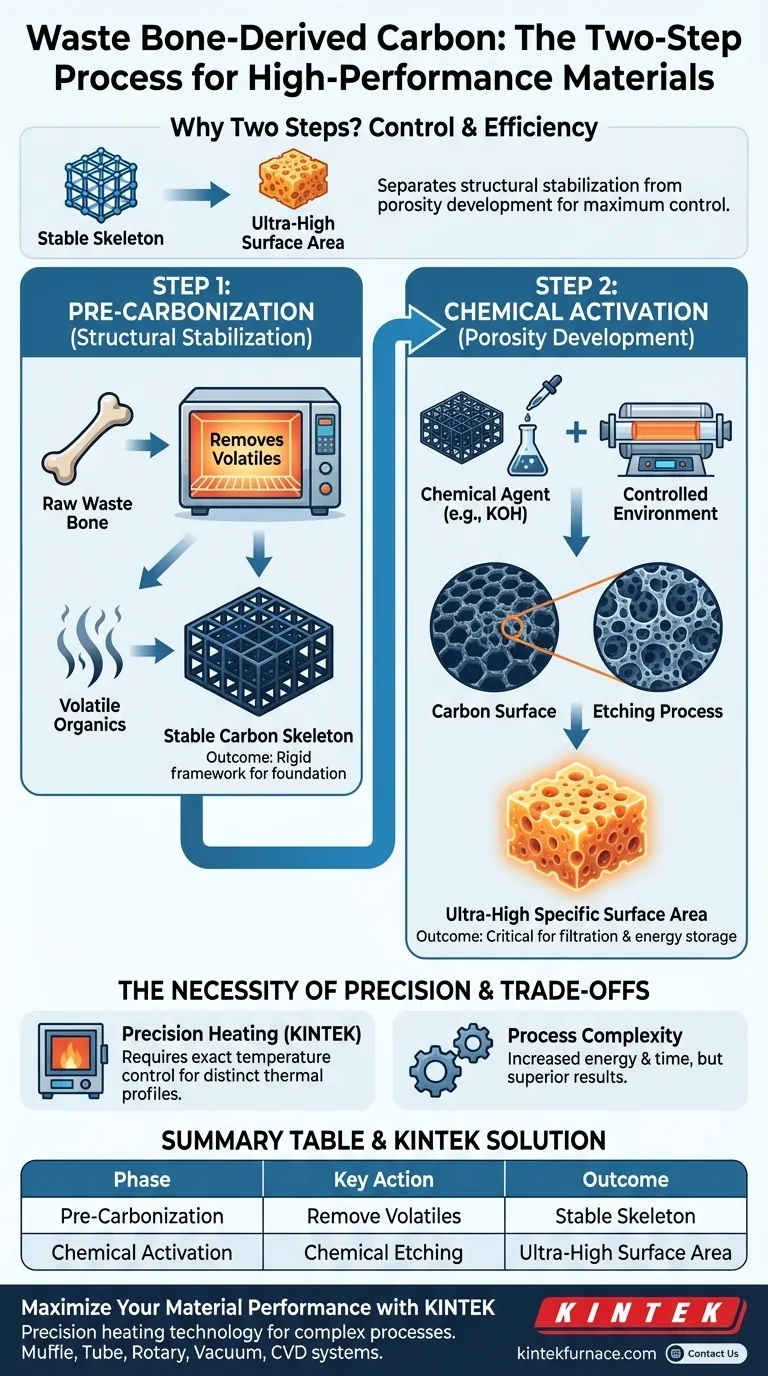
The initial phase of the process focuses on purification. Heating the raw waste bone drives off volatile organic compounds that are naturally present in the biomass. Removing these elements early prevents them from interfering with the chemical reactions required in the later stages.

Establishing a Stable Skeleton

Once the volatiles are removed, the remaining material forms a stable carbon skeleton. This rigid framework serves as the physical foundation for the final product. Without this stabilization, the material could collapse or degrade unpredictably during the more aggressive activation phase.

The Role of Chemical Activation

Etching the Carbon Surface

The second step typically involves introducing a chemical agent, such as KOH (potassium hydroxide). This step is performed in a controlled environment, such as a tube furnace. The chemical agent actively etches the previously stabilized carbon surface.

Generating Ultra-High Surface Area

The physical etching process drastically alters the material's topography. By eating away specific parts of the carbon skeleton, the process generates an ultra-high specific surface area. This high surface area is the critical performance metric for activated carbon used in filtration or energy storage.

The Necessity of Precision

Leveraging Temperature Control

Success in this two-step process relies on the precise capabilities of laboratory high-temperature furnaces. Distinct thermal profiles are required for driving off volatiles versus activating the carbon. Separating the steps allows for the exact temperature control needed to optimize the chemical reactions in each phase.

Understanding the Trade-offs

Process Complexity and Energy

While this method produces superior materials, it is inherently more complex than single-step carbonization. It requires two distinct heating cycles, which increases energy consumption and total processing time.

Chemical Handling Requirements

The use of chemical activators like KOH introduces handling challenges. These agents are corrosive and require careful management within the furnace environment to prevent equipment damage or safety hazards.

Optimizing Your Material Preparation

To ensure you are getting the most out of your waste bone-derived carbon, consider your specific performance targets when designing your thermal profile.

  • If your primary focus is Structural Integrity: Ensure your pre-carbonization dwell time is sufficient to fully remove volatiles and solidify the carbon skeleton before introducing chemical agents.
  • If your primary focus is Maximum Surface Area: Prioritize precise temperature regulation during the KOH activation phase to maximize the etching effect without destroying the underlying framework.

This sequential method offers the most reliable path for converting biological waste into high-performance functional materials.

Summary Table:

Process Phase Primary Objective Key Action Outcome
Pre-Carbonization Structural Stabilization Removal of volatile organic compounds Stable carbon skeleton framework
Chemical Activation Porosity Development Chemical etching (e.g., with KOH) Ultra-high specific surface area
Precision Control Optimization Distinct thermal profile management Maximum efficiency and material integrity

Maximize Your Material Performance with KINTEK

Ready to transform biological waste into high-performance functional materials? KINTEK provides the precision heating technology required for complex two-step carbonization and activation processes.

Backed by expert R&D and manufacturing, KINTEK offers Muffle, Tube, Rotary, Vacuum, and CVD systems, all customizable to meet your unique laboratory needs. Whether you require exact temperature control for structural stabilization or a robust environment for chemical etching, our equipment ensures consistent, high-quality results for your research and production.

Take the next step in material excellence—Contact KINTEK today for a customized solution!

Visual Guide
Why is a two-step process used for waste bone-derived carbon? Unlock Ultra-High Surface Area & Stability Visual Guide

References

  1. Perseverance Dzikunu, Pedro Vilaça. Waste-to-carbon-based supercapacitors for renewable energy storage: progress and future perspectives. DOI: 10.1007/s40243-024-00285-4

This article is also based on technical information from Kintek Furnace Knowledge Base .

Related Products

People Also Ask

Related Products

1400℃ Muffle Oven Furnace for Laboratory

1400℃ Muffle Oven Furnace for Laboratory

KT-14M Muffle Furnace: Precision 1400°C heating with SiC elements, PID control, and energy-efficient design. Ideal for labs.

Laboratory Muffle Oven Furnace with Bottom Lifting

Laboratory Muffle Oven Furnace with Bottom Lifting

Boost lab efficiency with KT-BL Bottom Lifting Furnace: precise 1600℃ control, superior uniformity, and enhanced productivity for material science and R&D.

1800℃ High Temperature Muffle Oven Furnace for Laboratory

1800℃ High Temperature Muffle Oven Furnace for Laboratory

KINTEK Muffle Furnaces: Precision 1800°C heating for labs. Energy-efficient, customizable, with PID control. Ideal for sintering, annealing, and research.

1700℃ High Temperature Muffle Oven Furnace for Laboratory

1700℃ High Temperature Muffle Oven Furnace for Laboratory

KT-17M Muffle Furnace: High-precision 1700°C lab furnace with PID control, energy efficiency, and customizable sizes for industrial & research applications.

High Temperature Muffle Oven Furnace for Laboratory Debinding and Pre Sintering

High Temperature Muffle Oven Furnace for Laboratory Debinding and Pre Sintering

KT-MD Debinding & Pre-Sintering Furnace for ceramics - precise temperature control, energy-efficient design, customizable sizes. Boost your lab efficiency today!

1700℃ High Temperature Laboratory Tube Furnace with Quartz or Alumina Tube

1700℃ High Temperature Laboratory Tube Furnace with Quartz or Alumina Tube

KINTEK's Tube Furnace with Alumina Tube: Precision heating up to 1700°C for material synthesis, CVD, and sintering. Compact, customizable, and vacuum-ready. Explore now!

1400℃ High Temperature Laboratory Tube Furnace with Quartz and Alumina Tube

1400℃ High Temperature Laboratory Tube Furnace with Quartz and Alumina Tube

KINTEK's Tube Furnace with Alumina Tube: Precision high-temperature processing up to 2000°C for labs. Ideal for material synthesis, CVD, and sintering. Customizable options available.

1200℃ Split Tube Furnace Laboratory Quartz Tube Furnace with Quartz Tube

1200℃ Split Tube Furnace Laboratory Quartz Tube Furnace with Quartz Tube

Discover KINTEK's 1200℃ Split Tube Furnace with quartz tube for precise high-temperature lab applications. Customizable, durable, and efficient. Get yours now!

2200 ℃ Tungsten Vacuum Heat Treat and Sintering Furnace

2200 ℃ Tungsten Vacuum Heat Treat and Sintering Furnace

2200°C Tungsten Vacuum Furnace for high-temperature materials processing. Precise control, superior vacuum, customizable solutions. Ideal for research & industrial applications.

1200℃ Controlled Inert Nitrogen Atmosphere Furnace

1200℃ Controlled Inert Nitrogen Atmosphere Furnace

KINTEK 1200℃ Controlled Atmosphere Furnace: Precision heating with gas control for labs. Ideal for sintering, annealing, and material research. Customizable sizes available.

Vacuum Heat Treat Furnace with Ceramic Fiber Liner

Vacuum Heat Treat Furnace with Ceramic Fiber Liner

KINTEK's Vacuum Furnace with Ceramic Fiber Lining offers precise high-temperature processing up to 1700°C, ensuring uniform heat distribution and energy efficiency. Ideal for labs and production.

1400℃ Controlled Inert Nitrogen Atmosphere Furnace

1400℃ Controlled Inert Nitrogen Atmosphere Furnace

KT-14A Controlled Atmosphere Furnace for labs & industry. 1400°C max temp, vacuum sealing, inert gas control. Customizable solutions available.

Vacuum Heat Treat Sintering Furnace Molybdenum Wire Vacuum Sintering Furnace

Vacuum Heat Treat Sintering Furnace Molybdenum Wire Vacuum Sintering Furnace

KINTEK's Vacuum Molybdenum Wire Sintering Furnace excels in high-temperature, high-vacuum processes for sintering, annealing, and material research. Achieve precise 1700°C heating with uniform results. Custom solutions available.

2200 ℃ Graphite Vacuum Heat Treat Furnace

2200 ℃ Graphite Vacuum Heat Treat Furnace

2200℃ Graphite Vacuum Furnace for high-temperature sintering. Precise PID control, 6*10⁻³Pa vacuum, durable graphite heating. Ideal for research & production.

High Pressure Laboratory Vacuum Tube Furnace Quartz Tubular Furnace

High Pressure Laboratory Vacuum Tube Furnace Quartz Tubular Furnace

KINTEK High Pressure Tube Furnace: Precision heating up to 1100°C with 15Mpa pressure control. Ideal for sintering, crystal growth, and lab research. Customizable solutions available.

1700℃ Controlled Inert Nitrogen Atmosphere Furnace

1700℃ Controlled Inert Nitrogen Atmosphere Furnace

KT-17A Controlled Atmosphere Furnace: Precise 1700°C heating with vacuum & gas control. Ideal for sintering, research & material processing. Explore now!

Laboratory Quartz Tube Furnace RTP Heating Tubular Furnace

Laboratory Quartz Tube Furnace RTP Heating Tubular Furnace

KINTEK's RTP Rapid Heating Tube Furnace delivers precise temperature control, rapid heating up to 100°C/sec, and versatile atmosphere options for advanced lab applications.

Vacuum Heat Treat Sintering Furnace with Pressure for Vacuum Sintering

Vacuum Heat Treat Sintering Furnace with Pressure for Vacuum Sintering

KINTEK's Vacuum Pressure Sintering Furnace offers 2100℃ precision for ceramics, metals, and composites. Customizable, high-performance, and contamination-free. Get a quote now!

Multi Zone Laboratory Quartz Tube Furnace Tubular Furnace

Multi Zone Laboratory Quartz Tube Furnace Tubular Furnace

KINTEK Multi-Zone Tube Furnace: Precise 1700℃ heating with 1-10 zones for advanced material research. Customizable, vacuum-ready, and safety-certified.

600T Vacuum Induction Hot Press Vacuum Heat Treat and Sintering Furnace

600T Vacuum Induction Hot Press Vacuum Heat Treat and Sintering Furnace

600T Vacuum Induction Hot Press Furnace for precise sintering. Advanced 600T pressure, 2200°C heating, vacuum/atmosphere control. Ideal for research & production.


Leave Your Message
