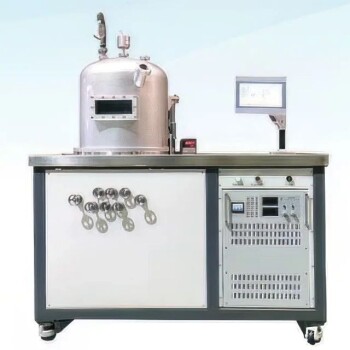
Strict vacuum control is the defining factor in the successful thermal evaporation of Se80In5Te6Sb9 thin films. It primarily serves to maximize the mean free path of evaporated molecules, ensuring they reach the substrate without colliding with residual gas particles. This environment is essential for maintaining the chemical integrity of the material and achieving a consistent deposition flux.
Core Insight: Vacuum conditions are not merely about reducing pressure; they are strictly about enabling ballistic transport. By removing obstacles (gas molecules) from the evaporation path, you ensure that the Se80In5Te6Sb9 deposits with high purity, uniform thickness, and superior surface quality.
The Physics of Deposition in Vacuum
Extending the Mean Free Path
The most critical function of the vacuum is to increase the mean free path of the Se80In5Te6Sb9 molecules.
In standard atmospheric conditions, vaporized atoms would instantly collide with air molecules. A high-vacuum environment ensures that the distance a molecule can travel without collision exceeds the distance from the evaporation source to the substrate.
Preventing Molecular Scattering
When the mean free path is maximized, the evaporated material travels in a straight-line path.
This minimizes scattering, which occurs when vapor atoms deflect off residual gas. By eliminating scattering, you ensure that the vapor flux remains directional and efficient, depositing directly onto the glass substrate rather than dispersing into the chamber.
Material-Specific Benefits for Se80In5Te6Sb9
Achieving High Purity
Se80In5Te6Sb9 is a complex chalcogenide glass; maintaining its stoichiometry is vital.
A vacuum environment significantly reduces the presence of reactive gases like oxygen. This prevents oxidation and contamination during the film growth process, ensuring the deposited film retains the specific chemical composition of the source material.
Precision in Thickness and Uniformity
The primary reference highlights that vacuum conditions allow for a uniform flux of material.
This stability enables precise control over film thickness—such as achieving a specific 400 nm target. Without the interference of gas collisions, the accumulation of the material is predictable, leading to a film with superior surface quality and consistent physical properties across the substrate.
Common Pitfalls to Avoid
The "Line-of-Sight" Limitation
Because high vacuum promotes straight-line (ballistic) trajectories, the process becomes strictly line-of-sight.
While this is excellent for flat surfaces, it can result in poor coverage on complex or shadowed geometries (step coverage). If your substrate has significant topography, a simple thermal evaporation setup might leave gaps unless substrate rotation is employed.
Sensitivity to Residual Gases
Even in a vacuum, "high purity" is relative to the base pressure achieved (e.g., $10^{-5}$ Torr vs $10^{-6}$ mbar).
Failing to reach a sufficient vacuum threshold allows residual gas molecules to impede the vapor stream. This results in porous films with poor adhesion, as energy is lost through collisions before the atoms strike the substrate.
Making the Right Choice for Your Goal
To ensure the best results for your Se80In5Te6Sb9 application, consider the following:
- If your primary focus is Optical Purity: Prioritize the highest possible base vacuum to eliminate oxidation, as impurities will drastically alter the optical transmission of chalcogenide films.
- If your primary focus is Thickness Precision: Ensure your vacuum level is stable to maintain a constant mean free path, allowing for reproducible thickness (e.g., exactly 400 nm) across multiple runs.
Ultimately, the vacuum is the invisible tool that transforms a chaotic vapor cloud into a disciplined, high-quality thin film.
Summary Table:
| Key Factor | Role in Se80In5Te6Sb9 Deposition | Benefit for Thin Film Quality |
|---|---|---|
| Mean Free Path | Prevents collisions with residual gas molecules | Ensures ballistic transport and direct deposition |
| Straight-Line Path | Minimizes molecular scattering during travel | Achieves uniform thickness and high flux efficiency |
| Inert Environment | Eliminates reactive oxygen and contaminants | Maintains stoichiometry and chemical purity |
| Vacuum Threshold | Reduces energy loss from atomic collisions | Improves film adhesion and surface density |
Elevate Your Thin Film Deposition with KINTEK Precision
High-quality Se80In5Te6Sb9 thin films require more than just heat—they demand a perfect vacuum. At KINTEK, we specialize in providing the advanced high-temperature systems needed for sophisticated material science. Backed by expert R&D and manufacturing, KINTEK offers a comprehensive range of Muffle, Tube, Rotary, Vacuum, and CVD systems, all fully customizable to meet your unique laboratory needs.
Ready to achieve superior film uniformity and purity?
Contact KINTEK Experts Today to discuss how our customizable thermal evaporation and furnace solutions can optimize your research and production workflows.
References
- Studies on phase change Se80In5Te6Sb9 thin films by -irradiation for optoelectronic devices. DOI: 10.56975/jetir.v12i1.563335
This article is also based on technical information from Kintek Furnace Knowledge Base .
Related Products
People Also Ask
- What is Hot-filament Chemical Vapor Deposition (HFCVD)? Achieve High-Quality Thin Films with Precision Control
- What are the equipment for chemical vapor deposition? A Guide to the 5 Essential Components
- What is the significance of the vacuum pressure control system in the CVD coating process for powders?
- What is the function of high-purity Argon (Ar) gas during CVD? Optimize Your Thin Film Uniformity and Purity
- What are the advantages of using Chemical Vapor Deposition (CVD) for coating turbine blades? Enhance Life & Performance