
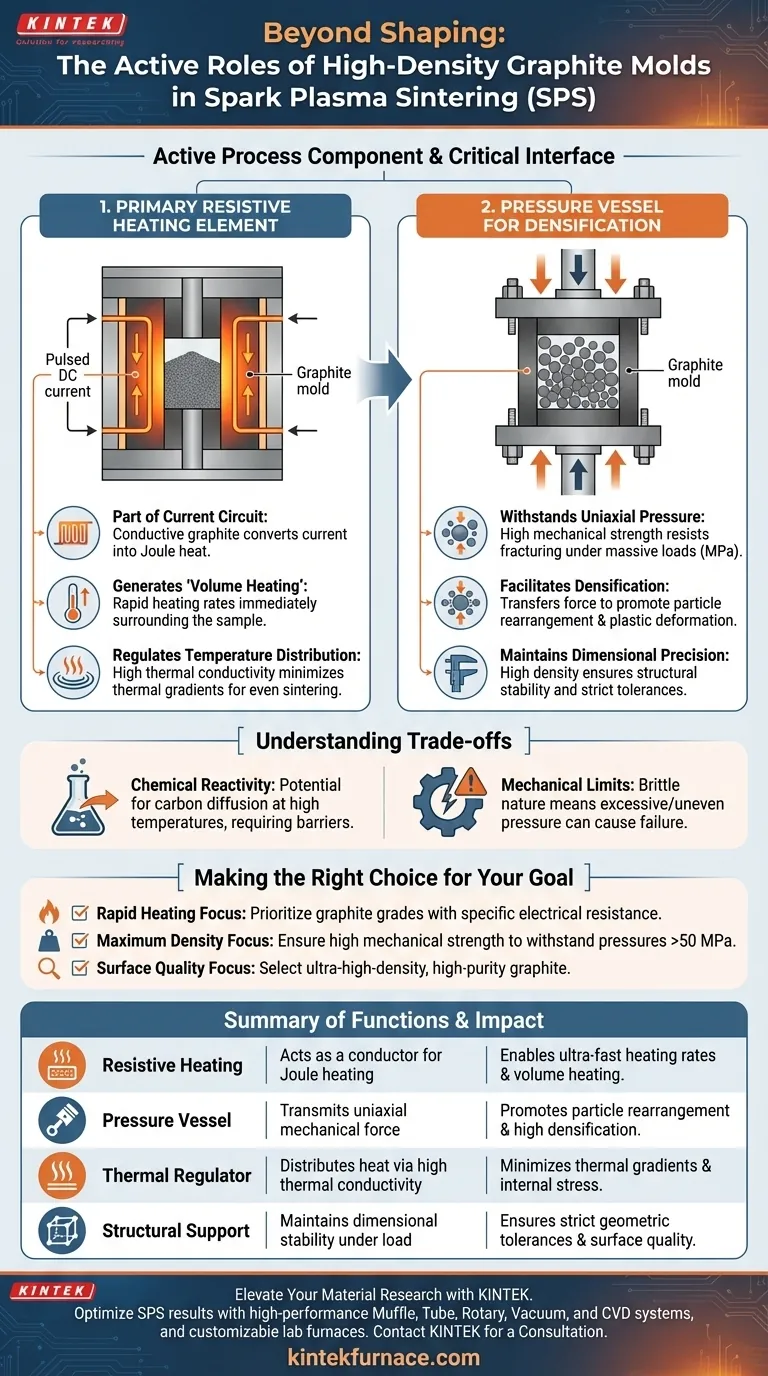
High-density graphite molds act as active process components rather than passive containers in Spark Plasma Sintering (SPS). Beyond simply defining the geometry of the sample, the mold serves two critical functions: it operates as the primary resistive heating element within the electrical circuit and acts as a pressure vessel capable of transmitting massive mechanical force to densify the powder.
In Spark Plasma Sintering, the mold is an integral part of the energy delivery system. Its electrical resistance generates the heat required for sintering, while its mechanical strength ensures the pressure necessary for particle rearrangement and high material density.
The Mold as an Active Thermal Element
Part of the Current Circuit
In an SPS setup, the mold is not insulated from the power source; it is a critical link in the electrical loop.
Because graphite is conductive, the pulsed direct current passes through the mold walls. The material's inherent electrical resistance converts this current into Joule heat.
Generating "Volume Heating"
Unlike external heating methods (like radiant elements in a standard furnace), the graphite mold generates heat immediately surrounding the sample.
This allows for extremely rapid heating rates, which is a hallmark efficiency of the SPS process.
Regulating Temperature Distribution
The high thermal conductivity of high-density graphite is essential for process control.
It ensures that the heat generated is distributed evenly across the sintering zone. This minimizes thermal gradients, preventing uneven sintering or internal stress within the final material.
Structural Integrity and Pressure Transmission
Withstanding Uniaxial Pressure
SPS relies on the simultaneous application of heat and pressure to bond particles.
The graphite mold must possess high mechanical strength to withstand significant uniaxial loads (often measured in MPa) without fracturing or deforming.
Facilitating Densification
The mold acts as a piston-cylinder system that transfers force from the hydraulic rams directly to the powder.
This pressure promotes particle rearrangement and plastic deformation, which are necessary mechanisms for achieving high-density, void-free materials.
Maintaining Dimensional Precision
The density of the graphite mold directly correlates to the dimensional stability of the final product.
A high-density mold resists expansion or warping under load, ensuring the sintered component maintains strict geometric tolerances and a high-quality surface finish.
Understanding the Trade-offs
Chemical Reactivity at High Temperatures
While graphite is excellent for conductivity, it is chemically reactive.
At elevated temperatures, carbon from the mold can diffuse into the sample, potentially forming unwanted carbides or adhering to the material. This often requires the use of diffusion barriers, such as graphite paper or boron nitride coatings.
Mechanical Limits
Graphite has exceptional high-temperature strength compared to metals, but it is brittle.
Excessive pressure, particularly if applied unevenly or too rapidly, can cause catastrophic mold failure. The mechanical limits of the specific graphite grade dictate the maximum pressure you can apply to the sample.
Making the Right Choice for Your Goal
To maximize the effectiveness of your SPS process, consider how the mold's properties align with your specific sintering objectives:
- If your primary focus is rapid heating: Prioritize graphite grades with specific electrical resistance properties to maximize Joule heating efficiency.
- If your primary focus is maximum density: Ensure the mold design and graphite grade have the mechanical strength to withstand pressures exceeding standard limits (e.g., 50 MPa or higher).
- If your primary focus is surface quality: Select ultra-high-density, high-purity graphite to minimize surface porosity and chemical contamination.
The graphite mold is the critical interface where electrical energy and mechanical force converge to transform loose powder into a solid, high-performance material.
Summary Table:
| Function | Description | Impact on SPS Process |
|---|---|---|
| Resistive Heating | Acts as a conductor for Joule heating | Enables ultra-fast heating rates and volume heating |
| Pressure Vessel | Transmits uniaxial mechanical force | Promotes particle rearrangement and high densification |
| Thermal Regulator | Distributes heat via high thermal conductivity | Minimizes thermal gradients and internal material stress |
| Structural Support | Maintains dimensional stability under load | Ensures strict geometric tolerances and surface quality |
Elevate Your Material Research with KINTEK
Are you looking to optimize your Spark Plasma Sintering (SPS) results? Achieving the perfect balance of heat and pressure starts with the right equipment. Backed by expert R&D and manufacturing, KINTEK offers high-performance Muffle, Tube, Rotary, Vacuum, and CVD systems, alongside customizable lab high-temp furnace solutions tailored to your unique research needs.
Our systems are engineered to help researchers and manufacturers achieve superior densification and material purity. Don't settle for standard—customize your sintering environment today.
Contact KINTEK for a Consultation
Visual Guide
Related Products
People Also Ask
- Why are vacuum heat treating furnaces essential for aerospace? Ensure Superior Material Integrity for High-Stakes Applications
- What is the primary application of vacuum heat treating furnaces in aerospace? Enhance Component Performance with Precision
- What is the process of vacuum heat treating? Achieve Superior Metallurgical Properties
- How does vacuum heat treating work in terms of temperature and time control? Master Precise Material Transformations
- How does a vacuum heat treating furnace improve the condition of metal alloys? Achieve Superior Metal Performance
