High-precision mass flow controllers (MFCs) serve as the critical regulation mechanism for carrier gases during the synthesis of fluorinated two-dimensional polymer (2DP-F) films. By strictly controlling the flow rate of gases like argon, these devices ensure the reaction environment remains stable and chemically consistent throughout the fabrication process.
Core Takeaway Precision in gas flow is not merely about transport; it dictates the structural integrity of the polymer. By maintaining a dynamic pressure balance and rigorously controlling monomer concentration, MFCs directly determine the cross-linking density and surface smoothness of the final film.
The Mechanics of Process Control
Regulating Carrier Gas Flow
The primary function of the MFC is to strictly regulate the admission of carrier gases, specifically argon. This consistent gas input acts as the foundation for the entire reaction system.
Maintaining Dynamic Pressure Balance
A constant flow rate is essential to achieve a dynamic pressure balance within the reactor. This equilibrium ensures that the reaction kinetics remain predictable over time.
Fluctuations in pressure can alter the deposition rate. The MFC actively compensates to keep the internal environment stable.
Optimizing Monomer Concentration
The MFC plays a vital role in diluting monomer concentrations to optimal levels. Proper dilution prevents the reaction from proceeding too aggressively or unevenly.
Efficient By-Product Removal
Effective flow control ensures the efficient removal of by-products from the reaction zone. Clearing these waste materials prevents contamination that could degrade the growing polymer film.
Direct Impact on Material Properties
Determining Cross-Linking Density
The stability of the gas flow directly impacts the cross-linking density of the 2DP-F films. Uniform flow ensures that the polymer chains connect consistently across the material.
Inconsistent flow leads to variations in density. This can result in weak spots or structural inconsistencies within the polymer network.
Controlling Surface Roughness
Fluid dynamics within the chamber heavily influence the surface roughness of the film. A strictly regulated flow promotes a smoother deposition process.
Turbulence or flow spikes can create irregularities on the surface. High-precision MFCs minimize these deviations to produce a high-quality finish.
Common Pitfalls to Avoid
The Risk of Flow Fluctuations
Using low-precision controllers or manual valves introduces micro-fluctuations in gas delivery. Even minor deviations can disrupt the dynamic pressure balance, leading to unpredictable reaction outcomes.
Neglecting By-Product Accumulation
If the flow rate is too low or inconsistent, by-products may linger in the reaction zone. This accumulation interferes with the polymerization process, often resulting in impurities embedded in the final film.
Making the Right Choice for Your Goal
To achieve the best results in 2DP-F film preparation, align your flow control strategy with your specific material requirements:
- If your primary focus is Structural Integrity: Prioritize flow stability to ensure optimal monomer dilution and uniform cross-linking density.
- If your primary focus is Surface Quality: rigorous flow regulation is required to maintain the pressure balance needed to minimize surface roughness.
Success in 2DP-F synthesis relies on treating gas flow not as a variable, but as a precise architectural tool.
Summary Table:
| Key MFC Function | Impact on 2DP-F Film Property | Role in Synthesis |
|---|---|---|
| Carrier Gas Regulation | Chemical Consistency | Maintains stable reaction environment using Argon. |
| Dynamic Pressure Balance | Deposition Uniformity | Prevents pressure fluctuations and kinetic instability. |
| Monomer Dilution | Cross-linking Density | Controls concentration to ensure even polymer chain connections. |
| By-product Removal | Material Purity | Sweeps waste materials to prevent film contamination. |
| Flow Stability | Surface Roughness | Minimizes turbulence for a smooth, high-quality finish. |
Elevate Your Thin-Film Research with KINTEK Precision
Precise flow control is the architectural backbone of high-performance polymer synthesis. At KINTEK, we understand that even minor fluctuations can compromise your material's structural integrity.
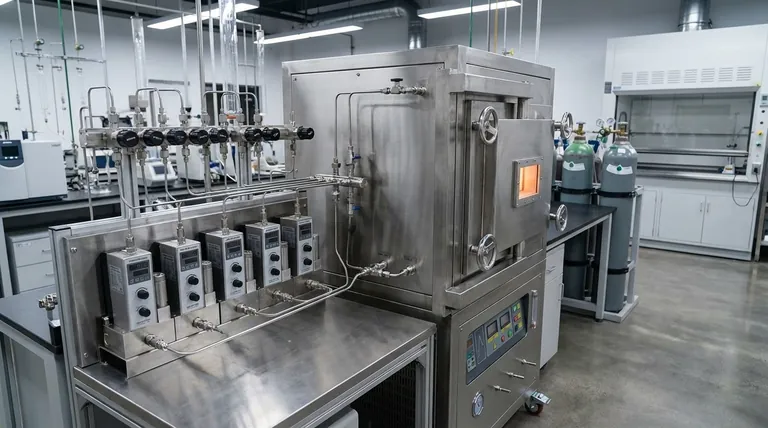
Backed by expert R&D and world-class manufacturing, KINTEK offers a comprehensive range of Muffle, Tube, Rotary, Vacuum, and CVD systems, all of which can be customized with high-precision mass flow controllers to meet your unique 2DP-F fabrication needs.
Ready to optimize your lab’s high-temperature processes? Contact us today to discuss your custom furnace requirements and discover how our expertise can bring unparalleled consistency to your research.
References
- Qiyi Fang, Jun Lou. High-performance 2D electronic devices enabled by strong and tough two-dimensional polymer with ultra-low dielectric constant. DOI: 10.1038/s41467-024-53935-6
This article is also based on technical information from Kintek Furnace Knowledge Base .
Related Products
- Ultra Vacuum Electrode Feedthrough Connector Flange Power Lead for High Precision Applications
- 915MHz MPCVD Diamond Machine Microwave Plasma Chemical Vapor Deposition System Reactor
- Ultra High Vacuum CF Observation Window Flange with High Borosilicate Glass Sight Glass
- Cylindrical Resonator MPCVD Machine System for Lab Diamond Growth
- MPCVD Machine System Reactor Bell-jar Resonator for Lab and Diamond Growth
People Also Ask
- Why is a high-precision vacuum sealing system necessary for CrSb? Ensure Pure Crystal Growth & Prevent Oxidation
- Why is an Ultra-High Vacuum (UHV) System Required for In2Se3? Achieving Atomic-Level Ferroelectric Clarity
- What is the function of quartz vacuum encapsulation in RhSeCl CVT? Mastering Pure Crystal Growth
- Why is vacuum sealing technology essential for K2In2As3 synthesis? Master High-Purity Solid-State Reactions
- What role do vacuum-sealed high-purity silica ampoules play in phase equilibrium experiments? Enhance Sample Integrity