
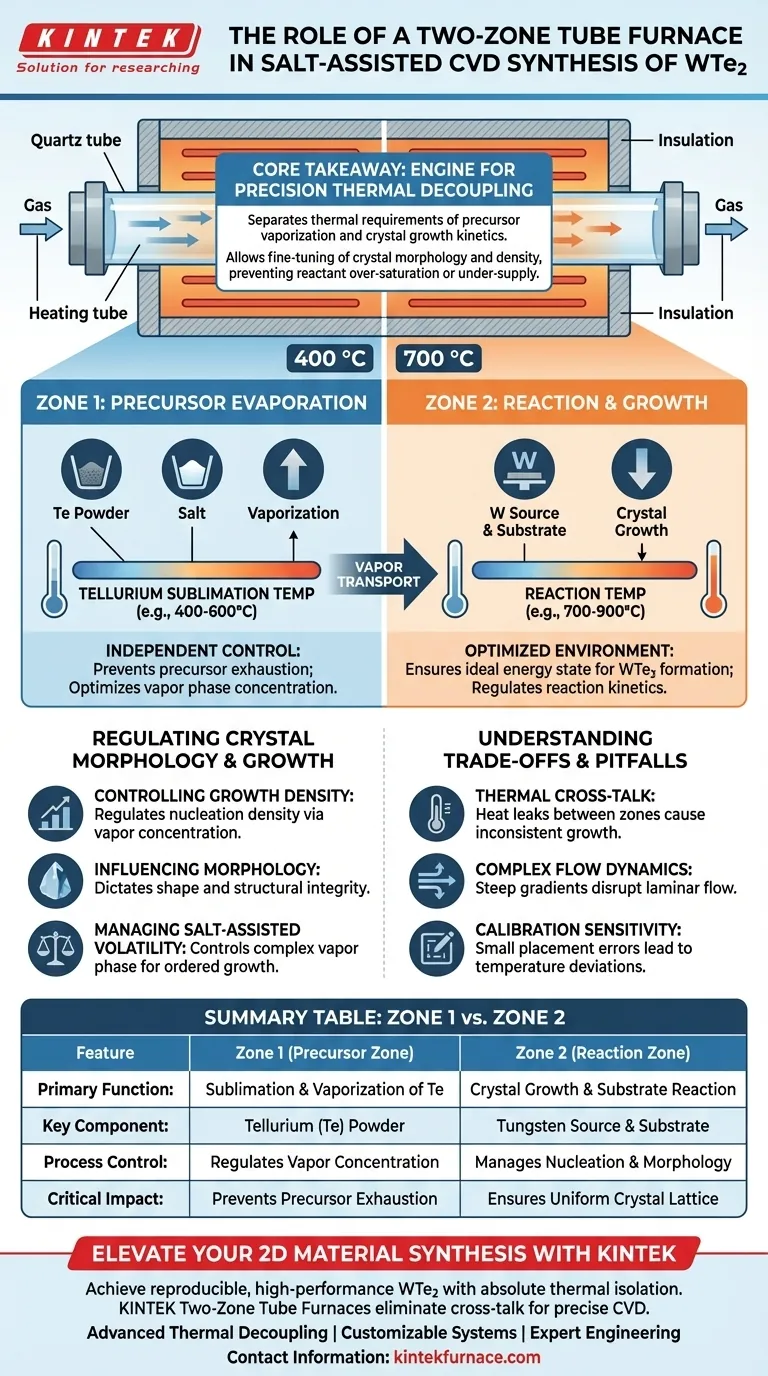
In the synthesis of tungsten ditelluride (WTe2), a two-zone tube furnace serves as the engine for precision thermal decoupling. This configuration allows researchers to independently manage the evaporation temperature of tellurium precursors and the reaction temperature of the tungsten-substrate zone. By isolating these thermal environments, the system provides the exact control over vapor phase concentration and reaction kinetics required to produce high-quality 2D crystals.
The Core Takeaway: A two-zone furnace is essential for WTe2 synthesis because it separates the thermal requirements of precursor vaporization from the kinetics of crystal growth. This independence allows for the fine-tuning of crystal morphology and growth density, preventing the over-saturation or under-supply of reactants.
Decoupling the Evaporation and Reaction Phases
Independent Control of Precursor Vaporization
In the first zone, the tellurium (Te) powder is heated to its specific sublimation temperature. Because tellurium has a different thermal requirement than the tungsten source, this independent zone prevents the precursor from exhausting too quickly or failing to vaporize.
Optimizing the Reaction Environment
The second zone contains the tungsten source and the substrate, maintained at a distinct temperature gradient optimized for chemical bonding. This ensures that when the tellurium vapor arrives, the substrate environment is at the ideal energy state to facilitate the formation of WTe2.
Regulating Chemical Reaction Kinetics
By adjusting the temperature delta between the two zones, operators can control the speed of the chemical transformation. This precise management of reaction kinetics is what determines whether the resulting material is a continuous film or isolated flakes.
Regulating Crystal Morphology and Growth
Controlling Growth Density
The concentration of tellurium vapor reaching the substrate is a direct function of the temperature in the first zone. Precise zoning allows for the regulation of nucleation density, ensuring that crystals do not overlap or aggregate in an uncontrolled manner.
Influencing Crystal Morphology
The temperature in the reaction zone dictates the final shape and structural integrity of the WTe2. Consistent thermal management across the substrate ensures uniform morphology, which is critical for the electronic properties of the material.
Managing Salt-Assisted Volatility
In salt-assisted CVD, the salt lowers the melting point of metal precursors or increases their volatility. The two-zone furnace manages the resulting complex vapor phase, ensuring that the increased reactivity provided by the salt does not lead to disordered growth.
Understanding the Trade-offs and Pitfalls
The Risk of Thermal Cross-Talk
A common challenge in two-zone setups is thermal interference, where heat from the higher-temperature zone leaks into the lower-temperature zone. This can cause the precursor to evaporate faster than intended, leading to inconsistent growth results.
Complexities in Flow Dynamics
Because the two zones create a temperature gradient, they also influence the gas flow dynamics within the tube. If the gradient is too steep, it can create turbulence that disrupts the laminar flow of precursors, resulting in non-uniform deposition across the substrate.
Calibration and Placement Sensitivity
The physical distance between the two zones and the placement of the precursors is high-stakes. Small errors in crucible positioning can lead to significant deviations in the actual temperature experienced by the materials versus the temperature recorded by the furnace sensors.
Applying This Setup to Your Synthesis Goals
To achieve the best results with a two-zone furnace, you must align your temperature profiles with your specific material requirements.
- If your primary focus is large-area uniformity: Maintain a stable, lower evaporation temperature in Zone 1 to ensure a slow, steady supply of tellurium vapor over a longer growth period.
- If your primary focus is high nucleation density: Increase the temperature of Zone 1 relative to Zone 2 to create a supersaturated vapor environment that encourages many small growth sites.
- If your primary focus is high crystallinity and purity: Prioritize the precise temperature of Zone 2 to provide sufficient thermal energy for atoms to arrange into a perfect lattice structure.
Mastering the independent thermal gradients of a two-zone furnace is the definitive path to achieving reproducible, high-performance WTe2 nanosheets.
Summary Table:
| Feature | Zone 1 (Precursor Zone) | Zone 2 (Reaction Zone) |
|---|---|---|
| Primary Function | Sublimation & Vaporization of Te | Crystal Growth & Substrate Reaction |
| Key Component | Tellurium (Te) Powder | Tungsten Source & Substrate |
| Process Control | Regulates Vapor Concentration | Manages Nucleation & Morphology |
| Critical Impact | Prevents Precursor Exhaustion | Ensures Uniform Crystal Lattice |
Elevate Your 2D Material Synthesis with KINTEK
High-performance tungsten ditelluride (WTe2) requires more than just heat; it requires absolute thermal isolation. KINTEK provides industry-leading Two-Zone Tube Furnaces specifically engineered to eliminate thermal cross-talk and deliver the precise gradients necessary for salt-assisted CVD.
Why choose KINTEK for your lab?
- Advanced Thermal Decoupling: Independent control systems to manage disparate vaporization and reaction temperatures.
- Customizable Systems: Backed by expert R&D, we offer Muffle, Tube, Rotary, Vacuum, and CVD systems tailored to your unique research requirements.
- Expert Engineering: Our furnaces are designed for laminar flow stability and precise crucible positioning.
Ready to achieve reproducible, high-purity results? Contact KINTEK today to discuss your custom furnace needs." Form)!"
Visual Guide
References
- Andrejs Terehovs, Gunta Kunakova. Chemical Vapor Deposition for the Fabrication of WTe<sub>2</sub>/h‐BN Heterostructures. DOI: 10.1002/admi.202500091
This article is also based on technical information from Kintek Furnace Knowledge Base .
Related Products
- Magnesium Extraction and Purification Condensing Tube Furnace
- Split Multi Heating Zone Rotary Tube Furnace Rotating Tube Furnace
- Multi Heating Zones CVD Tube Furnace Machine for Chemical Vapor Deposition Equipment
- Multi Zone Laboratory Quartz Tube Furnace Tubular Furnace
- 1200℃ Split Tube Furnace Laboratory Quartz Tube Furnace with Quartz Tube
People Also Ask
- What are the advantages of using a condensing tube furnace for magnesium extraction? Achieve High Purity and Efficient Metal Recovery
- How does a two-stage sintering process in a tube furnace contribute to high-performance sodium-ion battery cathodes?
- What is the purpose of using an argon purging system during tube furnace pyrolysis? Ensure Pure Yields & Lab Safety
- How does the design of tube furnaces ensure uniform heating? Master Precision with Multi-Zone Control
- What features ensure precise temperature control in tube furnaces? Discover the Key Components for Accuracy



















