
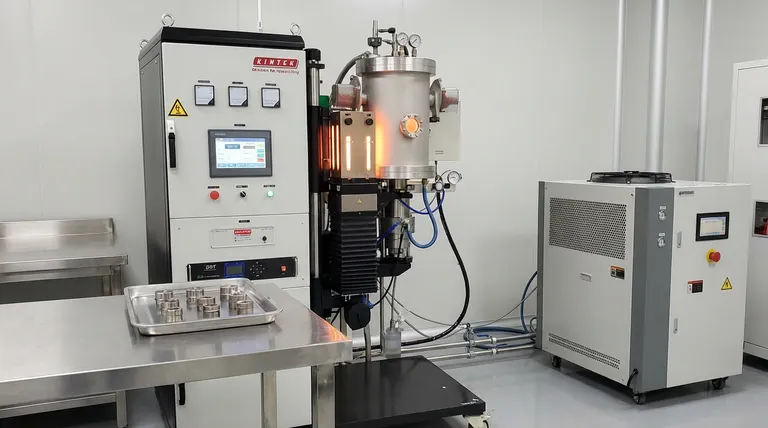
A high-temperature sintering furnace is the transformative engine responsible for converting loosely bound metal powder into a solid, high-performance component. It executes a dual process: first removing residual binding agents through thermal debinding, and subsequently heating the material to near-melting temperatures to fuse the particles into a dense, unified mass.
By driving atomic diffusion and grain growth at extreme temperatures, the sintering furnace forces the material to shrink by up to 20%, eliminating internal pores to establish the metal's full mechanical properties.
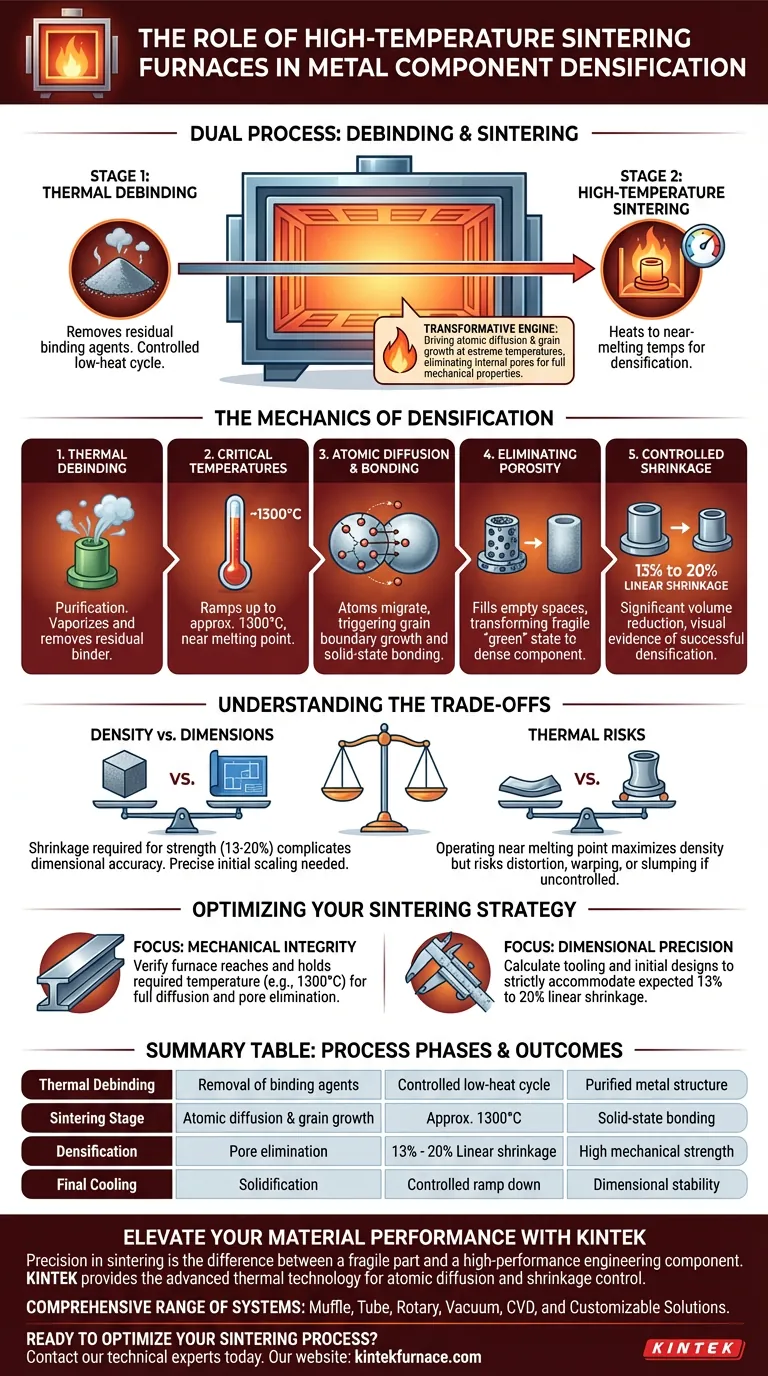
The Mechanics of Densification
Thermal Debinding
Before final densification can occur, the component must be purified. The furnace first initiates a thermal debinding cycle.
This stage applies controlled heat to vaporize and remove any residual binder materials that were previously used to hold the metal powder in its shape.
Reaching Critical Temperatures
Once the binder is removed, the furnace ramps the temperature up to extreme levels.
For many common alloys, temperatures are raised to approximately 1300°C. This specific heat level brings the metal particles close to their melting point without turning them into a liquid.
Atomic Diffusion and Bonding
At these elevated temperatures, the metal powder particles undergo a physical transformation.
The heat energy triggers diffusion, causing atoms to migrate across the boundaries of adjacent particles. This movement facilitates grain boundary growth, effectively welding the individual particles together at an atomic level.
Eliminating Porosity
As diffusion occurs, the empty spaces (pores) between the original powder particles are filled in.
The elimination of these pores is what transforms the part from a fragile "green" state into a dense metal component capable of withstanding structural loads.
Controlled Shrinkage
The removal of pore space results in a significant reduction in the component's physical volume.
Operators can expect a linear shrinkage of 13% to 20% during this process. This contraction is the visual evidence that the material has successfully densified.
Understanding the Trade-offs
Balancing Density and Dimensions
The primary trade-off in high-temperature sintering is between achieving full density and maintaining dimensional accuracy.
While the linear shrinkage of 13% to 20% is necessary for strength, it introduces complexity in manufacturing. The initial design must be scaled up precisely to account for this reduction, or the final part will be out of tolerance.
Thermal Risks
Operating near the melting point maximizes density but risks distortion.
If the temperature control is imprecise, or if the part is not supported correctly, the metal may soften too much. This can lead to warping or slumping under its own weight before the structure fully solidifies.
Optimizing Your Sintering Strategy
To ensure your components meet their performance criteria, consider the following regarding furnace operation:
- If your primary focus is mechanical integrity: Verify that the furnace reaches and holds the specific temperature required (e.g., 1300°C) to ensure full diffusion and the complete elimination of pores.
- If your primary focus is dimensional precision: Calculate your tooling and initial designs to strictly accommodate the expected 13% to 20% linear shrinkage.
The sintering furnace is not just a heater; it is the critical environment where powder becomes a true engineering material.
Summary Table:
| Process Phase | Primary Action | Key Temperature/Metric | Outcome |
|---|---|---|---|
| Thermal Debinding | Removal of binding agents | Controlled low-heat cycle | Purified metal structure |
| Sintering Stage | Atomic diffusion & grain growth | Approx. 1300°C | Solid-state bonding |
| Densification | Pore elimination | 13% - 20% Linear shrinkage | High mechanical strength |
| Final Cooling | Solidification | Controlled ramp down | Dimensional stability |
Elevate Your Material Performance with KINTEK
Precision in sintering is the difference between a fragile part and a high-performance engineering component. KINTEK provides the advanced thermal technology required to master atomic diffusion and shrinkage control.
Backed by expert R&D and world-class manufacturing, we offer a comprehensive range of Muffle, Tube, Rotary, Vacuum, and CVD systems. Whether you need standard lab high-temp furnaces or fully customizable solutions tailored to your unique metallurgical requirements, KINTEK ensures your components achieve maximum density and structural integrity.
Ready to optimize your sintering process? Contact our technical experts today to find the perfect furnace for your application.
Visual Guide
References
- Tobias Rosnitschek, Stephan Tremmel. Dimensional Accuracy and Mechanical Characterization of Inconel 625 Components in Atomic Diffusion Additive Manufacturing. DOI: 10.3390/applmech5020022
This article is also based on technical information from Kintek Furnace Knowledge Base .
Related Products
- 2200 ℃ Tungsten Vacuum Heat Treat and Sintering Furnace
- High Temperature Muffle Oven Furnace for Laboratory Debinding and Pre Sintering
- 2200 ℃ Graphite Vacuum Heat Treat Furnace
- Vacuum Heat Treat Sintering Furnace Molybdenum Wire Vacuum Sintering Furnace
- 1400℃ High Temperature Laboratory Tube Furnace with Alumina Tube
People Also Ask
- How does a tungsten-heated vacuum sintering furnace prepare (TbxY1-x)2O3 ceramics? Achieve 99%+ Density & Purity
- How do compaction pressure and vacuum sintering optimize porous ceramics? Maximize Density & Toughness
- What wear-resistance enhancements are achieved by powder coating? The Role of Vacuum Sintering Furnaces
- What role does a high-temperature vacuum sintering furnace play in the densification of WC-10(Ni, Ni/Co) alloys?
- What core role does a high-temperature vacuum sintering furnace play in Sm:YAG ceramics? Mastering Optical Clarity



















