
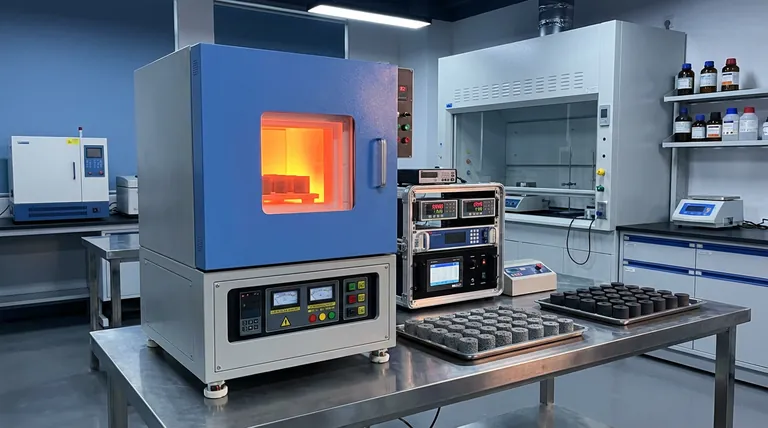
A high-temperature muffle furnace serves as the critical reaction vessel for transforming compacted nickel ferrite powder into a functional, dense ceramic.
It provides a precisely controlled thermal environment that drives the physical and chemical changes necessary to turn a porous "green" compact into a solid material. By regulating the sintering temperature and soaking duration, the furnace enables the solid-state reactions that define the material's final magnetic and electrical capabilities.
Core Takeaway The muffle furnace is not merely a heating device; it is the tool used to dictate the microstructural evolution of the material. Its primary role is to facilitate diffusion and grain growth without melting the material, converting loose nanopowders into a unified, high-density structure with specific performance characteristics.
The Mechanics of Transformation
Driving Solid-State Reactions
The sintering process for nickel ferrite occurs below the melting point of the material. The muffle furnace provides the thermal energy required for solid-state reactions.
At these elevated temperatures, atoms gain enough energy to diffuse across particle boundaries. This diffusion is essential for stabilizing the crystal phase of the material, particularly in complex formulations like yttrium-doped nickel ferrite.
From Porous Compact to Dense Ceramic
Before sintering, the material is a "green compact"—essentially pressed powder held together by mechanical force and binders. It is highly porous and structurally weak.
The muffle furnace promotes densification. As the temperature rises, the pores between powder particles are eliminated. This process often results in significant linear shrinkage (typically 13% to 20%) as the material compacts into a solid mass.
Facilitating Grain Growth
The muffle furnace controls the size and arrangement of the crystalline grains within the material.
Heat causes the individual nanopowder particles to fuse and grow into larger grains. This grain growth is the defining factor for the material's end properties. The size of these grains directly influences the magnetic permeability and electrical resistivity of the final nickel ferrite component.
Critical Process Variables
Precise Temperature Control
The specific sintering temperature is the most critical variable the furnace controls. It must be high enough to trigger atomic diffusion but low enough to prevent melting or structural collapse.
For nickel ferrite, this temperature regime ensures that the correct chemical phase forms. Even slight deviations can lead to incomplete reactions or the formation of unwanted secondary phases.
Soaking Time Management
The "soaking time" refers to the duration the material is held at the peak temperature.
The muffle furnace maintains this stable environment to allow the reaction to reach equilibrium. Sufficient soaking time ensures that the heat penetrates the core of the material, resulting in uniform density and consistent properties throughout the component.
Understanding Process Trade-offs
The Risk of Over-Sintering
While heat is necessary, too much thermal energy or an excessively long soaking time can be detrimental.
Over-sintering leads to excessive grain growth. If the grains become too large, the mechanical strength may degrade, and the magnetic properties can shift outside the desired specifications.
Thermal Uniformity Challenges
The quality of the sintered part relies on the furnace's ability to heat evenly.
If the muffle furnace has inconsistent heating zones (cold spots), the nickel ferrite component may suffer from uneven shrinkage. This leads to internal stresses, warping, or cracking, compromising the structural integrity of the final ceramic.
Atmosphere Control Limitations
Standard muffle furnaces typically operate under atmospheric pressure.
While effective for general oxidation, they may not be suitable for materials requiring strict vacuum or inert gas environments to prevent unwanted chemical reactions. However, for standard nickel ferrite production, the oxidative environment is generally required to maintain the stoichiometry of the oxide ceramic.
Making the Right Choice for Your Goal
To optimize the production of nickel ferrite, you must adjust the furnace parameters based on your specific performance targets:
- If your primary focus is Magnetic Performance: Prioritize precise temperature regulation to control grain size, as this directly dictates magnetic permeability.
- If your primary focus is Structural Integrity: Focus on optimizing the soaking time to ensure complete pore elimination and maximum material density.
The muffle furnace is the bridge between raw chemical potential and functional reality; its precise operation is the single biggest factor in the quality of your final material.
Summary Table:
| Stage of Production | Role of Muffle Furnace | Impact on Nickel Ferrite |
|---|---|---|
| Pre-Sintering | Heating green compacts | Drives off binders and initiates atomic diffusion |
| Densification | Maintaining peak temperature | Reduces porosity and causes 13%-20% linear shrinkage |
| Microstructure | Controlling grain growth | Defines final magnetic permeability and electrical resistivity |
| Completion | Uniform cooling/soaking | Ensures consistent material density and prevents internal stress |
Elevate Your Material Science with KINTEK Precision
Achieving the perfect balance of grain growth and densification in nickel ferrite requires absolute thermal precision. KINTEK provides the cutting-edge laboratory solutions you need to master your sintering process. Backed by expert R&D and world-class manufacturing, we offer a comprehensive range of Muffle, Tube, Rotary, Vacuum, and CVD systems—all fully customizable to meet your unique research or production requirements.
Ready to optimize your high-temperature applications?
Contact KINTEK Today to Consult with Our Experts
References
- Mirjana Šiljegović, Vladimir Tadić. Impedance and Dielectric Analysis of Nickel Ferrites: Revealing the Role of the Constant Phase Element and Yttrium Doping. DOI: 10.3390/electronics13081496
This article is also based on technical information from Kintek Furnace Knowledge Base .
Related Products
- High Temperature Muffle Oven Furnace for Laboratory Debinding and Pre Sintering
- 1700℃ High Temperature Muffle Oven Furnace for Laboratory
- 1800℃ High Temperature Muffle Oven Furnace for Laboratory
- 1200℃ Muffle Oven Furnace for Laboratory
- 1400℃ Muffle Oven Furnace for Laboratory
People Also Ask
- What thermal phenomena occur during polymer binder burnout in ceramic green bodies? Lab Furnace Guide
- Why is controlled heat treatment in a muffle furnace necessary for calcined clay? Achieve Optimal Pozzolanic Activity
- What role does a high-temperature muffle furnace play in STFO synthesis? Achieve Pure Perovskite Results
- How does a high-temperature muffle furnace facilitate the formation of LaNbxAl1−xO3+δ perovskite structures? Key Roles
- What role does a high-temperature muffle furnace play in the formation of biochar catalysts? Master Catalyst Synthesis



















