
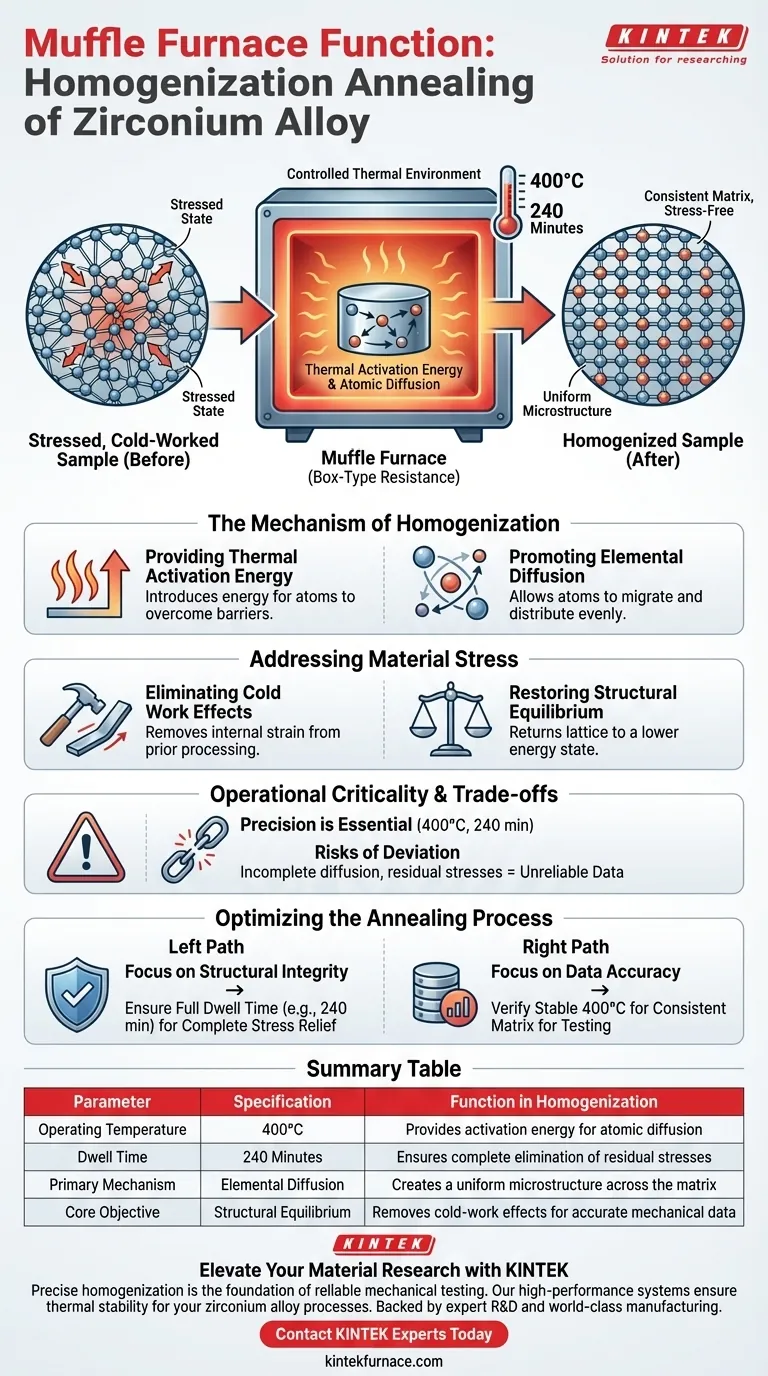
The primary function of a muffle furnace (or box-type resistance furnace) in this context is to provide a strictly controlled thermal environment essential for stabilizing zirconium alloy samples. Specifically, the furnace maintains a temperature of 400°C for a sustained duration, typically 240 minutes. This controlled heating cycle is the physical catalyst required to initiate the homogenization annealing process.
By supplying precise thermal activation energy, the muffle furnace transforms the alloy from a stressed, cold-worked state into a uniform material. This ensures that any subsequent mechanical data reflects the alloy's true properties, not its processing history.
The Mechanism of Homogenization
Providing Thermal Activation Energy
The core function of the furnace is to introduce thermal activation energy into the zirconium alloy. Heat is not merely for temperature elevation; it serves as the energy source that allows atoms within the solid metal to overcome energy barriers and move.
Promoting Elemental Diffusion
Once sufficiently energized, the atoms of the alloying elements begin to migrate. This process, known as diffusion, allows elements to distribute themselves evenly throughout the zirconium matrix, eliminating localized concentrations that could weaken the material.
Addressing Material Stress
Eliminating Cold Work Effects
Prior to annealing, zirconium alloys often undergo cold working, which introduces significant internal strain. The muffle furnace's sustained heat treats these defects by eliminating residual stresses.
Restoring Structural Equilibrium
By holding the temperature at 400°C, the lattice structure of the alloy is allowed to relax. This returns the material to a lower energy state, removing the mechanical "noise" created by previous manufacturing steps.
The Consequence for Evaluation
Achieving Microstructural Uniformity
The ultimate goal of using the furnace is to create a uniform microstructure. The heating process ensures that the alloy's internal structure is consistent from the surface to the core.
Establishing a Consistent Matrix
A consistent matrix is critical for scientific validity. It ensures that the sample is physically homogenous before it undergoes destructive testing.
Operational Criticality and Trade-offs
The Necessity of Precision
The specific parameters—400°C for 240 minutes—are not arbitrary. They represent the specific window required to achieve full homogenization without degrading the material.
Risks of Deviation
If the furnace fails to maintain stable heat, or if the duration is shortened, the diffusion process will be incomplete. This results in a sample that retains residual stresses, rendering subsequent tensile testing or mechanical performance evaluations inaccurate and unreliable.
Optimizing the Annealing Process
To ensure valid results when working with zirconium alloys, apply the process principles as follows:
- If your primary focus is Structural Integrity: Ensure the dwell time is fully adhered to (e.g., 240 minutes) to guarantee complete stress relief and elimination of cold-work defects.
- If your primary focus is Data Accuracy: Verify that the furnace maintains a stable 400°C to create the consistent matrix required for repeatable tensile testing.
Reliable mechanical characterization is impossible without the precise thermal baseline established by the muffle furnace.
Summary Table:
| Parameter | Specification | Function in Homogenization |
|---|---|---|
| Operating Temperature | 400°C | Provides activation energy for atomic diffusion |
| Dwell Time | 240 Minutes | Ensures complete elimination of residual stresses |
| Primary Mechanism | Elemental Diffusion | Creates a uniform microstructure across the matrix |
| Core Objective | Structural Equilibrium | Removes cold-work effects for accurate mechanical data |
Elevate Your Material Research with KINTEK
Precise homogenization is the foundation of reliable mechanical testing. KINTEK provides high-performance muffle, tube, and vacuum systems designed to maintain the strict thermal stability required for your most sensitive zirconium alloy processes.
Backed by expert R&D and world-class manufacturing, our lab high-temp furnaces are fully customizable to meet your unique research needs—ensuring every sample reflects its true properties.
Ready to optimize your annealing process? Contact KINTEK experts today to find the perfect thermal solution for your laboratory.
Visual Guide
References
- Kun Zhang, Hao Wang. Effect of Hydride Types on the Fracture Behavior of a Novel Zirconium Alloy Under Different Hydrogen-Charging Current Densities. DOI: 10.3390/ma18020467
This article is also based on technical information from Kintek Furnace Knowledge Base .
Related Products
- 1400℃ Muffle Oven Furnace for Laboratory
- 1700℃ High Temperature Muffle Oven Furnace for Laboratory
- 1800℃ High Temperature Muffle Oven Furnace for Laboratory
- 1200℃ Muffle Oven Furnace for Laboratory
- High Temperature Muffle Oven Furnace for Laboratory Debinding and Pre Sintering
People Also Ask
- How does a high-temperature laboratory muffle furnace affect material properties? Transform Anodic Oxide Films Fast
- What is the primary function of a high-temperature laboratory muffle furnace in chemical synthesis? Achieve Precision.
- What is the muffle furnace function in ilmenite oxidative roasting? Enhance Phase Change & Magnetic Separation
- What is the role of a laboratory high-temperature muffle furnace in H13 steel treatment? Optimize Tool Performance
- How does a laboratory high-temperature muffle furnace contribute to the final formation of Bismuth Oxide nanosheets?



















