
At its core, the muffle furnace is a cornerstone of industrial and laboratory work because it solves a fundamental problem: the need for clean, precise, and uniform high-temperature processing. Its widespread use stems directly from a unique design that isolates the material being heated from the heat source itself, preventing contamination and ensuring highly repeatable results.
The true value of a muffle furnace is not just its ability to get hot, but its ability to create a perfectly controlled and contaminant-free heating environment. This separation between the heat source and the material is the defining feature that makes it indispensable for sensitive applications.
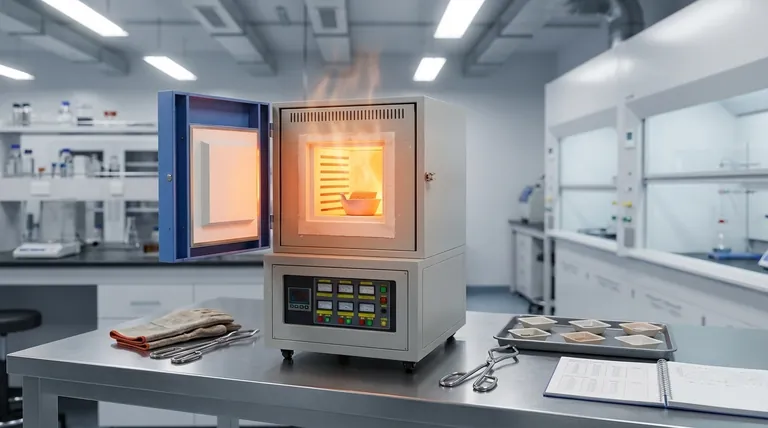
The Defining Principle: Isolating the Material
The name "muffle furnace" comes from its most critical component: the muffle. This is an isolated chamber, often made of high-temperature ceramic or alumina fiber, that contains the material being processed.
How a Muffle Prevents Contamination
The muffle acts as a physical barrier. It separates the sample from the direct flame, combustion gases, and other byproducts generated by the heating elements or fuel source.
This separation is non-negotiable for applications where even trace amounts of impurities could ruin a sample, such as in material analysis, pharmaceutical development, or the creation of high-purity ceramics.
Ensuring Precise Temperature Uniformity
By heating the muffle chamber from the outside, the furnace delivers radiant heat evenly across all surfaces of the material inside.
This avoids "hot spots" that can occur with direct heating, ensuring a constant and uniform temperature throughout the sample. This level of control is essential for processes like annealing and tempering, where precise temperature curves determine the final properties of the material.
Key Advantages in Industrial Use
The muffle design directly leads to several advantages that make it a practical and powerful tool across various industries.
Unmatched Process Versatility
A single muffle furnace can be used for an incredibly wide range of tasks. These include:
- Ashing: Burning off organic material to determine inorganic content.
- Sintering: Fusing powdered materials together with heat.
- Heat Treating: Altering the physical properties of metals through quenching, annealing, or tempering.
- Material Research: Testing the thermal properties of new alloys, ceramics, and composites.
- Ceramics and Glass: Firing, fusing, and forming sensitive materials.
Operational Efficiency and Durability
Modern muffle furnaces are built with advanced, heat-resistant insulation materials. This not only allows them to reach very high temperatures but also improves energy efficiency and reduces heat-up/cool-down times.
Their simple design, with no direct contact between corrosive elements and the sample, results in high durability and low maintenance costs over the furnace's lifespan.
Understanding the Trade-offs
While incredibly useful, the muffle furnace is not the perfect solution for every heating application. Its design comes with inherent trade-offs.
Indirect Heating and Speed
Because the heat must first saturate the muffle chamber before reaching the sample, the heating process can be slower compared to direct-fire kilns or induction furnaces. This is the price paid for temperature uniformity and cleanliness.
Batch Size and Throughput
Muffle furnaces are typically best suited for small-to-medium-sized parts or batch processes. They are not designed for the massive, continuous throughput required in large-scale manufacturing, where a tunnel kiln might be more appropriate.
Atmosphere Control Adds Complexity
While the sealed muffle chamber is ideal for creating a controlled atmosphere (e.g., inert gas), implementing and managing this system adds cost and complexity. It requires additional equipment for gas flow, pressure regulation, and safety monitoring.
Making the Right Choice for Your Goal
Selecting the correct heating technology depends entirely on your primary objective.
- If your primary focus is material purity and precise analysis: The muffle furnace is the superior choice, as its isolated chamber is essential for preventing contamination.
- If your primary focus is versatility for a lab or workshop: The muffle furnace's ability to handle diverse processes from ashing to annealing makes it a highly cost-effective, multi-purpose tool.
- If your primary focus is high-volume, rapid production: A direct-fire or continuous furnace may be more efficient, but only if trace contamination of the product is acceptable.
Understanding this core principle of controlled, isolated heating empowers you to select the right tool for the job.
Summary Table:
| Key Aspect | Description |
|---|---|
| Principle | Isolates material in a muffle chamber to prevent contamination and ensure uniform heating. |
| Advantages | Clean processing, precise temperature control, versatility for various tasks, high durability, and energy efficiency. |
| Common Uses | Ashing, sintering, heat treating, material research, ceramics and glass processing. |
| Trade-offs | Slower heating due to indirect method, limited batch size, and added complexity for atmosphere control. |
Upgrade your laboratory with KINTEK's advanced high-temperature furnace solutions! Leveraging exceptional R&D and in-house manufacturing, we provide diverse labs with reliable equipment like Muffle, Tube, Rotary Furnaces, Vacuum & Atmosphere Furnaces, and CVD/PECVD Systems. Our strong deep customization capability ensures precise solutions for your unique experimental needs, enhancing efficiency and accuracy. Contact us today to discuss how we can support your industrial processes!
Visual Guide

Related Products
- 1400℃ Muffle Oven Furnace for Laboratory
- 1700℃ High Temperature Muffle Oven Furnace for Laboratory
- 1800℃ High Temperature Muffle Oven Furnace for Laboratory
- 1200℃ Muffle Oven Furnace for Laboratory
- High Temperature Muffle Oven Furnace for Laboratory Debinding and Pre Sintering
People Also Ask
- What is the primary function of a high-temperature laboratory muffle furnace in chemical synthesis? Achieve Precision.
- How does a high-temperature laboratory muffle furnace affect material properties? Transform Anodic Oxide Films Fast
- What is the role of a laboratory high-temperature muffle furnace in H13 steel treatment? Optimize Tool Performance
- What are the primary objectives of using a muffle furnace in zirconia synthesis? Achieve precision phase control.
- What is the purpose of using a laboratory high-temperature muffle furnace for drying Fe-Ni-Co catalysts? Boost Purity



















