
The primary function of a high-temperature laboratory furnace in this context is regeneration. It provides the intense thermal energy required to reverse the deactivation that occurs during catalytic pyrolysis. Specifically, the furnace burns off carbon deposits (coking) and ash that block active sites, while simultaneously restoring the catalyst's internal pore structure and metal oxide distribution.
Core Takeaway Recalcination is not merely a cleaning process; it is a structural restoration that extends the usable lifecycle of Layered Double Hydroxide (LDH) derived catalysts. By effectively removing contaminants and resetting the chemical architecture, this process makes industrial biomass conversion economically viable by reducing the need for constant catalyst replacement.
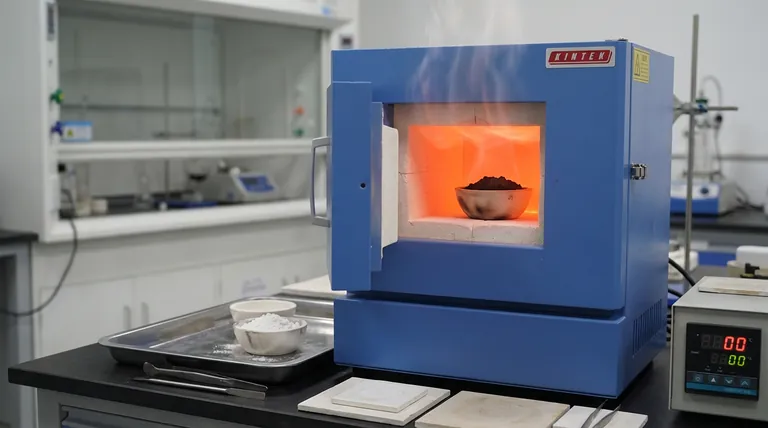
The Mechanics of Catalyst Regeneration
Eliminating Physical Blockages
During catalytic pyrolysis, the surface of the catalyst becomes coated with byproducts. Coking (carbon deposition) and ash accumulation physically cover the active sites, rendering the catalyst ineffective. A high-temperature furnace provides the oxidative environment necessary to burn off these carbonaceous deposits, exposing the active surface once again.
Restoring Structural Integrity
Beyond simple cleaning, the catalyst undergoes physical changes during use. The high thermal energy of the furnace facilitates the redistribution of metal oxides. This helps reverse the structural degradation that occurs during the reaction phase, returning the material closer to its optimal Mixed Metal Oxide (LDO) state.
Recovering Porosity
Activity is heavily dependent on surface area. The accumulation of contaminants and thermal stress often collapses or blocks the catalyst's pores. Recalcination re-opens these pathways, restoring the pore structure required for reactants to access the internal active sites during future cycles.
Understanding the Trade-offs
While high-temperature recalcination is essential for recycling, it requires precise control to avoid further damage.
The Risk of Sintering
Excessive heat or prolonged exposure can lead to sintering. This is when the catalyst particles fuse together, permanently reducing the specific surface area and porosity. If sintering occurs, the active sites are lost irreversibly, and the catalyst cannot be regenerated further.
Thermal Shock and Structural Collapse
LDH-derived catalysts rely on a specific crystalline structure for their activity. Rapid temperature fluctuations or temperatures exceeding the material's stability limit can cause the crystalline structure to collapse or peel away from the substrate. This degrades the mechanical strength of the catalyst, leading to fines production and pressure drop issues in industrial reactors.
Making the Right Choice for Your Goal
To maximize the efficiency of your catalytic process, consider how thermal treatment aligns with your specific objectives.
- If your primary focus is cost reduction: Prioritize a furnace capability that allows for consistent recalcination cycles, as this directly lowers operational expenses by enabling catalyst recycling.
- If your primary focus is catalyst longevity: Ensure your thermal profile is strictly controlled to remove coke without exceeding the sintering temperature of the specific metal oxides involved.
Effective recalcination transforms a single-use expense into a renewable asset, securing both the economic and technical viability of your biomass conversion process.
Summary Table:
| Process Objective | Mechanism | Key Benefit |
|---|---|---|
| Coke Removal | Oxidative burning of carbon deposits | Unblocks active catalytic sites |
| Structural Reset | Redistribution of mixed metal oxides | Restores Mixed Metal Oxide (LDO) state |
| Pore Recovery | Thermal clearance of physical blockages | Increases surface area for reactants |
| Lifecycle Extension | Iterative recalcination cycles | Reduces operational costs and waste |
Maximize Your Catalyst Lifecycle with KINTEK Precision
Don't let sintering or structural collapse compromise your research. KINTEK provides industry-leading thermal solutions designed to handle the delicate balance of catalyst regeneration. Backed by expert R&D and manufacturing, we offer a comprehensive range of Muffle, Tube, Rotary, Vacuum, and CVD systems, as well as other lab high-temp furnaces—all fully customizable to meet your specific recalcination parameters.
Whether you are scaling biomass conversion or optimizing catalyst longevity, our systems deliver the precise temperature control and uniform heating essential for restoring LDH-derived catalysts.
Ready to transform your single-use materials into renewable assets? Contact KINTEK today to discuss your custom furnace needs!
References
- Sivashunmugam Sankaranarayanan, Wangyun Won. Catalytic pyrolysis of biomass to produce bio‐oil using layered double hydroxides (<scp>LDH</scp>)‐derived materials. DOI: 10.1111/gcbb.13124
This article is also based on technical information from Kintek Furnace Knowledge Base .
Related Products
- 1200℃ Muffle Oven Furnace for Laboratory
- 1700℃ High Temperature Laboratory Tube Furnace with Alumina Tube
- 1400℃ High Temperature Laboratory Tube Furnace with Alumina Tube
- High Temperature Muffle Oven Furnace for Laboratory Debinding and Pre Sintering
- 1800℃ High Temperature Muffle Oven Furnace for Laboratory
People Also Ask
- What is the primary function of a high-temperature laboratory muffle furnace in chemical synthesis? Achieve Precision.
- How does a high-temperature laboratory muffle furnace affect material properties? Transform Anodic Oxide Films Fast
- How is a laboratory muffle furnace used in 3D-printed PP-CF cross-linking? Achieve Thermal Stability at 150 °C
- What functions does a laboratory muffle furnace perform for AISI 1025 steel post-processing? Precision Thermal Control
- How is a laboratory high-temperature muffle furnace used to evaluate porous Co-Al materials? Precision Thermal Analysis



















