
The primary function of a muffle furnace in this context is to induce controlled thermal decomposition without combustion. specifically for Licuri bark, the furnace maintains a critical oxygen-free environment while heating the material to 700°C. This process strips away volatile organic components, leaving behind a carbon-rich charcoal.
Core Insight: The muffle furnace does not simply burn the material; it acts as a structural architect. By subjecting Licuri bark to high heat in an oxygen-deprived atmosphere, it engineers the initial porous structure necessary for the material to function as a high-capacity adsorbent.
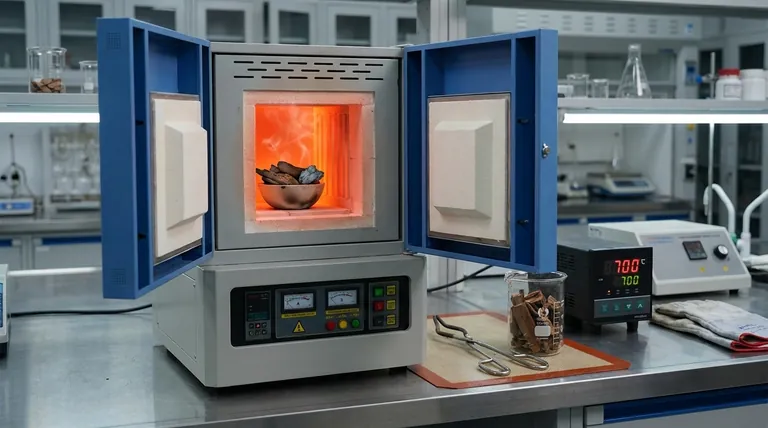
The Mechanics of Thermal Decomposition
Establishing the Environment
The defining characteristic of the muffle furnace during this process is isolation. It isolates the Licuri bark from external oxygen sources.
If oxygen were present at 700°C, the bark would simply incinerate into ash. By excluding oxygen, the furnace forces the material to undergo pyrolysis rather than combustion.
The Role of High Temperature
The furnace must maintain a consistent temperature of 700°C. This specific thermal threshold is required to break down the complex organic polymers found in the bark.
At this temperature, the chemical bonds holding the biomass together begin to snap. This triggers a phase change where solid biomass converts into solid char and volatile gases.
Engineering the Material Structure
Removal of Volatiles
As the temperature rises, volatile substances trapped within the organic matrix are vaporized and expelled.
The muffle furnace drives these components out of the solid material. This evacuation is not merely a byproduct; it is the mechanism of restructuring.
Creation of Porosity
When volatile gases escape the bark, they leave behind voids. These voids become the initial porous structure of the charcoal.
This porosity is the "physical basis" for the material's utility. Without the furnace's ability to drive out volatiles effectively, the charcoal would lack the surface area required for high adsorption capacity.
Understanding the Trade-offs
Energy Intensity
Maintaing a chamber at 700°C for the duration of pyrolysis requires significant energy input.
While effective for creating high-quality charcoal, this process can be operationally expensive compared to lower-temperature methods. You must balance the need for high adsorption capacity against the energy costs of production.
Throughput Limitations
Muffle furnaces are typically batch-processing units. This means production is discontinuous; you must load, heat, cool, and unload before starting the next batch.
For large-scale industrial production, this batch cycle can create bottlenecks compared to continuous reactor designs, though it offers superior control over material quality.
Optimizing Your Pyrolysis Strategy
To maximize the effectiveness of the muffle furnace for Licuri bark, align your operational parameters with your specific end-goals.
- If your primary focus is Adsorption Capacity: Ensure the temperature strictly reaches and maintains 700°C to guarantee the complete removal of volatiles and maximum pore formation.
- If your primary focus is Material Yield: Monitor the seal of the furnace rigorously to ensure the environment remains totally oxygen-free, as any leakage will turn valuable charcoal into useless ash.
The muffle furnace is not just a heater; it is the tool that transforms raw biological waste into a functional, high-performance material.
Summary Table:
| Feature | Function in Licuri Bark Pyrolysis |
|---|---|
| Environment | Oxygen-free isolation to prevent combustion and ash formation |
| Temperature Target | Consistent 700°C to break complex organic polymers |
| Transformation | Converts solid biomass into carbon-rich char and volatile gases |
| Structural Result | Creates essential porous voids for high adsorption capacity |
| Process Style | Batch processing for superior control over material quality |
Elevate Your Material Research with KINTEK
Precision is non-negotiable when engineering high-performance adsorbents. Backed by expert R&D and manufacturing, KINTEK offers high-temperature Muffle, Tube, Rotary, Vacuum, and CVD systems designed to deliver the rigorous thermal control your pyrolysis research demands.
Whether you are processing Licuri bark or advanced biomass, our customizable lab furnaces ensure an oxygen-free environment and uniform heat distribution for maximum yield and porosity.
Ready to optimize your thermal decomposition process? Contact KINTEK experts today to find the perfect customized furnace for your unique laboratory needs.
Visual Guide

References
- Charlotte Santana Velame, Ary Rocha Bezerra. Application of Activated Carbon Produced from Licuri Bark (Syagrus coronata) in Water Filtration. DOI: 10.34178/jbth.v8i2.476
This article is also based on technical information from Kintek Furnace Knowledge Base .
Related Products
- 1700℃ High Temperature Muffle Oven Furnace for Laboratory
- High Temperature Muffle Oven Furnace for Laboratory Debinding and Pre Sintering
- Laboratory Muffle Oven Furnace with Bottom Lifting
- 1800℃ High Temperature Muffle Oven Furnace for Laboratory
- 1400℃ Muffle Oven Furnace for Laboratory
People Also Ask
- What is the primary function of a high-temperature laboratory muffle furnace in chemical synthesis? Achieve Precision.
- How does a high-temperature laboratory muffle furnace affect material properties? Transform Anodic Oxide Films Fast
- What role does a muffle furnace play in BCZY712 electrolyte powder production? Achieve Perfect Phase Purity
- How does the two-stage sintering process contribute to the synthesis of MeCuFeO3 perovskite? Optimize crystal purity.
- What is the role of a high-temperature muffle furnace in guava leaf carbonization? Master Precise Pyrolysis Control

















