
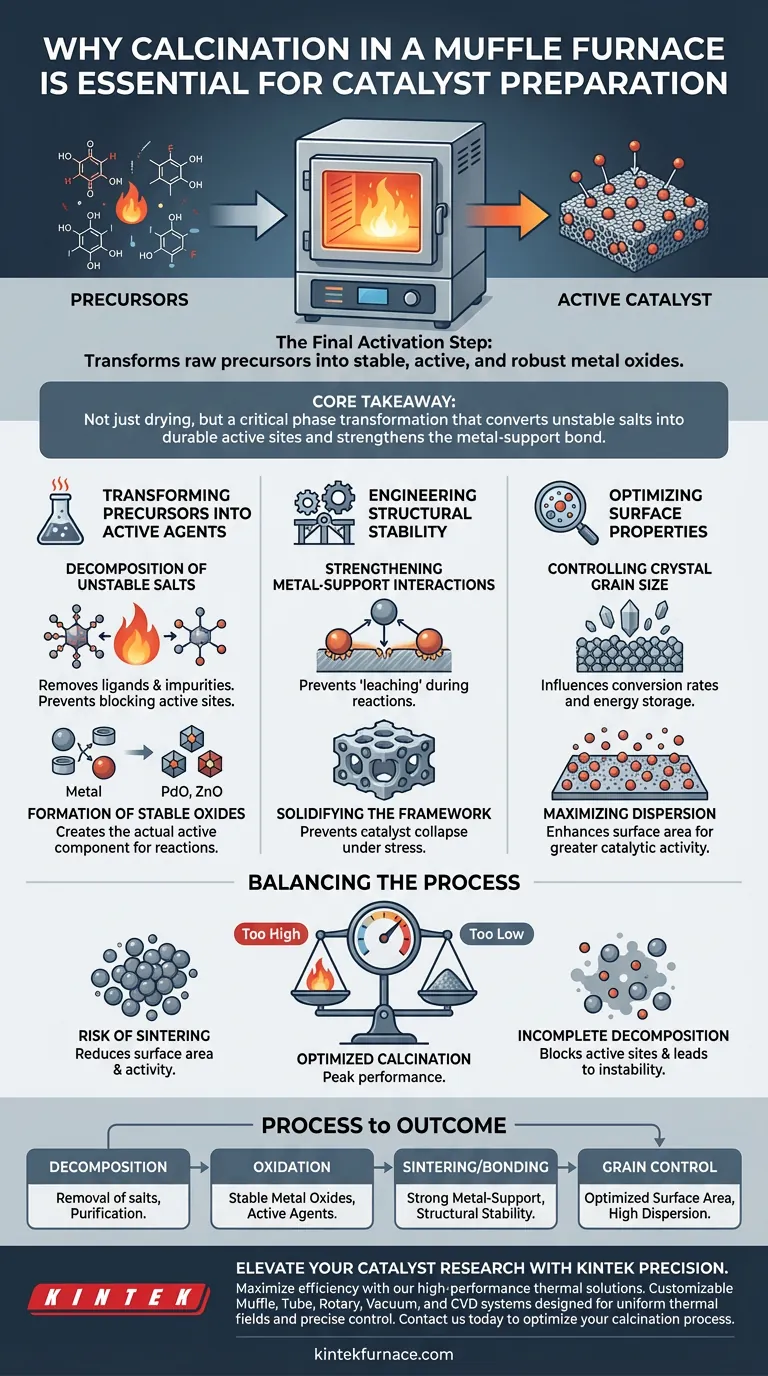
The final heat treatment in a muffle furnace is the definitive step that activates a catalyst. It transforms raw chemical precursors into stable, active metal oxides through controlled thermal decomposition in an air atmosphere. This process anchors the active metals to their support, ensuring the catalyst is chemically active and mechanically robust enough to withstand reaction conditions.
Core Takeaway Calcination is not merely a drying process; it is a critical phase transformation step. It converts unstable metal salts into durable active sites, strengthens the structural bond between the metal and the carrier, and optimizes surface properties to maximize catalytic efficiency.
Transforming Precursors into Active Agents
The primary function of the muffle furnace during this stage is to facilitate a chemical change, not just a physical one.
Decomposition of Unstable Salts
Raw catalyst precursors often contain ligands or salts, such as nitrates or acetylacetonates. The muffle furnace provides a controlled oxidation environment (typically around 300°C to 500°C) to completely decompose these materials.
Removal of Impurities
As the precursors break down, residual anionic impurities are expelled from the material. This purification prevents these residues from blocking active sites or interfering with the final chemical reaction.
Formation of Stable Oxides
The heat treatment converts metal components into their stable oxide states (e.g., Palladium Oxide, Zinc Oxide, or Nickel Oxide). This phase transformation is essential, as the oxide form usually serves as the actual active component in reactions like transesterification.
Engineering Structural Stability
Beyond chemical composition, the muffle furnace ensures the physical durability of the catalyst.
Strengthening Metal-Support Interactions
The uniform thermal field within the furnace promotes a strong interaction between the active metal and the support material. This bonding is critical for preventing "leaching," where active metals detach from the carrier during liquid-phase reactions.
Solidifying the Framework
For supports derived from hydrothermal methods, such as Boehmite, calcination drives the transformation into stable phases like Alumina. This creates a robust framework with high structural stability, preventing the catalyst from collapsing under stress.
Creating Heterojunctions
In complex composite materials, high-temperature sintering induces thermochemical bonding between different components. This can form stable heterojunction structures, which are vital for advanced applications like photocatalysis.
Optimizing Surface Properties
The performance of a catalyst is defined by its surface architecture, which is finalized during calcination.
Controlling Crystal Grain Size
Precise temperature control allows for the regulated growth of crystal grains. Managing this growth is vital, as the size of the crystals directly influences conversion rates and energy storage capabilities.
Maximizing Dispersion
Proper calcination ensures that metal components, such as copper, are highly dispersed across the support rather than clumped together. High dispersion increases the surface area available for reactions, directly enhancing catalytic activity.
Understanding the Trade-offs
While calcination is essential, the parameters must be balanced carefully to avoid degrading the catalyst.
The Risk of Sintering
If the temperature is too high or the duration too long, the active metal particles may aggregate (sinter). This drastically reduces the specific surface area and lowers the catalyst's overall activity.
Incomplete Decomposition
Conversely, if the temperature is too low, the precursors may not decompose fully. This leaves behind impurities that block active sites and lead to unstable catalytic performance.
Making the Right Choice for Your Goal
The specific parameters you choose for your muffle furnace process should align with the specific requirements of your catalytic reaction.
- If your primary focus is Long-Term Stability: Prioritize higher temperatures or longer durations to maximize the metal-support interaction and leaching resistance.
- If your primary focus is High Reactivity: Focus on precise, moderate temperature control to maximize the dispersion of active sites and minimize crystal grain growth.
Ultimately, the muffle furnace transforms a fragile mixture of chemicals into a robust, high-performance tool capable of driving industrial reactions.
Summary Table:
| Process Phase | Primary Function | Key Outcome |
|---|---|---|
| Decomposition | Removal of ligands/salts (e.g., nitrates) | Purification of active sites |
| Oxidation | Conversion to stable metal oxides | Formation of active chemical agents |
| Sintering/Bonding | Strengthening metal-support interaction | Prevention of leaching and structural collapse |
| Grain Control | Regulated thermal growth | Optimized surface area and high dispersion |
Elevate Your Catalyst Research with KINTEK Precision
Maximize your catalytic efficiency with high-performance thermal solutions. KINTEK provides industry-leading, customizable Muffle, Tube, Rotary, Vacuum, and CVD systems designed for the rigorous demands of material science and R&D. Our expert manufacturing ensures uniform thermal fields and precise temperature control—essential for preventing sintering and ensuring high metal dispersion.
Ready to optimize your calcination process? Contact us today to discuss your unique laboratory needs and discover how our advanced high-temp furnaces can drive your industrial innovation.
Visual Guide
References
- Laraib Aamir Khan, Waqar Ul Habib Khan. Investigation of Novel Transition Metal Loaded Hydrochar Catalyst Synthesized from Waste Biomass (Rice Husk) and Its Application in Biodiesel Production Using Waste Cooking Oil (WCO). DOI: 10.3390/su16177275
This article is also based on technical information from Kintek Furnace Knowledge Base .
Related Products
- 1400℃ Muffle Oven Furnace for Laboratory
- 1700℃ High Temperature Muffle Oven Furnace for Laboratory
- 1800℃ High Temperature Muffle Oven Furnace for Laboratory
- 1200℃ Muffle Oven Furnace for Laboratory
- High Temperature Muffle Oven Furnace for Laboratory Debinding and Pre Sintering
People Also Ask
- What is the primary function of a high-temperature laboratory muffle furnace in chemical synthesis? Achieve Precision.
- How does a high-temperature laboratory muffle furnace affect material properties? Transform Anodic Oxide Films Fast
- How does a muffle furnace facilitate Ag/ATP catalyst preparation? Optimize Calcination for Superior Performance
- What are the primary objectives of using a muffle furnace in zirconia synthesis? Achieve precision phase control.
- How is a laboratory high-temperature muffle furnace utilized to achieve the specific crystalline structure of LaFeO3 catalysts?



















