
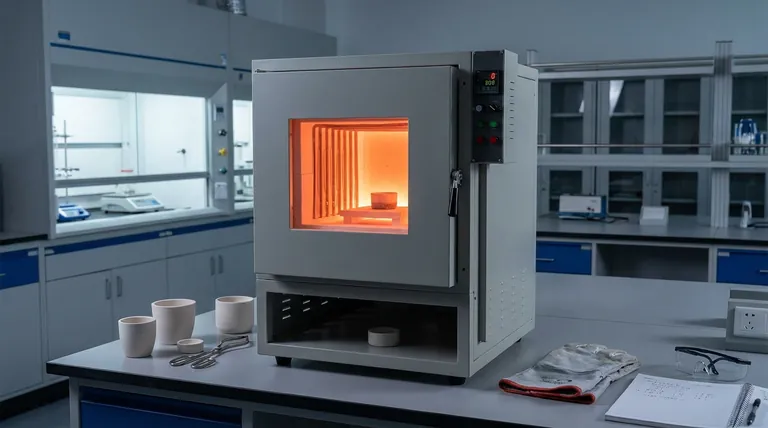
The primary function of a high-temperature box resistance furnace in this context is to drive the sintering and densification of the ceramic green body. Specifically for γ-Y1.5Yb0.5Si2O7 ceramics, the furnace provides a strictly controlled environment of 1450 °C with a precise heating rate of 2.5 °C/min. This thermal energy triggers the solid-phase reactions required to transform compacted powder into a solid, high-density material.
Core Takeaway The furnace acts as the kinetic driver for microstructural change, using controlled heat to initiate particle diffusion and sintering neck formation. This process eliminates pores and converts loose powder into a cohesive bulk ceramic with a relative density of 91.2%.
The Mechanism of Densification
Driving Solid-Phase Reactions
The central role of the furnace is to provide the thermal activation energy necessary for solid-phase reactions.
At ambient temperatures, the ceramic precursor is merely a compacted powder. The furnace raises the internal energy of the system to 1450 °C, allowing chemical interactions to occur at the boundaries of the powder particles without fully melting them.
Facilitating Diffusion and Neck Formation
As the temperature rises, the furnace environment promotes atomic diffusion between the powder particles.
This diffusion leads to the formation of "sintering necks"—bridges of material that connect individual particles. As these necks grow, the particles merge, effectively reducing the void space (pores) between them.
Achieving Structural Density
The ultimate goal of this thermal treatment is to maximize the density of the final component.
Through prolonged exposure to high heat, the furnace ensures the material achieves a relative density of 91.2%. This high density is critical for the mechanical integrity and functional performance of the final ceramic part.
The Importance of Process Control
Precise Heating Rates
The furnace does not simply blast the material with heat; it applies a controlled ramp rate of 2.5 °C/min.
This slow, deliberate heating is essential to ensure uniform temperature distribution throughout the sample. It prevents thermal shock and allows for the gradual evolution of the microstructure, avoiding defects that could arise from rapid expansion.
Promoting Grain Growth
Beyond simple bonding, the furnace facilitates controlled grain growth.
By maintaining the high-temperature environment, the furnace allows the microscopic crystalline grains within the ceramic to align and grow. This microstructural evolution is a key factor in defining the final physical properties of the ceramic.
Understanding the Trade-offs
Time vs. Throughput
The requirement for a slow heating rate (2.5 °C/min) and prolonged dwell times at 1450 °C creates a significant bottleneck in production speed.
While this maximizes quality and density, it drastically reduces throughput. Attempting to accelerate this process to save time risks incomplete sintering, resulting in a porous, weak material with low relative density.
Energy Consumption vs. Material Quality
Reaching and maintaining 1450 °C requires substantial energy input.
This high operational cost is the price paid for achieving a density of 91.2%. Lowering the temperature to save energy would likely fail to trigger the necessary diffusion mechanisms, rendering the ceramic unusable for high-performance applications.
Making the Right Choice for Your Goal
To maximize the quality of γ-Y1.5Yb0.5Si2O7 ceramics, you must align your furnace programming with your specific objectives.
- If your primary focus is Structural Integrity (Density): Prioritize reaching the full 1450 °C target to ensure sufficient energy for pore elimination and maximum densification (91.2%).
- If your primary focus is Microstructural Uniformity: Strictly adhere to the 2.5 °C/min heating rate to prevent thermal gradients and ensure consistent grain growth throughout the bulk material.
Success in this process relies not just on reaching high temperatures, but on the precise regulation of thermal energy to dictate the material's atomic behavior.
Summary Table:
| Aspect | Detail |
|---|---|
| Primary Function | Sintering & Densification |
| Target Temperature | 1450 °C |
| Heating Rate | 2.5 °C/min |
| Achieved Density | 91.2% Relative Density |
| Key Mechanism | Solid-Phase Reactions, Atomic Diffusion, Neck Formation |
Achieve unparalleled precision and material quality in your advanced ceramic and materials research. KINTEK's high-temperature furnaces are engineered for the exact control your processes demand, from sintering to CVD. Backed by expert R&D and manufacturing, KINTEK offers Muffle, Tube, Rotary, Vacuum, CVD systems, and other lab high-temp furnaces, all customizable for unique needs.
Ready to elevate your material synthesis? Contact us today to discuss how our solutions can meet your specific high-temperature processing requirements and ensure optimal results.
References
- Buhao Zhang, Tanvir Hussain. Thermal properties and calcium-magnesium-alumino-silicate (CMAS) interaction of novel γ-phase ytterbium-doped yttrium disilicate (γ-Y1.5Yb0.5Si2O7) environmental barrier coating material. DOI: 10.1007/s42114-024-00879-6
This article is also based on technical information from Kintek Furnace Knowledge Base .
Related Products
- 1700℃ High Temperature Laboratory Tube Furnace with Alumina Tube
- 1400℃ High Temperature Laboratory Tube Furnace with Alumina Tube
- Vertical Laboratory Quartz Tube Furnace Tubular Furnace
- 1700℃ Controlled Inert Nitrogen Atmosphere Furnace
- 1200℃ Split Tube Furnace Laboratory Quartz Tube Furnace with Quartz Tube
People Also Ask
- How does zone-melting in tube furnaces synthesize bismuth micro-wires? Master Single-Crystal Thermoelectric Growth
- How do high-temperature laboratory tube furnaces ensure environmental stability? Precision Thermal Reduction Tips
- How are high-temperature laboratory tube furnaces applied in long-term vacuum homogenization heat treatments for intermetallic samples?
- How are high-temp tube furnaces used to measure diffusion coefficients per Fick's law? Master Precision Annealing
- How are high-temperature tube furnaces applied in testing ceramic-supported alloy membranes? Insights



















