
At its core, a muffle furnace is a system built around a few essential components designed to work in concert. It consists of an outer casing, a layer of high-performance insulation, an internal heating chamber called a "muffle," electrical heating elements surrounding that chamber, and a sophisticated temperature control system to regulate the entire process.
A muffle furnace is not just a hot box; it is a precision instrument designed to create an isolated, contaminant-free, and highly uniform temperature environment. Understanding its components reveals how it achieves the accuracy and repeatability required for scientific and industrial applications.
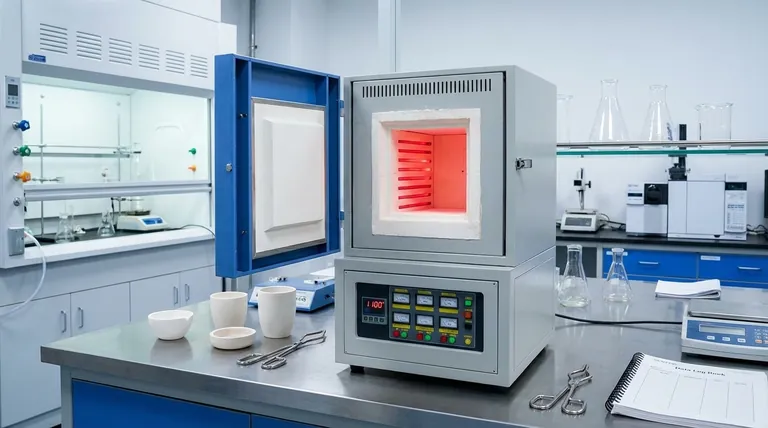
The Core Functional Units of a Muffle Furnace
Each part of the furnace serves a distinct purpose, contributing to the three primary goals of any high-temperature process: generating heat, containing it safely and efficiently, and controlling it with precision.
The Heating System: Generating Extreme Temperatures
The heart of the furnace is its set of heating elements. These are responsible for converting electrical energy into the intense thermal energy required for processes like ashing, annealing, or materials testing.
The type of element used directly dictates the furnace's maximum operating temperature. Common materials include Kanthal or Nichrome wire for temperatures up to around 1200°C, with more advanced materials like Silicon Carbide (SiC) or Molybdenum Disilicide (MoSi2) used for higher ranges, often reaching 1600-1800°C.
The Muffle Chamber: Isolating the Sample
The defining component is the muffle itself—an inner chamber that separates the material being heated from the heating elements. This is the furnace's critical feature for ensuring sample purity.
Made from refractory materials like high-purity ceramic or alumina, the muffle shields the sample from direct radiation and any potential contaminants flaking off the heating elements. This isolation is essential for accurate chemical analysis and creating predictable material transformations.
The Insulation and Casing: Containing the Heat
To reach and maintain high temperatures efficiently, the furnace must minimize heat loss. This is the job of the insulation.
High-grade materials like ceramic fiber or mineral wool blankets are packed between the muffle chamber and the outer shell. This ensures maximum thermal efficiency, reduces energy consumption, and keeps the exterior of the furnace cool enough to be safe for operators. A rigid metal outer shell provides structural integrity and protects the internal components.
The Control System: Achieving Precision and Repeatability
Arguably the most sophisticated part of the furnace, the control system acts as its brain. It forms a constant feedback loop to maintain a stable, uniform temperature.
This system has three main parts:
- The Sensor: A thermocouple (like a J-type sensor) is placed inside the chamber to constantly measure the actual temperature.
- The Controller: A PID (Proportional-Integral-Derivative) controller is the standard for modern furnaces. It reads the temperature from the sensor and calculates the precise amount of power needed. It anticipates temperature changes to prevent overshooting or undershooting the setpoint.
- The Relay: The controller sends its signal to a Solid-State Relay (SSR), which precisely modulates the power going to the heating elements.
Understanding the Trade-offs and Key Features
Not all muffle furnaces are created equal. The specific components used determine the furnace's capabilities, limitations, and ideal applications.
Temperature Range vs. Element Type
The single biggest differentiator is the maximum temperature, which is a direct result of the heating elements used. Choosing a furnace with a much higher range than you need often results in unnecessary cost and power consumption.
The Importance of Uniformity
True accuracy comes from temperature uniformity, meaning the temperature is consistent throughout the entire chamber. This is achieved through a combination of good insulation, strategic placement of heating elements, and, most importantly, a well-tuned PID controller. Without it, you cannot trust that your results are repeatable.
Safety Mechanisms are Non-Negotiable
Essential safety features protect both the operator and the furnace itself. A door switch that automatically cuts power to the heating elements when the door is opened is a critical protection against thermal shock and operator injury. Over-temperature protection is another vital circuit that shuts the system down if it exceeds a safe maximum, preventing catastrophic failure.
When Ventilation is Required
For applications like ashing or chemical decomposition where the sample releases fumes, smoke, or corrosive gases, an exhaust port or ventilation system is mandatory. This protects the furnace's interior from damage and ensures a safe lab environment.
How to Apply This to Your Project
Your choice of furnace should be dictated entirely by the demands of your specific application.
- If your primary focus is general lab work like drying or simple heat-treating below 1100°C: A standard furnace with Kanthal elements and a reliable PID controller is sufficient.
- If your primary focus is materials science or ceramics requiring temperatures of 1200°C to 1700°C: You must select a furnace with specialized SiC or MoSi2 heating elements designed for that range.
- If your primary focus is ashing, burn-off, or any process that produces fumes: A furnace equipped with a built-in exhaust port is not optional; it is essential for safety and equipment longevity.
By understanding how these core components function together, you can confidently select and operate the right tool for the job.
Summary Table:
| Component | Function | Key Materials/Features |
|---|---|---|
| Heating Elements | Generate high temperatures | Kanthal, SiC, MoSi2 (up to 1800°C) |
| Muffle Chamber | Isolates sample from contaminants | Ceramic, alumina for purity |
| Insulation & Casing | Minimizes heat loss, ensures safety | Ceramic fiber, metal shell |
| Control System | Regulates temperature precisely | PID controller, thermocouple, SSR |
| Safety Features | Protects operators and equipment | Door switch, over-temperature protection |
Upgrade your laboratory with KINTEK's precision high-temperature furnaces! We specialize in advanced solutions like Muffle, Tube, Rotary, Vacuum & Atmosphere Furnaces, and CVD/PECVD Systems, backed by deep customization to meet your unique experimental needs. Leverage our exceptional R&D and in-house manufacturing for reliable, efficient performance. Contact us today to discuss how we can enhance your processes and deliver tailored results!
Visual Guide

Related Products
- 1400℃ Muffle Oven Furnace for Laboratory
- 1700℃ High Temperature Muffle Oven Furnace for Laboratory
- 1800℃ High Temperature Muffle Oven Furnace for Laboratory
- 1200℃ Muffle Oven Furnace for Laboratory
- High Temperature Muffle Oven Furnace for Laboratory Debinding and Pre Sintering
People Also Ask
- What is the primary function of a high-temperature laboratory muffle furnace in chemical synthesis? Achieve Precision.
- How does a high-temperature laboratory muffle furnace affect material properties? Transform Anodic Oxide Films Fast
- What role does a laboratory high-temperature muffle furnace play in the treatment of highly contaminated waste glass?
- What are the primary objectives of using a muffle furnace in zirconia synthesis? Achieve precision phase control.
- What role does a muffle furnace play in refractory bricks? Enhance Performance and Durability Testing



















