
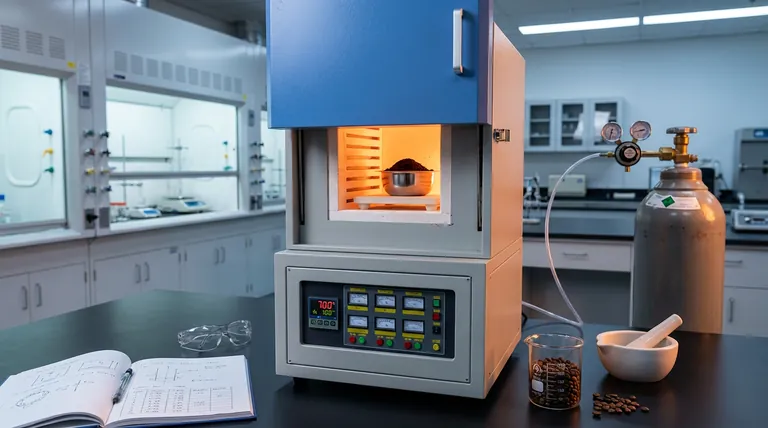
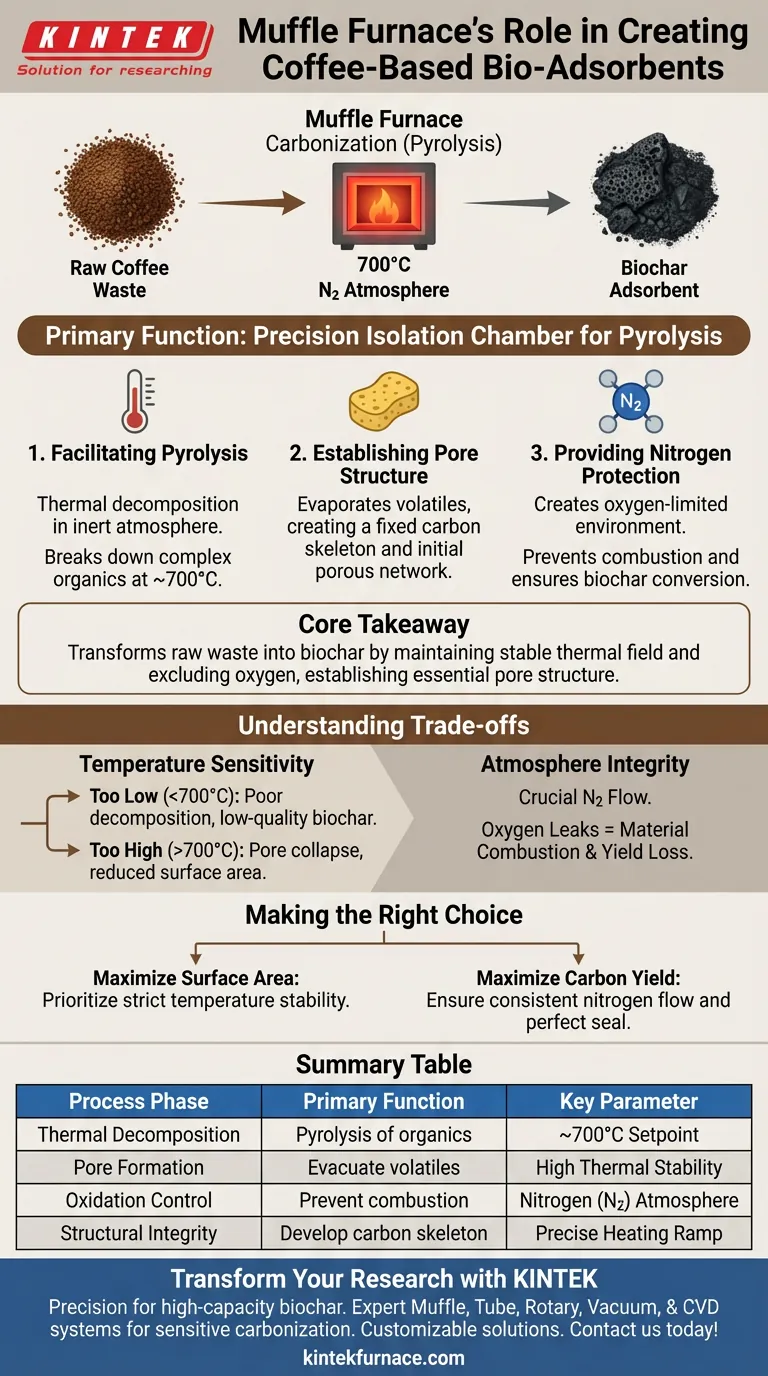
The primary function of a muffle furnace during the carbonization of coffee-based bio-adsorbents is to provide a strictly controlled, high-temperature environment to facilitate pyrolysis. By heating coffee waste to approximately 700 °C under nitrogen protection, the furnace decomposes organic substances and drives off volatile components without burning the material to ash.
Core Takeaway The muffle furnace acts as a precision isolation chamber that transforms raw coffee waste into biochar. By maintaining a stable thermal field and excluding oxygen, it establishes the initial pore structure that serves as the essential physical foundation for subsequent activation stages.
The Mechanics of Carbonization
To understand why a muffle furnace is indispensable for this process, you must look beyond simple heating. The furnace performs three critical operations simultaneously to ensure the coffee waste becomes a viable adsorbent.
Facilitating Pyrolysis
The muffle furnace is not used to burn the coffee waste; it is used to thermally decompose it. This process, known as pyrolysis, occurs when the material is subjected to high heat in an inert atmosphere.
According to standard protocols for coffee waste, the furnace must reach temperatures around 700 °C. At this specific thermal point, complex organic structures begin to break down chemically.
Establishing the Pore Structure
The effectiveness of a bio-adsorbent is defined by its surface area and porosity. As the muffle furnace heats the biomass, it forces volatile components (liquids and gases) to evaporate and exit the material.
This evacuation leaves behind empty spaces, creating a fixed carbon skeleton. This initial porous network provides the physical baseline required for any further chemical or physical activation.
Providing Nitrogen Protection
For successful carbonization, oxygen is the enemy. If coffee waste is heated to 700 °C in the presence of standard air, it will simply combust and turn into useless ash.
The muffle furnace setup allows for nitrogen protection, creating an oxygen-limited or oxygen-free environment. This ensures the biomass converts into carbon-rich biochar rather than oxidizing completely.
Understanding the Trade-offs
While the muffle furnace is the standard tool for this process, precise operation is required to avoid compromising the material.
Temperature Sensitivity
The specific temperature of 700 °C is a calculated target, not a random setting. If the temperature is too low, the volatile components may not fully decompose, resulting in low-quality biochar with poor adsorption capabilities.
Conversely, excessive temperatures can cause the porous structure to collapse or sinter. This reduces the specific surface area, rendering the final product less effective at trapping contaminants.
Atmosphere Integrity
The "muffle" design isolates the sample from direct heating elements, but it relies on an external gas supply for the inert atmosphere. Any fluctuation in nitrogen flow or leaks in the chamber can introduce oxygen.
Even minor oxidation during this phase drastically reduces the yield of fixed carbon. It essentially "eats away" the skeleton you are trying to build.
Making the Right Choice for Your Goal
When configuring your muffle furnace for coffee-based bio-adsorbents, consider your specific objectives.
- If your primary focus is maximizing surface area: Prioritize strict temperature stability at 700 °C to drive off all volatiles without collapsing the newly formed pores.
- If your primary focus is maximizing carbon yield: Ensure your nitrogen flow is consistent and the furnace seal is perfect to prevent material loss through oxidation.
The muffle furnace is not just a heater; it is the architect of your material's internal structure.
Summary Table:
| Process Phase | Primary Function | Key Parameter |
|---|---|---|
| Thermal Decomposition | Pyrolysis of organic matter | ~700 °C Setpoint |
| Pore Formation | Evacuation of volatile components | High Thermal Stability |
| Oxidation Control | Prevention of material combustion | Nitrogen (N2) Atmosphere |
| Structural Integrity | Development of carbon skeleton | Precise Heating Ramp |
Transform Your Bio-Adsorbent Research with KINTEK
Precision is the difference between high-capacity biochar and useless ash. KINTEK provides industry-leading muffle and tube furnace systems specifically designed for nitrogen-protected pyrolysis and sensitive carbonization processes.
Backed by expert R&D and world-class manufacturing, we offer Muffle, Tube, Rotary, Vacuum, and CVD systems—all fully customizable to meet your unique laboratory or industrial needs. Whether you are maximizing surface area or optimizing carbon yield, our equipment ensures the stable thermal field your research demands.
Ready to elevate your material science? Contact our experts today to find the perfect high-temp solution for your lab.
Visual Guide
References
- A Coffee-Based Bioadsorbent for CO2 Capture from Flue Gas Using VSA: TG-Vacuum Tests. DOI: 10.3390/en18153965
This article is also based on technical information from Kintek Furnace Knowledge Base .
Related Products
- 1400℃ Muffle Oven Furnace for Laboratory
- 1700℃ High Temperature Muffle Oven Furnace for Laboratory
- 1800℃ High Temperature Muffle Oven Furnace for Laboratory
- 1200℃ Muffle Oven Furnace for Laboratory
- High Temperature Muffle Oven Furnace for Laboratory Debinding and Pre Sintering
People Also Ask
- What is the primary function of a high-temperature laboratory muffle furnace in chemical synthesis? Achieve Precision.
- How does a high-temperature laboratory muffle furnace affect material properties? Transform Anodic Oxide Films Fast
- How is a laboratory high-temperature muffle furnace utilized to achieve the specific crystalline structure of LaFeO3 catalysts?
- What is the purpose of using a laboratory high-temperature muffle furnace for drying Fe-Ni-Co catalysts? Boost Purity
- What is the function of a muffle furnace in MOF-derived zirconia conversion? Optimize Phase & Pore Engineering



















