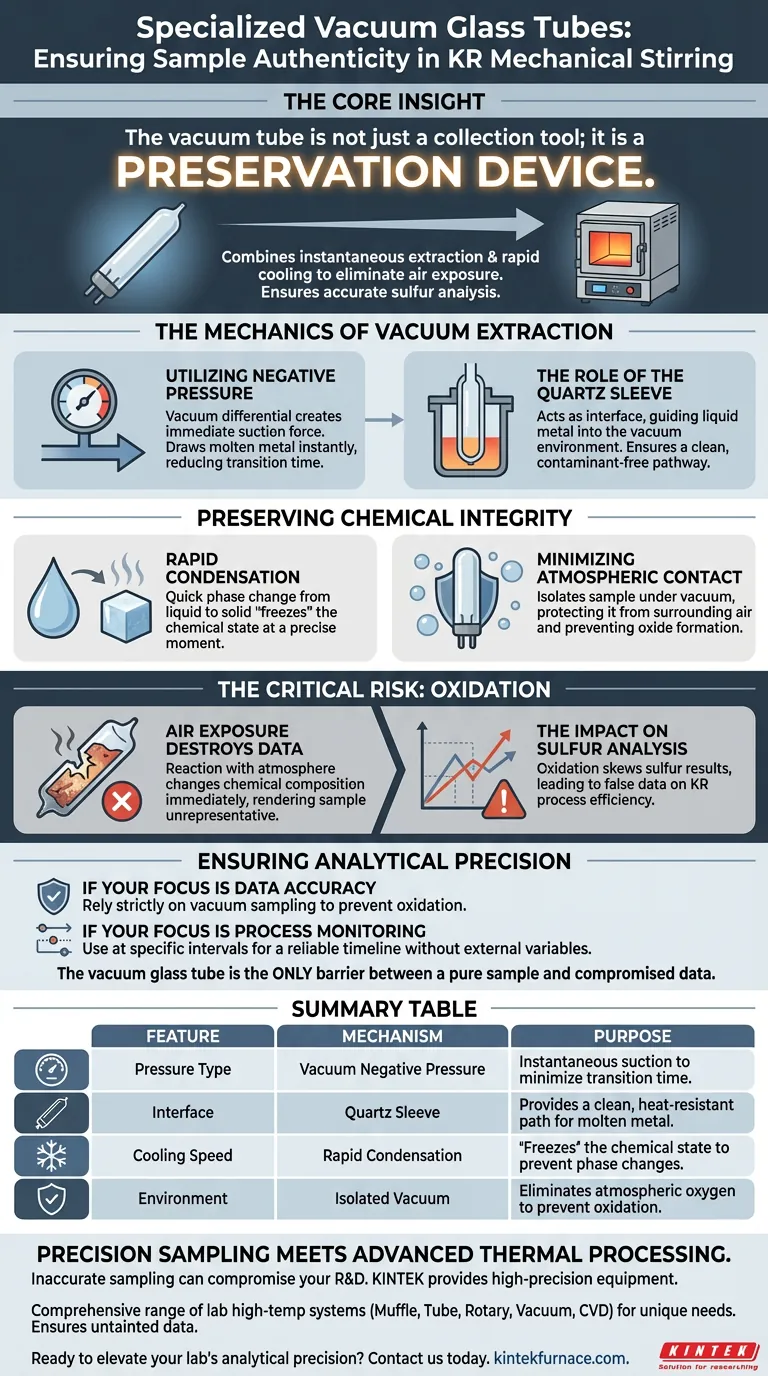
The primary purpose of specialized vacuum glass tubes in KR mechanical stirring is to guarantee the chemical authenticity of molten metal samples. These tubes utilize vacuum negative pressure to instantly draw liquid metal through a quartz sleeve and force rapid condensation. This specific mechanism is required to isolate the sample from the atmosphere, preventing oxidation that would otherwise corrupt subsequent sulfur content analysis.
The Core Insight: The vacuum tube is not just a collection tool; it is a preservation device. By combining instantaneous extraction with rapid cooling, it eliminates the variable of air exposure, ensuring that the sulfur levels measured in the lab match exactly what exists in the reactor.
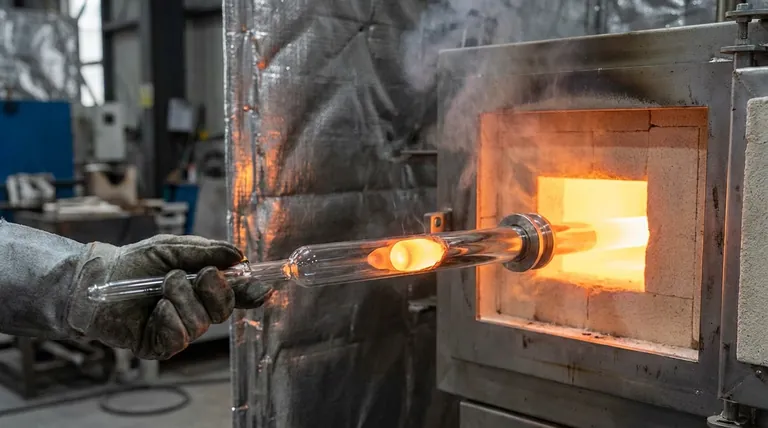
The Mechanics of Vacuum Extraction
Utilizing Negative Pressure
The system relies on vacuum negative pressure rather than manual scooping or gravity.
This pressure differential creates an immediate suction force. It draws the molten metal into the tube instantly, reducing the time the metal spends in transition.
The Role of the Quartz Sleeve
The extraction takes place through a quartz sleeve acting as the interface between the reactor and the sampler.
This component guides the liquid metal into the vacuum environment. It ensures a clean pathway for the sample to enter the tube without picking up external contaminants.
Preserving Chemical Integrity
Rapid Condensation
Once the molten metal enters the tube, it undergoes rapid condensation.
This quick phase change from liquid to solid is deliberate. It "freezes" the chemical state of the metal at that precise moment in the stirring process.
Minimizing Atmospheric Contact
The defining feature of this method is the minimization of oxidation.
By keeping the sample under vacuum and cooling it quickly, the metal is protected from the surrounding air. This prevents the formation of oxides that would occur if the hot metal were exposed to oxygen during a slower cooling process.
The Critical Risk: Oxidation
Why Air Exposure Destroys Data
The primary pitfall in high-temperature metal sampling is the reaction between the metal and the atmosphere.
If a sample oxidizes, its chemical composition changes immediately. This alteration renders the sample unrepresentative of the actual batch in the reactor.
The Impact on Sulfur Analysis
The text explicitly links the use of vacuum tubes to the accuracy of sulfur content analysis.
Sulfur analysis is highly sensitive to the quality of the sample. Without the protection provided by the vacuum tube, oxidation would skew the results, leading to false data regarding the desulfurization efficiency of the KR process.
Ensuring Analytical Precision
To ensure your KR mechanical stirring data is actionable, consider the following:
- If your primary focus is Data Accuracy: Rely strictly on vacuum sampling to prevent oxidation from skewing your sulfur measurements.
- If your primary focus is Process Monitoring: Use these tubes at specific time intervals to create a reliable timeline of the stirring effect without external variables.
The vacuum glass tube is the only barrier standing between a pure sample and compromised data.
Summary Table:
| Feature | Mechanism | Purpose in KR Sampling |
|---|---|---|
| Pressure Type | Vacuum Negative Pressure | Instantaneous suction to minimize transition time |
| Interface | Quartz Sleeve | Provides a clean, heat-resistant path for molten metal |
| Cooling Speed | Rapid Condensation | "Freezes" the chemical state to prevent phase changes |
| Environment | Isolated Vacuum | Eliminates atmospheric oxygen to prevent oxidation |
Precision Sampling Meets Advanced Thermal Processing
Inaccurate sampling can compromise your entire R&D or production timeline. KINTEK provides the high-precision equipment necessary to maintain the integrity of your most sensitive materials.
Backed by expert R&D and manufacturing, KINTEK offers a comprehensive range of lab high-temp systems—including Muffle, Tube, Rotary, Vacuum, and CVD systems—all fully customizable to meet your unique experimental needs. Whether you are conducting KR mechanical stirring experiments or advanced metallurgy, our solutions ensure your data remains untainted by environmental variables.
Ready to elevate your lab's analytical precision? Contact us today to discuss your custom furnace requirements.
Visual Guide
References
- Jyun-Ming Shen, Weite Wu. Effects of Different CaO/Al2O3 Ratios on the Phase Composition and Desulfurization Ability of CaO-Based Desulfurizers in Hot Metal. DOI: 10.3390/met14030363
This article is also based on technical information from Kintek Furnace Knowledge Base .
Related Products
- Ultra-High Vacuum Flange Aviation Plug Glass Sintered Airtight Circular Connector for KF ISO CF
- Vacuum Heat Treat Sintering Furnace with Pressure for Vacuum Sintering
- Vacuum Hot Press Furnace Machine Heated Vacuum Press Tube Furnace
- Vacuum Heat Treat Sintering Furnace Molybdenum Wire Vacuum Sintering Furnace
- Vacuum Dental Porcelain Sintering Furnace for Dental Laboratories
People Also Ask
- Why is an Ultra-High Vacuum (UHV) System Required for In2Se3? Achieving Atomic-Level Ferroelectric Clarity
- What is the function of PTFE sealing rings in plastic pyrolysis? Ensure Safe, Anaerobic Material Decomposition
- Why is a PTFE-lined stainless steel autoclave used for Ni12P5 synthesis? Key Benefits for Nanomaterial Production
- What is the function of a Teflon-lined stainless steel autoclave in the hydrothermal synthesis of Bi2O3 precursors?
- Why is a stainless steel autoclave with a Teflon liner necessary for BiVO4? Ensure Purity & High Performance