
Thermal treatment is the primary catalyst for rapid structural development. Subjecting fly ash geopolymer specimens to a constant 60 °C environment accelerates the chemical reactions necessary for hardening. This controlled thermal treatment speeds up the dehydration polycondensation process, allowing the material to achieve structural stability and high mechanical strength within just 24 hours.
While curing can occur naturally, it is often too slow for manufacturing demands. Heat curing at 60 °C acts as a multiplier for chemical efficiency, ensuring the geopolymer network transforms from a reactive mixture into a rigid, high-strength solid in a fraction of the time.
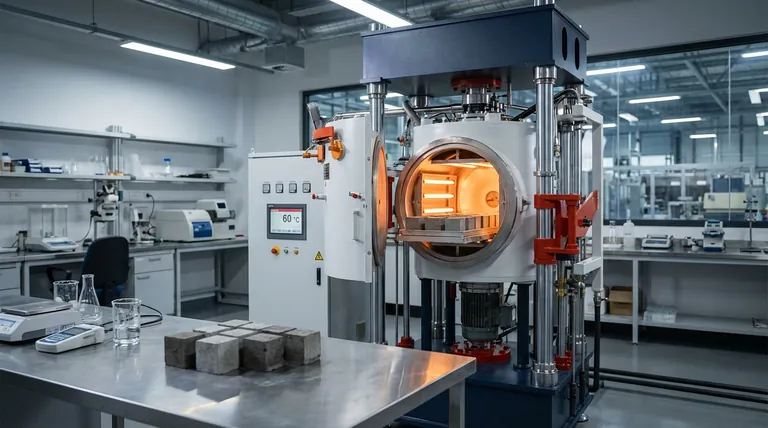
The Science of Accelerated Curing
Accelerating Chemical Reactions
The core reason for using an industrial oven is to drive dehydration polycondensation.
This specific chemical reaction is responsible for linking the geopolymer molecules together. By introducing a constant 60 °C temperature, you significantly increase the kinetic energy within the mixture, forcing the reaction to proceed much faster than it would at ambient temperatures.
Maximizing the Rate of Gelation
Heat plays a critical role in the rate of gelation.
This is the phase where the geopolymer paste loses its plasticity and begins to set. A constant thermal environment ensures this transition happens quickly and uniformly throughout the specimen.
Achieving Mechanical Superiority
Stabilizing the Network Structure
For a geopolymer to be durable, its internal structure must be stable.
The 24-hour heating period allows the geopolymer network structure to harden fully. This rapid stabilization prevents the formation of weak points that might occur during a slower, uneven curing process.
Meeting Industrial Standards
The ultimate goal of this thermal treatment is the attainment of superior mechanical properties.
Standardized testing requires materials to meet specific compressive strength thresholds. The 60 °C curing cycle is the proven method to ensure the final product meets these rigorous industrial standards.
Understanding the Constraints
The Necessity of Controlled Environments
The process relies heavily on a controlled thermal environment.
You cannot achieve these results with inconsistent heating methods. The industrial oven is essential because it maintains the precise 60 °C required; fluctuations could lead to uneven curing or structural inconsistencies.
Strict Time Dependencies
The benefits of this method are tied to the 24-hour heating period.
This is not a flexible variable. Reducing the time in the oven prevents the material from achieving full dehydration polycondensation, which will directly result in lower compressive strength.
Making the Right Choice for Your Goal
To apply this to your processing or quality control workflow, consider your primary objectives:
- If your primary focus is Production Speed: Utilize the 60 °C cycle to reduce the curing timeline to a reliable 24-hour window, allowing for faster mold turnover.
- If your primary focus is Structural Integrity: Strictly adhere to the constant temperature requirement to ensure maximum gelation and network stability.
Precision in thermal treatment is the key to unlocking the full mechanical potential of fly ash geopolymers.
Summary Table:
| Factor | Influence of 60 °C Thermal Treatment |
|---|---|
| Chemical Process | Accelerates dehydration polycondensation for faster hardening |
| Gelation Rate | Increases kinetic energy to transition paste into a rigid solid |
| Curing Time | Reduces structural stabilization window to just 24 hours |
| Mechanical Impact | Ensures high compressive strength and uniform network stability |
| Environment | Provides the controlled heat necessary for industrial standards |
Elevate Your Material Testing with KINTEK Precision
To achieve the rigorous structural standards required for fly ash geopolymers, precise thermal control is non-negotiable. KINTEK provides industry-leading Muffle, Tube, and Vacuum systems, alongside customizable industrial ovens specifically engineered for stable, high-performance curing.
Backed by expert R&D and world-class manufacturing, our systems ensure your specimens reach maximum mechanical strength through uniform heat distribution and exact temperature maintenance.
Ready to optimize your geopolymer research or production workflow?
Contact KINTEK Experts Today to find the perfect customizable furnace solution for your lab’s unique needs.
References
- Enhancement of Properties of Fly Ash Geopolymer Paste with Low NaOH Concentrations Using a Pressing Approach. DOI: 10.46604/aiti.2024.14516
This article is also based on technical information from Kintek Furnace Knowledge Base .
Related Products
- High Temperature Muffle Oven Furnace for Laboratory Debinding and Pre Sintering
- 1200℃ Muffle Oven Furnace for Laboratory
- Dental Porcelain Zirconia Sintering Ceramic Vacuum Press Furnace
- 1400℃ Muffle Oven Furnace for Laboratory
- 1700℃ High Temperature Muffle Oven Furnace for Laboratory
People Also Ask
- What thermal phenomena occur during polymer binder burnout in ceramic green bodies? Lab Furnace Guide
- What role does a high-temperature muffle furnace play in STFO synthesis? Achieve Pure Perovskite Results
- Why is controlled heat treatment in a muffle furnace necessary for calcined clay? Achieve Optimal Pozzolanic Activity
- How does a high-temperature muffle furnace facilitate the formation of LaNbxAl1−xO3+δ perovskite structures? Key Roles
- What role does a high-temperature muffle furnace play in the multi-stage synthesis of Li0.5MnFe1.5O4? Key to Pure Spinel








