
The primary purpose of an Argon stream is to establish a strictly inert protective atmosphere. During the thermal pre-treatment phase at 650°C, this gas isolates the dolomite-based adsorbents from external environmental factors. This isolation is not passive; it actively drives the formation of crystal defects and oxygen vacancies within the material's structure.
By inducing specific microscopic defects, the Argon atmosphere effectively lowers the activation energy required for chemical reactions, resulting in an adsorbent that is both more reactive and structurally durable.
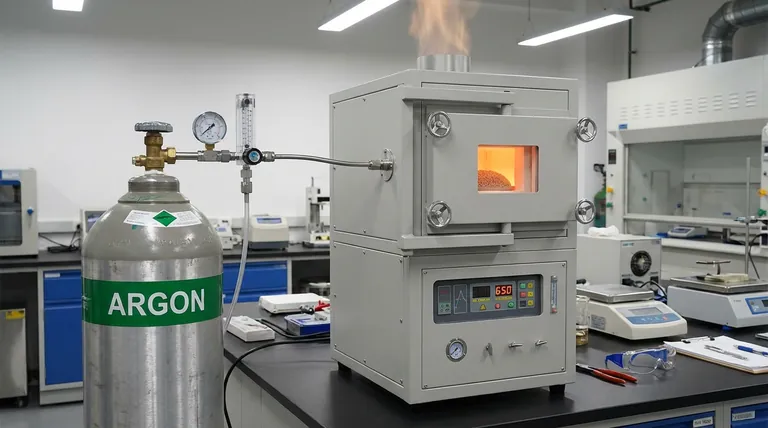
The Mechanism of Structural Enhancement
Creating a Protective Shield
The Argon stream serves as a high-purity barrier around the sample. This prevents unwanted oxidation or side reactions that could occur with atmospheric gases during the heating process. It ensures the mixed oxides evolve in a controlled environment.
Inducing Atomic Defects
The specific aim of this atmosphere is to engineer the material at the atomic level. The inert environment promotes the creation of oxygen vacancies and crystal defects. These defects are not errors; they are critical features that modify how the material interacts with other gases.
Operational Impact on Performance
Lowering the Energy Barrier
The defects created by the Argon stream act as facilitators for future reactions. They significantly lower the energy barrier required for the chemical adsorption of carbon dioxide. This makes the capture process more efficient energetically.
Improving Reaction Kinetics
Beyond energy efficiency, the speed of reaction is enhanced. The modified structure allows for faster uptake of $CO_2$ during operation. This kinetic improvement is essential for practical applications where speed equates to throughput.
Critical Process Requirements
Temperature Specificity
To achieve these benefits, the thermal activation must occur specifically at 650°C. This temperature, combined with the Argon flow, provides the thermodynamic conditions necessary to generate the beneficial mixed oxides.
High-Purity Necessity
The effectiveness of this process relies on the quality of the gas stream. The Argon must be high-purity to ensure the atmosphere remains truly inert. Any impurities could disrupt the formation of the desired crystal defects.
Making the Right Choice for Your Goal
The use of Argon during activation is a strategic choice to optimize the lifecycle and efficiency of the material.
- If your primary focus is Adsorption Efficiency: Rely on the Argon stream to create oxygen vacancies that reduce the energy barrier for capturing $CO_2$.
- If your primary focus is Material Longevity: Use this activation method to enhance structural stability, ensuring the adsorbent performs consistently over many subsequent cycles.
Properly activated dolomite-based adsorbents transform from simple minerals into highly engineered tools for carbon capture.
Summary Table:
| Feature | Function & Impact |
|---|---|
| Inert Atmosphere | Prevents oxidation and ensures high-purity material evolution at 650°C. |
| Structural Defects | Induces oxygen vacancies that lower reaction energy barriers. |
| Reaction Kinetics | Accelerates $CO_2$ capture speed for increased process throughput. |
| Material Longevity | Enhances structural stability for consistent performance over multiple cycles. |
Optimize Your Adsorbent Research with KINTEK Precision
Achieving the perfect crystal defect structure requires uncompromising atmosphere control and thermal stability. Backed by expert R&D and world-class manufacturing, KINTEK provides high-performance Muffle, Tube, and Vacuum furnace systems designed to meet your most rigorous activation protocols. Whether you need specialized gas flow integration for Argon streams or customizable heating profiles for $CO_2$ capture research, our lab high-temp furnaces are engineered for your unique needs.
Ready to elevate your material performance? Contact KINTEK today to discuss your custom furnace solution.
References
- Iyiade Gbolahan Alalade, V. Collins-Martı́nez. Moderate-Temperature Carbon Capture Using Thermally Pre-Treated Dolomite: A Novel Approach. DOI: 10.3390/c11020037
This article is also based on technical information from Kintek Furnace Knowledge Base .
Related Products
- High Temperature Muffle Oven Furnace for Laboratory Debinding and Pre Sintering
- Vertical Laboratory Quartz Tube Furnace Tubular Furnace
- 1200℃ Muffle Oven Furnace for Laboratory
- Laboratory Quartz Tube Furnace RTP Heating Tubular Furnace
- Electric Rotary Kiln Small Rotary Furnace for Activated Carbon Regeneration
People Also Ask
- What thermal phenomena occur during polymer binder burnout in ceramic green bodies? Lab Furnace Guide
- What role does a high-temperature muffle furnace play in STFO synthesis? Achieve Pure Perovskite Results
- Why is controlled heat treatment in a muffle furnace necessary for calcined clay? Achieve Optimal Pozzolanic Activity
- How does a high-temperature muffle furnace facilitate the formation of LaNbxAl1−xO3+δ perovskite structures? Key Roles
- What role does a high-temperature muffle furnace play in the formation of biochar catalysts? Master Catalyst Synthesis



















