
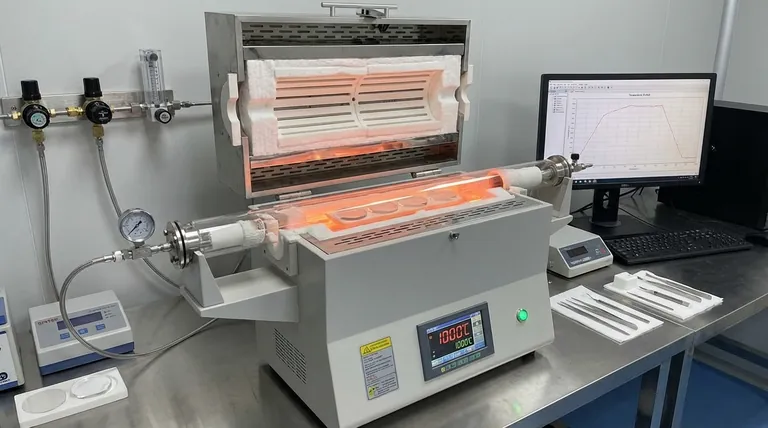
The primary purpose of pre-treating sapphire substrates is to engineer a pristine, atomic-level foundation essential for high-quality material growth. By subjecting the substrate to air annealing in a tube furnace at approximately 1000 °C, you simultaneously eliminate surface impurities—specifically organic contaminants and moisture—and induce a physical restructuring of the surface atoms into a stable, stepped morphology.
High-temperature air annealing transforms a raw sapphire surface into an ideal epitaxial template by thermally removing microscopic contaminants and organizing atoms into the ordered structure required for successful heteroepitaxial growth.
The Mechanics of Surface Purification
Eliminating Contaminants
Raw sapphire substrates often carry microscopic residues from handling or storage. The annealing process utilizes high thermal energy to burn off organic contaminants that chemical cleaning alone might miss.
Removing Residual Moisture
In addition to organics, the high-temperature environment drives off adsorbed water molecules. Eliminating this moisture is critical, as residual water can interfere with the vacuum integrity or chemical reactions in subsequent growth stages.
Atomic Rearrangement and Morphology
Inducing Atomic Mobility
At temperatures near 1000 °C, surface atoms gain enough kinetic energy to move. This mobility allows the atoms to reorganize themselves into a thermodynamically lower-energy state.
Creating a Stepped Surface
The result of this rearrangement is a stepped, atomically flat surface morphology. Rather than a chaotic or rough surface, the sapphire aligns into regular atomic terraces.
The Template for Growth
This ordered structure serves as the physical template for heteroepitaxial growth. It is particularly effective for depositing materials such as ruthenium (Ru) and chromium trioxide (Cr2O3), which require a strictly ordered foundation to crystallize correctly.
Understanding the Trade-offs
The Necessity of High Temperature
Achieving the required atomic stepping is an energy-intensive process. Temperatures significantly lower than 1000 °C may effectively clean the surface of contaminants but fail to induce the necessary atomic rearrangement.
Process Atmosphere
This specific technique relies on air annealing. While effective for sapphire, the presence of oxygen at these temperatures makes this specific pre-treatment method unsuitable for substrates or equipment components that are sensitive to oxidation.
Making the Right Choice for Your Goal
To ensure the success of your epitaxial layers, apply the following guidelines:
- If your primary focus is surface purity: Ensure your furnace reaches the full 1000 °C threshold to guarantee the complete thermal desorption of stubborn organic residues and moisture.
- If your primary focus is crystal quality (Epitaxy): Verify that the annealing time is sufficient to allow for atomic rearrangement, resulting in the distinct stepped morphology required for materials like Ru or Cr2O3.
A disciplined pre-treatment protocol is the single most effective way to ensure adhesion and structural integrity in your final thin film.
Summary Table:
| Feature | Pre-treatment Effect | Benefit for Growth |
|---|---|---|
| Surface Purity | Thermal desorption of organics & moisture | Prevents vacuum contamination & film defects |
| Morphology | Formation of stepped, atomic terraces | Provides an ordered template for crystal alignment |
| Atomic Energy | Increased kinetic mobility at 1000°C | Enables reorganization into a stable, flat state |
| Application | Ideal for Ru and Cr2O3 deposition | Ensures high adhesion and structural integrity |
Elevate Your Thin Film Quality with KINTEK
Precise epitaxial growth starts with a perfectly prepared substrate. KINTEK provides industry-leading Tube, Muffle, and Vacuum furnace systems engineered for rigorous 1000°C annealing processes. Backed by expert R&D and manufacturing, our high-temp lab furnaces are fully customizable to meet the specific thermal profiles required for your advanced materials research.
Ready to achieve atomic-level precision? Contact us today to discuss how our heating solutions can optimize your sapphire pre-treatment and overall lab efficiency.
References
- Quintin Cumston, William E. Kaden. Wafer-scale development, characterization, and high temperature stabilization of epitaxial Cr2O3 films grown on Ru(0001). DOI: 10.1063/5.0201818
This article is also based on technical information from Kintek Furnace Knowledge Base .
Related Products
- Magnesium Extraction and Purification Condensing Tube Furnace
- 2200 ℃ Graphite Vacuum Heat Treat Furnace
- Laboratory Quartz Tube Furnace RTP Heating Tubular Furnace
- 1400℃ High Temperature Laboratory Tube Furnace with Alumina Tube
- Slide PECVD Tube Furnace with Liquid Gasifier PECVD Machine
People Also Ask
- What are the advantages of using a condensing tube furnace for magnesium extraction? Achieve High Purity and Efficient Metal Recovery
- What are the applications of a tube furnace? Master Precise Thermal Processing for Advanced Materials
- What is the purpose of sulfur-enriched environments for MoS2-WS2 heterojunctions? Ensure Optimal Crystal Stoichiometry
- What factors should be considered when selecting a tube furnace? Choose the Right Furnace for Your Lab Needs
- What are the main advantages of using a tube furnace in industrial and laboratory settings? Achieve Precise Temperature and Atmosphere Control



















