The primary purpose of a nested dual-quartz tube configuration is to engineer a strictly controlled micro-environment that stabilizes both fluid dynamics and thermal profiles. By nesting a 12mm inner tube within a 1-inch outer tube, the system achieves spatial confinement that significantly limits airflow velocity. This modification is critical for preventing rapid heat dissipation and ensuring the stable gas-phase conditions necessary for twisted bilayer molybdenum disulfide (TB-MoS2) synthesis.
The nested configuration functions as a dual-purpose stabilizer, acting as both a flow restrictor and a thermal insulator. By confining the reaction space, it isolates the substrate from environmental fluctuations to ensure high process repeatability.
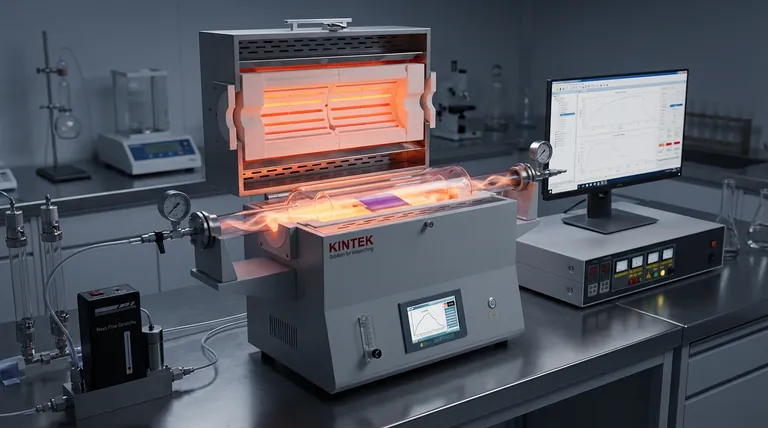
Mechanisms of Stabilization
To understand why this configuration is necessary for TB-MoS2 synthesis, one must look at how it alters the physical environment around the substrate.
Creating Spatial Confinement
The core mechanic of this design is the reduction of the reaction volume. Placing a 12mm inner tube inside a standard 1-inch outer tube creates a zone of spatial confinement. This physical restriction forces the precursor gases into a narrower path, altering their behavior compared to a standard open-tube setup.
Regulating Airflow Velocity
Within this confined space, the design specifically limits airflow velocity. By restricting the speed of the gas, the system establishes a stable flow field. This reduction in turbulence is essential for uniform deposition, preventing chaotic gas interactions that could disrupt the delicate growth of twisted bilayer structures.
Thermal Management Principles
Beyond flow dynamics, the dual-tube structure plays a critical role in managing the thermal energy of the system.
Acting as an Insulation Layer
The dual-tube setup effectively creates a thermal insulation layer around the reaction zone. The gap between the inner and outer tubes acts as a buffer. This prevents the rapid heat dissipation that often occurs in single-tube systems, maintaining a consistent temperature profile.
Ensuring Deposition Stability
By preventing heat loss and stabilizing flow, the configuration ensures highly repeatable gas-phase deposition conditions. The environment near the substrate remains constant throughout the synthesis process. This stability is the key factor in achieving the precise structural control required for TB-MoS2.
Understanding the Trade-offs
While the nested tube configuration offers superior control, it introduces specific constraints that must be managed.
Spatial Limitations
The primary trade-off is the reduction in usable working volume. Spatial confinement inherently limits the size of the substrate that can be processed. This configuration favors precision and quality over large-area throughput.
Complexity of Setup
Introducing a second tube adds a variable to the hardware configuration. Ensuring the concentric alignment of the 12mm tube within the 1-inch tube is necessary to maintain the symmetry of the flow field and thermal distribution.
Making the Right Choice for Your Goal
When designing a CVD system for advanced materials like TB-MoS2, the nested configuration is a tool for precision.
- If your primary focus is [High Repeatability]: Implement the nested dual-tube design to insulate the reaction zone from thermal fluctuations and ensure consistent run-to-run results.
- If your primary focus is [Flow Stabilization]: Use the inner tube confinement to limit airflow velocity, creating the stable flow field required for delicate bilayer growth.
Control the environment, and you control the material quality.
Summary Table:
| Feature | Function in Nested Configuration | Impact on TB-MoS2 Growth |
|---|---|---|
| Spatial Confinement | Limits reaction volume using a 12mm inner tube | Increases precursor concentration & control |
| Airflow Velocity | Reduces gas speed and turbulence | Ensures uniform deposition of bilayer structures |
| Thermal Management | Acts as an insulation buffer layer | Prevents heat dissipation for stable growth |
| Process Repeatability | Isolates substrate from fluctuations | Delivers consistent run-to-run material quality |
Elevate Your 2D Material Synthesis with KINTEK
Precise control over fluid dynamics and thermal insulation is non-negotiable for high-quality TB-MoS2 production. Backed by expert R&D and world-class manufacturing, KINTEK provides high-performance CVD systems, Muffle, Tube, and Vacuum furnaces designed to meet the rigorous demands of advanced material science.
Whether you require a custom nested-tube setup or a large-scale Rotary furnace, our systems are fully customizable to your unique research needs. Contact us today to discover how KINTEK’s laboratory solutions can enhance your deposition stability and research throughput.
References
- Manzhang Xu, Wei Huang. Reconfiguring nucleation for CVD growth of twisted bilayer MoS2 with a wide range of twist angles. DOI: 10.1038/s41467-023-44598-w
This article is also based on technical information from Kintek Furnace Knowledge Base .
Related Products
- 915MHz MPCVD Diamond Machine Microwave Plasma Chemical Vapor Deposition System Reactor
- MPCVD Machine System Reactor Bell-jar Resonator for Lab and Diamond Growth
- Cylindrical Resonator MPCVD Machine System for Lab Diamond Growth
- Custom Made Versatile CVD Tube Furnace Chemical Vapor Deposition CVD Equipment Machine
- Slide PECVD Tube Furnace with Liquid Gasifier PECVD Machine
People Also Ask
- What is the MPCVD method and why is it considered effective for diamond deposition? Superior Purity & High Growth Rates
- What factors influence the quality of diamond deposition in the MPCVD method? Master the Critical Parameters for High-Quality Diamond Growth
- What is the purpose of a microwave plasma chemical vapor deposition system? Grow High-Purity Diamonds and Advanced Materials
- What are some key features and benefits of the microwave plasma chemical vapor deposition system? Achieve Unmatched Material Synthesis
- What is the basic principle of operation for the microwave plasma chemical vapor deposition system? Unlock High-Purity Material Growth