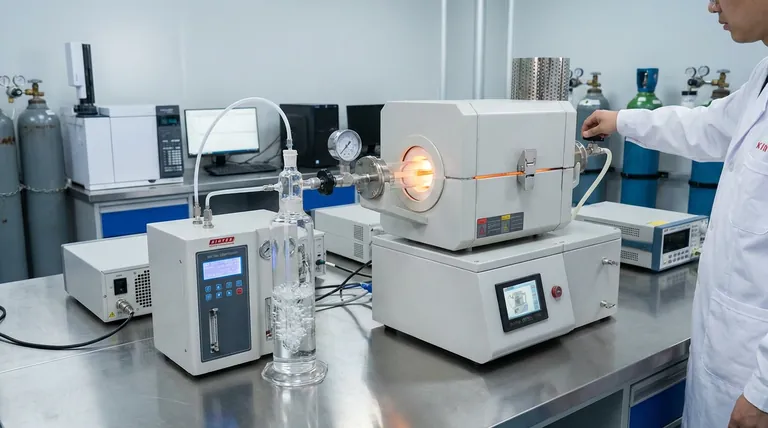
The primary function of a solvent bubbler in a Chemical Vapor Deposition (CVD) system is to introduce gaseous catalysts or auxiliary solvents into the reaction environment with high precision. By passing a carrier gas through a liquid solvent, the system transports a specific concentration of chemical vapor to the furnace to regulate the growth of the material.
Core Takeaway: The synthesis of 2D Covalent Organic Frameworks (COFs) requires a delicate balance of reaction speed and reversibility. A solvent bubbler creates a "gas-phase assisted" environment that modulates polymerization kinetics, which is critical for transforming simple monomers into highly ordered, crystalline 2D structures.
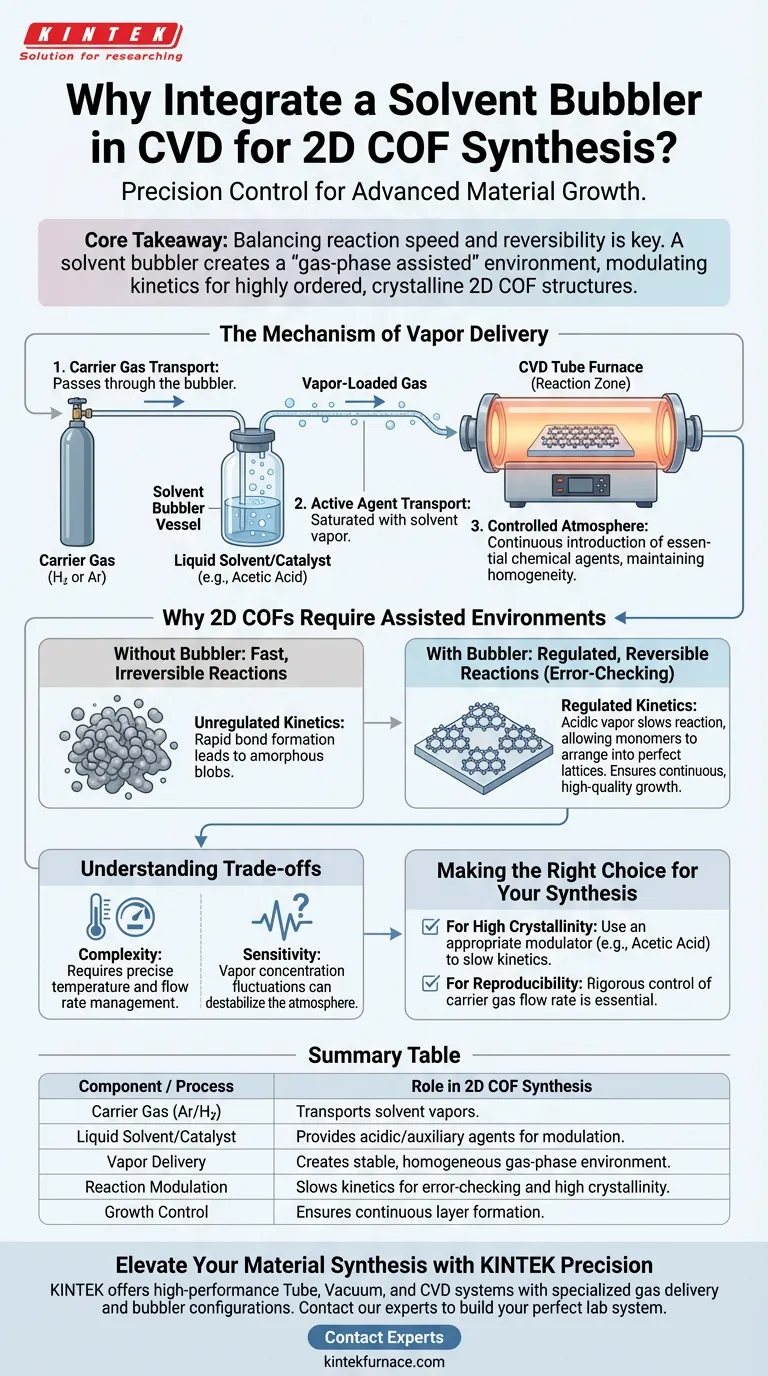
The Mechanism of Vapor Delivery
Utilizing Carrier Gases
The process begins with a carrier gas, typically hydrogen or argon. This gas is directed through the bubbler vessel which contains a specific liquid solvent or catalyst, such as acetic acid.
Transporting Active Agents
As the gas bubbles through the liquid, it becomes saturated with solvent vapor. This vapor-loaded gas is then transported into the main reaction zone of the tube furnace.
Creating a Controlled Atmosphere
This mechanism allows for the continuous introduction of essential chemical agents without using liquid injection. It maintains a stable, homogeneous reaction atmosphere throughout the synthesis process.
Why 2D COFs Require Assisted Environments
Regulating Polymerization Kinetics
The formation of Covalent Organic Frameworks relies on reversible chemistry. If the reaction happens too quickly, the material creates irreversible bonds and becomes an amorphous blob.
Improving Crystalline Quality
The vapor introduced by the bubbler (often an acidic catalyst) slows the reaction or makes it reversible. This "error-checking" process allows the monomers to arrange themselves into perfect, periodic 2D lattices.
Ensuring Continuous Growth
Standard CVD provides high temperatures for precursor reaction. The bubbler supplements this by ensuring the chemical environment remains chemically active enough to support continuous layer growth on the substrate.
Understanding the Trade-offs
Complexity of Process Control
While a bubbler adds necessary chemical control, it introduces new variables to the system. You must precisely manage the temperature of the bubbler and the flow rate of the carrier gas.
Sensitivity to Saturation Limits
If the carrier gas flow is too high, it may not pick up enough solvent vapor. Conversely, fluctuations in the bubbler's temperature can lead to inconsistent vapor concentrations, potentially destabilizing the reaction atmosphere.
Making the Right Choice for Your Synthesis
To optimize your CVD system for 2D COF growth, consider your specific experimental targets:
- If your primary focus is High Crystallinity: Ensure your bubbler contains an appropriate modulator (like acetic acid) to slow down kinetics and allow for ordered lattice formation.
- If your primary focus is Reproducibility: rigorous control of the carrier gas flow rate through the bubbler is essential to maintain a stable gas-phase concentration across different runs.
The solvent bubbler turns a standard deposition instrument into a precision chemistry tool capable of synthesizing complex organic architectures.
Summary Table:
| Component / Process | Role in 2D COF Synthesis |
|---|---|
| Carrier Gas (Ar/H2) | Transports solvent vapors into the reaction zone. |
| Liquid Solvent/Catalyst | Provides acidic/auxiliary agents to modulate reaction speed. |
| Vapor Delivery | Creates a stable, homogeneous gas-phase environment. |
| Reaction Modulation | Slows kinetics to enable error-checking for high crystallinity. |
| Growth Control | Ensures continuous layer formation on the substrate. |
Elevate Your Material Synthesis with KINTEK Precision
High-performance 2D COF synthesis requires more than just heat; it demands precise chemical control. Backed by expert R&D and manufacturing, KINTEK offers high-performance Tube, Vacuum, and CVD systems—including specialized gas delivery and bubbler configurations—designed to meet your unique lab requirements. Whether you are optimizing polymerization kinetics or scaling up production, our customizable high-temperature solutions provide the stability and precision your research deserves.
Ready to achieve superior crystalline quality? Contact our technical experts today to build the perfect CVD system for your lab.
Visual Guide
References
- Jin Hyuk Cho, Soo Young Kim. Advancements in two-dimensional covalent organic framework nanosheets for electrocatalytic energy conversion: current and future prospects. DOI: 10.20517/energymater.2023.72
This article is also based on technical information from Kintek Furnace Knowledge Base .
Related Products
- HFCVD Machine System Equipment for Drawing Die Nano Diamond Coating
- Cylindrical Resonator MPCVD Machine System for Lab Diamond Growth
- Custom Made Versatile CVD Tube Furnace Chemical Vapor Deposition CVD Equipment Machine
- 915MHz MPCVD Diamond Machine Microwave Plasma Chemical Vapor Deposition System Reactor
- MPCVD Machine System Reactor Bell-jar Resonator for Lab and Diamond Growth
People Also Ask
- What is Hot-filament Chemical Vapor Deposition (HFCVD)? Achieve High-Quality Thin Films with Precision Control
- What are the equipment for chemical vapor deposition? A Guide to the 5 Essential Components
- What is the significance of the vacuum pressure control system in the CVD coating process for powders?
- What is the function of high-purity Argon (Ar) gas during CVD? Optimize Your Thin Film Uniformity and Purity
- What are the advantages of using Chemical Vapor Deposition (CVD) for coating turbine blades? Enhance Life & Performance