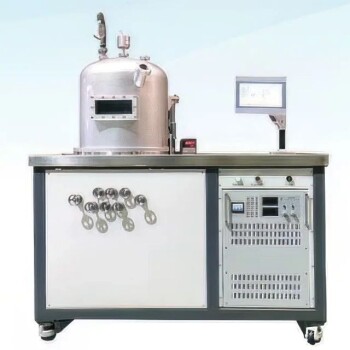
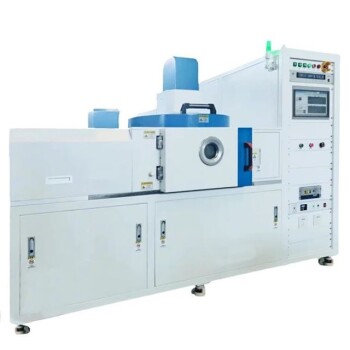
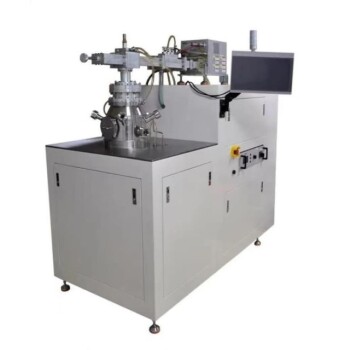
In CNC machining, the core advantage of using Chemical Vapor Deposition (CVD) is the ability to apply a thin, exceptionally hard, and durable coating to either cutting tools or finished components. This process fundamentally enhances surface properties, providing superior wear resistance, reduced friction, and protection from corrosion, which dramatically extends the operational life and performance of the part.
CVD is more than just a protective layer; it's a strategic process for engineering superior surface properties onto a machined substrate. By creating a uniform, high-purity film, it transforms a standard component into one that is more durable, efficient, and resilient in demanding applications.
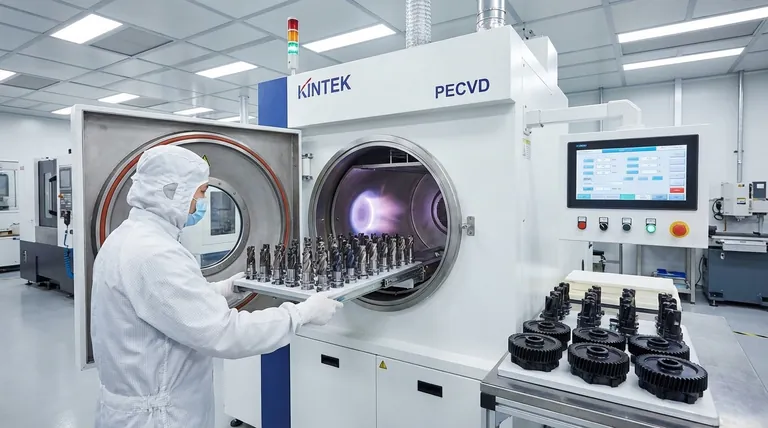
How CVD Fundamentally Enhances Machined Components
The benefits of a CVD coating stem from the specific material properties it imparts to the surface of a part or tool.
Creating an Ultra-Hard, Wear-Resistant Surface
The deposited film is often significantly harder than the underlying metal. This creates a powerful barrier against abrasive and adhesive wear.
For cutting tools, this means the cutting edge stays sharp longer, leading to more consistent parts and fewer tool changes. For finished components, it means they last longer in high-contact or abrasive environments.
Reducing Friction and Heat
CVD coatings can be engineered to have a very low coefficient of friction. This property, known as lubricity, reduces the force required for machine operations and minimizes heat generation.
Lower friction allows for faster cutting speeds and improved surface finishes. In mechanical assemblies, it reduces energy loss and wear between moving parts.
Providing Superior Corrosion and Oxidation Resistance
The CVD process creates a dense, non-porous film that acts as a robust chemical barrier.
This isolates the base material from moisture, chemicals, and high-temperature gases, effectively preventing rust, corrosion, and oxidation that would otherwise degrade the component.
The Process Advantage: Why CVD Excels for Complex Geometries
Beyond the material benefits, the nature of the CVD process itself makes it uniquely suitable for the intricate parts often produced by CNC machining.
Achieving Uniform Coverage
Because CVD relies on a chemical reaction from a vapor phase, the coating material is deposited evenly across all exposed surfaces of the component.
This ensures complete and uniform protection, even inside deep bores, sharp corners, and complex internal features where line-of-sight coating methods would fail.
Precision Control Over Film Properties
CVD furnaces offer precise control over the deposition process, including gas flow, temperature, and pressure.
This allows for fine-tuning the coating’s thickness, hardness, and composition to meet the exact performance requirements of a specific application, from microelectronics to aerospace components.
Versatility and Scalability
The technology is incredibly versatile, capable of depositing a wide range of materials, including ceramics (like titanium nitride) and other advanced compounds.
It is also highly scalable, used for both high-value research applications and large-scale industrial production, ensuring consistency from prototype to mass manufacturing.
Understanding the Trade-offs and Considerations
While powerful, CVD is not a universal solution. An objective assessment requires understanding its limitations.
High-Temperature Processing
Traditional CVD processes often require very high temperatures, which can potentially affect the temper, hardness, or dimensional stability of the underlying substrate.
It is crucial to ensure the base material of your CNC part can withstand the heat of the specific CVD process without adverse effects. Newer, lower-temperature variants exist but may come with their own trade-offs.
It Is a Batch Process
CVD is not an inline procedure; parts must be loaded into a vacuum furnace for coating. This adds a step to the manufacturing workflow.
This batch-based nature can influence lead times and costs, making it more cost-effective for medium-to-large production runs rather than single prototypes.
Substrate and Coating Compatibility
The chemistry of the CVD process must be compatible with the substrate material. Not all coatings can be applied to all metals.
Careful material selection is necessary to ensure strong adhesion and to prevent any undesirable chemical reactions between the coating and the part.
When to Choose CVD for Your CNC Application
To make a decision, align the benefits of CVD with your primary project goal.
- If your primary focus is extending cutting tool life: Choose CVD to add a hard, low-friction coating that reduces wear and heat, allowing for faster cycle times and fewer tool changes.
- If your primary focus is improving finished part durability: Use CVD to create a wear-resistant and corrosion-proof surface for components operating in high-friction or harsh chemical environments.
- If your primary focus is enabling high performance: Leverage CVD to provide the thermal and chemical barrier needed for parts in demanding aerospace, automotive, or energy applications.
- If your primary focus is long-term cost reduction: The initial investment in CVD coating can yield significant savings at scale through reduced maintenance, fewer failures, and greater operational efficiency.
Ultimately, applying a CVD coating is a strategic decision to engineer superior surface performance, transforming a standard machined part into a highly resilient and more capable component.
Summary Table:
| Advantage | Description |
|---|---|
| Enhanced Wear Resistance | Applies ultra-hard coatings that protect against abrasive and adhesive wear, extending tool and component life. |
| Reduced Friction | Lowers coefficient of friction for faster machining speeds, better surface finishes, and less heat generation. |
| Corrosion and Oxidation Resistance | Forms a dense barrier against moisture and chemicals, preventing rust and degradation. |
| Uniform Coverage | Ensures even coating on complex geometries, including internal features, for complete protection. |
| Precision Control | Allows fine-tuning of coating properties like thickness and hardness for specific application needs. |
| Versatility and Scalability | Supports various materials and scales from prototypes to mass production with consistent results. |
Transform your CNC machining with advanced CVD solutions from KINTEK! Leveraging exceptional R&D and in-house manufacturing, we provide high-temperature furnace systems like CVD/PECVD, Muffle, Tube, Rotary, Vacuum, and Atmosphere Furnaces. Our deep customization capabilities ensure precise coatings for your unique experimental and production needs, enhancing durability, efficiency, and cost-effectiveness. Ready to engineer superior surface performance? Contact us today to discuss how we can elevate your projects!
Visual Guide

Related Products
- HFCVD Machine System Equipment for Drawing Die Nano Diamond Coating
- Custom Made Versatile CVD Tube Furnace Chemical Vapor Deposition CVD Equipment Machine
- RF PECVD System Radio Frequency Plasma Enhanced Chemical Vapor Deposition
- Multi Heating Zones CVD Tube Furnace Machine for Chemical Vapor Deposition Equipment
- 915MHz MPCVD Diamond Machine Microwave Plasma Chemical Vapor Deposition System Reactor
People Also Ask
- What is Hot-filament Chemical Vapor Deposition (HFCVD)? Achieve High-Quality Thin Films with Precision Control
- What are the equipment for chemical vapor deposition? A Guide to the 5 Essential Components
- What is the significance of the vacuum pressure control system in the CVD coating process for powders?
- What is the function of high-purity Argon (Ar) gas during CVD? Optimize Your Thin Film Uniformity and Purity
- What are the advantages of using Chemical Vapor Deposition (CVD) for coating turbine blades? Enhance Life & Performance