
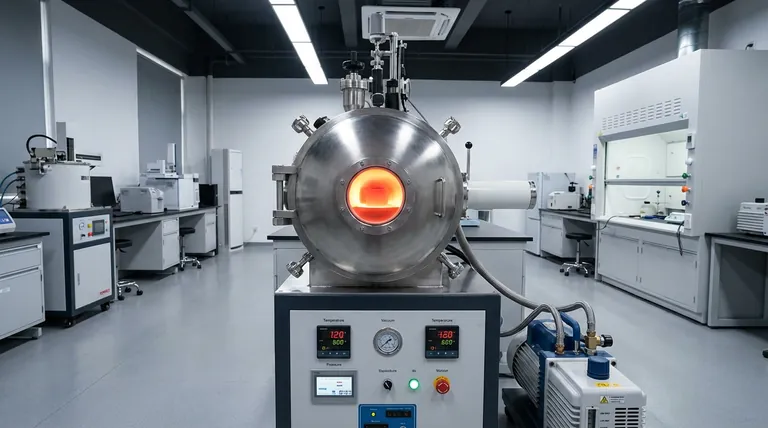
The primary role of vacuum induction melting (VIM) equipment is to create a strictly controlled, contamination-free environment that preserves the precise atomic ratio of Nickel to Titanium. By melting the alloy in a vacuum, the equipment prevents the highly reactive titanium from bonding with oxygen or nitrogen at high temperatures. This isolation is the mechanism that ensures the final material retains its critical shape memory capabilities and biocompatibility.
The core challenge in producing NiTi alloys is that Titanium is extremely reactive at melting temperatures. VIM equipment serves as a containment shield, preventing oxidation to maintain the exact chemical balance required for the alloy's advanced performance.
The Chemistry of Contamination Control
The Sensitivity of Titanium
Titanium is the volatile variable in NiTi production. At the high temperatures required for melting, titanium becomes highly reactive with oxygen and nitrogen found in the atmosphere.
The Consequence of Oxidation
If exposed to air during melting, titanium atoms will irreversibly bond with oxygen. This creates brittle oxides rather than integrating into the alloy matrix, effectively "stealing" titanium from the mix.
The Vacuum Solution
VIM equipment eliminates this risk by removing the atmosphere before heat is applied. This ensures that the titanium remains metallic and available to bond specifically with nickel, rather than reacting with environmental impurities.
Securing Material Properties
Precise Atomic Ratios
The unique properties of NiTi (Nitinol) are strictly dependent on the ratio of nickel atoms to titanium atoms. Even a slight deviation caused by oxidation can fundamentally alter the alloy's transformation temperature.
Preserving Shape Memory
VIM ensures that the chemical composition remains chemically exact. This precision is what allows the alloy to exhibit the "shape memory effect," where it returns to a pre-set shape upon heating.
Ensuring Biocompatibility
Medical applications require materials that are chemically stable and pure. By preventing the formation of oxides and removing volatile impurities, VIM produces a clean alloy safe for use in the human body.
Understanding the Trade-offs
The Risk of Vacuum Breach
While VIM provides superior purity, the process is entirely dependent on the integrity of the vacuum seal. Even a minor leak or insufficient pressure drop can introduce oxygen, leading to the formation of brittle compounds that compromise the ductility of the ingot.
Equipment Complexity vs. Purity
VIM allows for the removal of volatile impurities, but it focuses heavily on chemical composition rather than physical structure. For applications requiring specific grain structures, VIM ingots may require subsequent processing steps to achieve the desired mechanical texture.
Making the Right Choice for Your Goal
To determine if VIM is the critical variable for your project, consider your end-use requirements:
- If your primary focus is Shape Memory Performance: You must use VIM to guarantee the exact atomic ratio required for precise transformation temperatures.
- If your primary focus is Medical Safety: VIM is non-negotiable for eliminating inclusions and oxides that could compromise biocompatibility.
- If your primary focus is Material Durability: VIM prevents the formation of brittle oxides that would otherwise act as crack initiation sites in the alloy.
Control the melting environment, and you control the reliability of the final alloy.
Summary Table:
| Feature | Role of VIM in NiTi Preparation | Impact on Material Properties |
|---|---|---|
| Atmosphere Control | Eliminates oxygen and nitrogen | Prevents brittle oxide formation and titanium loss |
| Compositional Integrity | Preserves exact Ni:Ti atomic ratio | Ensures precise shape memory transformation temperatures |
| Impurity Removal | Extracts volatile contaminants | Enhances biocompatibility and medical-grade safety |
| Performance Stability | Maintains chemical homogeneity | Increases material ductility and fatigue resistance |
Elevate Your Alloy Precision with KINTEK
Maintaining the delicate chemical balance of Nitinol requires world-class thermal processing. Backed by expert R&D and manufacturing, KINTEK offers high-performance Vacuum Induction Melting (VIM) systems, alongside our range of Muffle, Tube, Rotary, and CVD furnaces—all customizable to meet your unique metallurgical specifications.
Whether you are developing medical-grade implants or advanced shape-memory actuators, our equipment provides the contamination-free environment necessary for superior material reliability. Contact KINTEK today to discuss your custom furnace needs and ensure your alloys meet the highest industry standards.
References
- Minja Miličić Lazić, Branimir Grgur. Corrosion Behavior of Nickel–Titanium Continuous-Casted Alloys. DOI: 10.3390/met14010088
This article is also based on technical information from Kintek Furnace Knowledge Base .
Related Products
- Vacuum Induction Melting Furnace
- 600T Vacuum Induction Hot Press Vacuum Heat Treat and Sintering Furnace
- Vacuum Hot Press Furnace Machine for Lamination and Heating
- Vacuum Heat Treat Sintering Furnace with Pressure for Vacuum Sintering
People Also Ask
- What are the core functions of the High Vacuum Induction Melting (VIM) furnace? Optimize DD5 Superalloy Purification
- What are the advantages of using a VIM furnace to control residual oxygen pressure? Achieve Superior Metal Uniformity
- What is the role of VIM and directional solidification in aero-engine blade substrates? Engineering Extreme Durability
- What role does a Vacuum Induction Melting furnace play in the production of high-aluminum nickel-based superalloys?
- What are the technical advantages of using a Vacuum Induction Melting furnace in the development of advanced packaging steel?



