
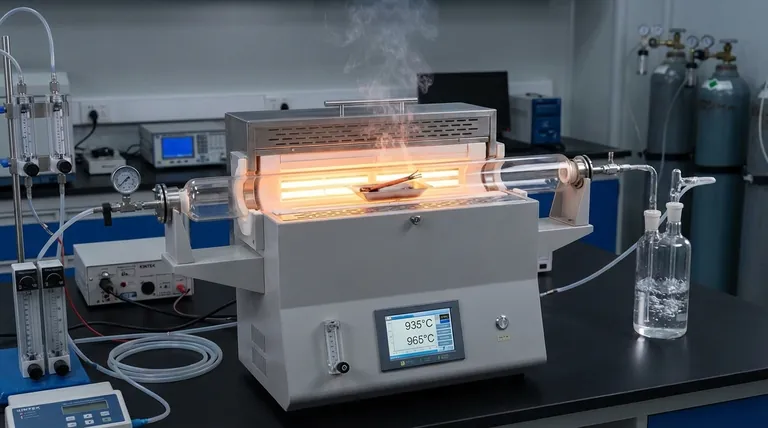
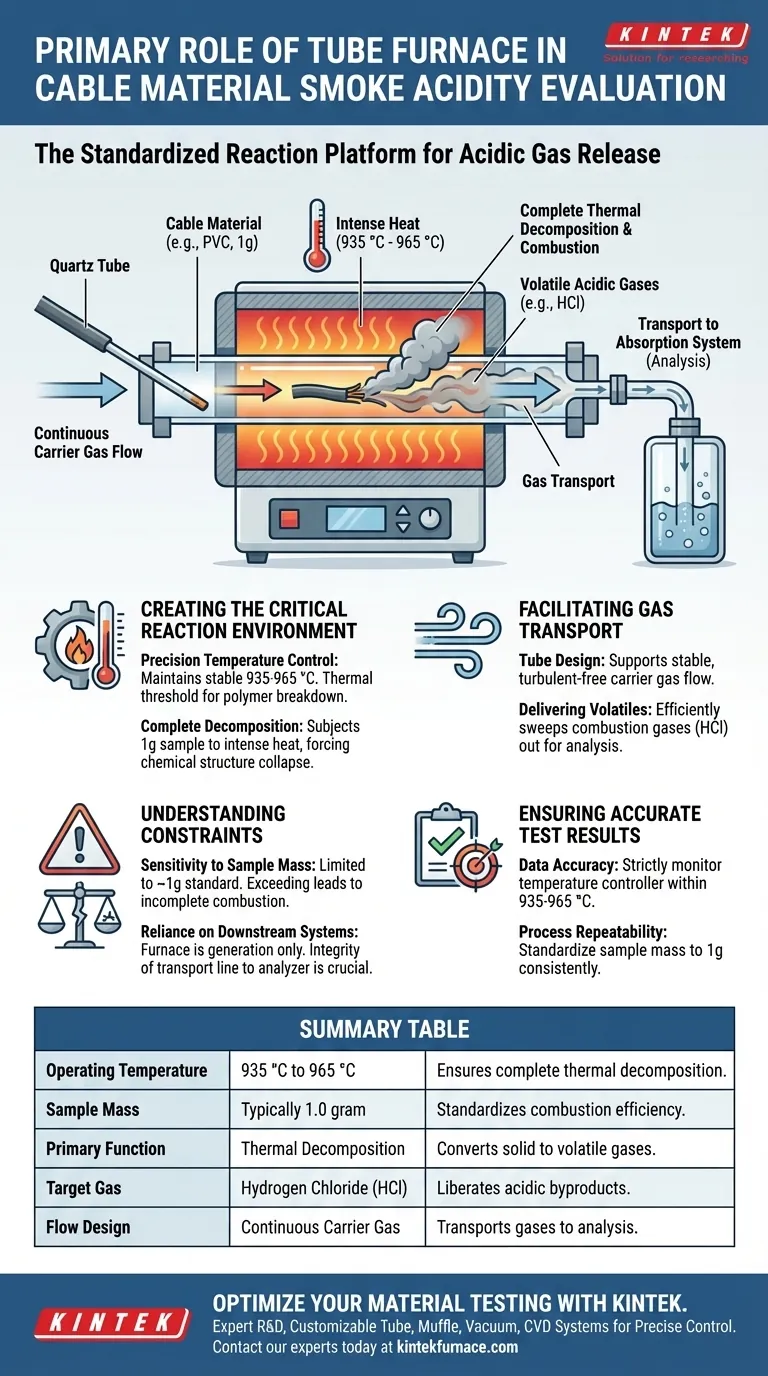
The tube furnace serves as the standardized reaction platform critical for releasing acidic gases from cable materials for testing. Its primary function is to create a precisely controlled high-temperature environment, specifically between 935 °C and 965 °C, which forces the complete thermal decomposition and combustion of a material sample. By maintaining this intense heat, the furnace ensures that volatile components are fully liberated and transported to an absorption system for analysis.
The tube furnace does not measure acidity itself; rather, it acts as the engine of liberation. It ensures that solid materials are converted entirely into combustion gases, allowing for a complete and accurate capture of potential acidic byproducts like hydrogen chloride.
Creating the Critical Reaction Environment
Precision Temperature Control
The furnace provides a highly stable thermal zone that must operate within a strict window of 935 °C to 965 °C.
This range is not arbitrary; it is the thermal threshold required to break down complex polymers used in cabling.
If the temperature drops below this range, the material may only partially degrade, failing to release all acidic compounds.
Complete Thermal Decomposition
The primary goal of this apparatus is to process a specific sample mass, typically 1 gram of material such as a PVC compound.
The furnace subjects this sample to intense heat, ensuring complete combustion rather than simple melting or charring.
This forces the chemical structure of the material to collapse, releasing all bound elements into the gas phase.
Facilitating Gas Transport
The Role of Tube Design
The physical geometry of the furnace tube is designed to support a continuous flow of a carrier gas.
This design creates a stable aerodynamic environment that moves gases away from the combustion zone without turbulence.
Delivering Volatiles for Analysis
As the material decomposes, it releases volatile components, most notably hydrogen chloride (HCl).
The furnace ensures these combustion gases are efficiently swept out of the heated zone.
They are then transported downstream to an absorption system, where the actual acidity quantification takes place.
Understanding the Constraints
Sensitivity to Sample Mass
The tube furnace is calibrated for small, precise quantities, generally limited to the 1-gram standard.
Exceeding this mass can overwhelm the thermal capacity of the specific zone or disrupt the carrier gas flow.
This leads to incomplete combustion ("sooting") and results that under-report the true acidity of the material.
Reliance on Downstream Systems
It is important to recognize that the furnace is only the generation point, not the detection point.
If the connection between the furnace and the absorption system is compromised, gases generated by the furnace will be lost.
Therefore, the furnace's effectiveness is entirely dependent on the integrity of the transport line to the analyzer.
Ensuring Accurate Test Results
To maximize the reliability of your smoke acidity evaluation, focus on the operational parameters of the furnace.
- If your primary focus is Data Accuracy: Strictly monitor the temperature controller to ensure it never drifts outside the 935–965 °C window during the burn.
- If your primary focus is Process Repeatability: Standardize your sample preparation to ensure the mass is consistently 1 gram to prevent fluctuations in combustion efficiency.
Reliable acidity data begins with the complete, controlled destruction of the sample within the tube furnace.
Summary Table:
| Feature | Specification/Requirement | Role in Testing |
|---|---|---|
| Operating Temperature | 935 °C to 965 °C | Ensures complete thermal decomposition of polymers. |
| Sample Mass | Typically 1.0 gram | Standardizes combustion efficiency and gas volume. |
| Primary Function | Thermal Decomposition | Converts solid cable materials into volatile combustion gases. |
| Target Gas | Hydrogen Chloride (HCl) | Liberates acidic byproducts for downstream absorption. |
| Flow Design | Continuous Carrier Gas | Transports gases from the heat zone to the analysis system. |
Optimize Your Material Testing with KINTEK
Precise acidity evaluation starts with a high-performance reaction environment. Backed by expert R&D and manufacturing, KINTEK offers specialized Tube, Muffle, Vacuum, and CVD systems—all customizable for your unique lab requirements. Our high-temperature furnaces ensure the thermal stability and precise control necessary for standardized cable material testing and polymer decomposition.
Ready to enhance your lab’s accuracy and repeatability?
Contact our experts today to find the perfect furnace solution for your specific needs!
Visual Guide
References
- Iacopo Bassi, Gianluca Sarti. A New Perspective on Hydrogen Chloride Scavenging at High Temperatures for Reducing the Smoke Acidity of PVC in Fires—III: EN 60754-2 and the Species in Solution Affecting pH and Conductivity. DOI: 10.3390/fire8010018
This article is also based on technical information from Kintek Furnace Knowledge Base .
Related Products
- Vacuum Sealed Continuous Working Rotary Tube Furnace Rotating Tube Furnace
- 1400℃ High Temperature Laboratory Tube Furnace with Alumina Tube
- 1700℃ High Temperature Laboratory Tube Furnace with Alumina Tube
- Magnesium Extraction and Purification Condensing Tube Furnace
- High Pressure Laboratory Vacuum Tube Furnace
People Also Ask
- What is the purpose of rotary tube furnaces? Achieve Uniform Heat Treatment for Powders and Granules
- What are the key advantages of using a rotary tube furnace? Achieve Dynamic, Uniform Heating for Powders
- How does the amount of material processed vary between batch and continuous rotary tube furnaces? Scale Your Production Efficiently
- What are the advantages of rotary tube furnaces in fuel compatibility? Boost Efficiency and Cut Costs
- What is the temperature range of some rotary tube furnaces? Achieve Uniform Heating Up to 1200°C



















