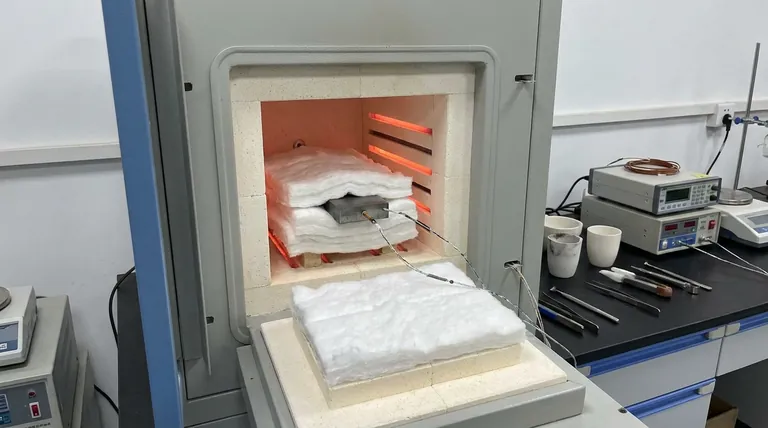
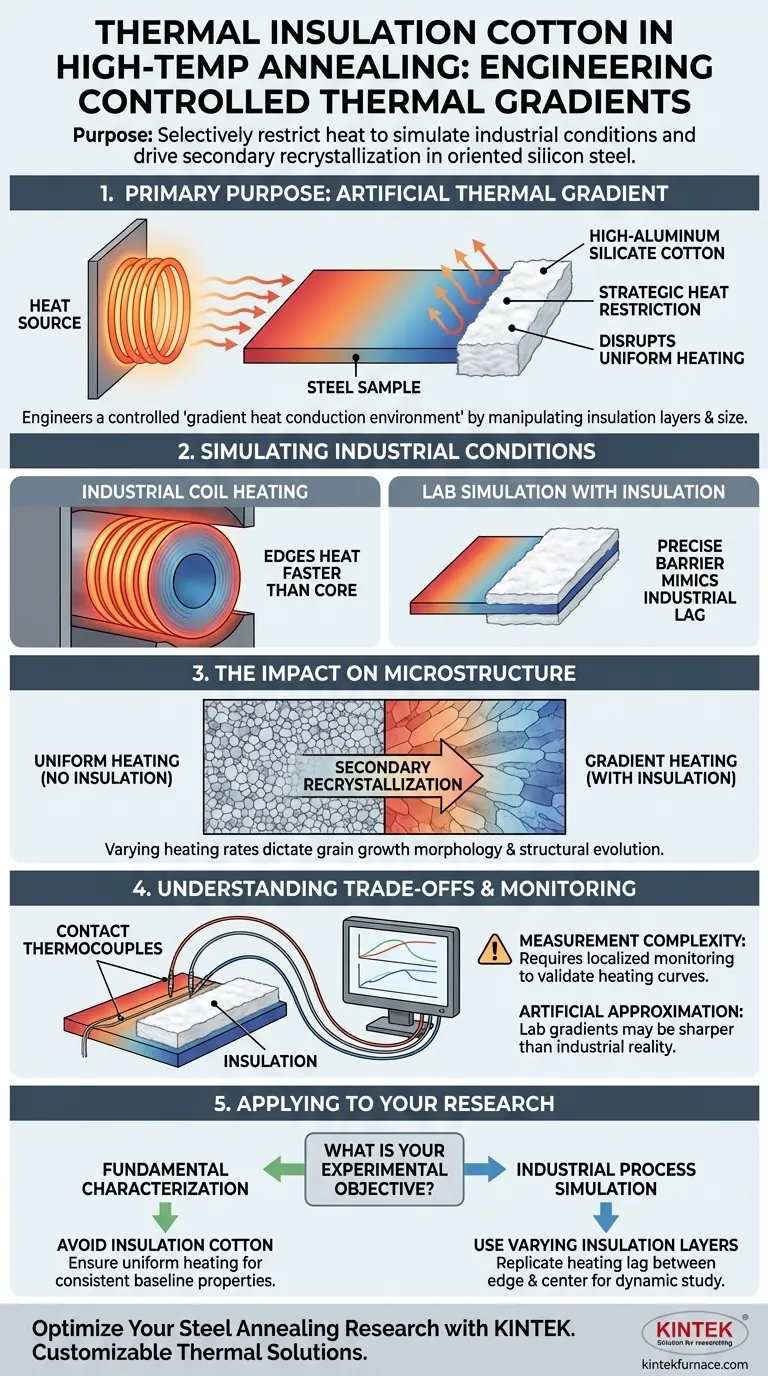
The primary purpose is to artificially engineer a controlled thermal gradient. By strategically covering specific areas of the oriented silicon steel sample with high-aluminum silicate thermal insulation cotton, researchers can selectively restrict the entry of heat energy. This process disrupts uniform heating, effectively simulating the uneven temperature distribution experienced by steel coils during industrial production.
By manipulating the number of layers and the size of the insulation cotton, researchers can create a "gradient heat conduction environment." This allows them to move beyond simple temperature tests and study exactly how varying heating rates across a single sample influence the material's structural evolution.
Simulating Industrial Conditions
Replicating Coil Heating
In large-scale industrial annealing, steel coils rarely heat uniformly. The outer edges often absorb heat much faster than the inner core.
The Role of Insulation
Thermal insulation cotton mimics this industrial reality in a small-scale laboratory setting. It acts as a barrier, slowing down heat transfer to specific sections of the sample.
Controlled Directionality
This is not random insulation; it is precise. Researchers can block heat from specific directions or edges to model exact production scenarios.
The Impact on Microstructure
Driving Secondary Recrystallization
The core phenomenon being studied here is secondary recrystallization. This is the process where certain crystalline grains grow significantly larger than their neighbors.
Linking Heat to Grain Growth
The heating gradient created by the cotton directly influences this growth. Differences in temperature rise rates across the sample lead to variations in grain growth morphology.
Quantifying the Difference
By comparing insulated areas against exposed areas, researchers can establish a correlation. They map how specific heating rate gradients result in specific grain structures.
Understanding the Trade-offs
Measurement Complexity
Introducing thermal gradients adds variables that must be rigorously monitored. Simple furnace temperature readings are no longer sufficient.
Requirement for Localized Monitoring
To validate the experiment, contact thermocouples must be placed at both the edges (fast heating) and centers (slowed heating) of the sample. Without real-time verification of the local heating curves, the data derived from the insulation cotton is unreliable.
Artificial vs. Natural
While this method simulates industrial conditions, it is still an artificial approximation. The boundary between the insulated and non-insulated zones in the lab may be sharper than the gradual gradients found in massive steel coils.
Applying This to Your Research
If you are designing an annealing experiment, the decision to use insulation cotton depends on your specific objective:
- If your primary focus is fundamental material characterization: Avoid insulation cotton to ensure uniform heating and consistent baseline properties across the sample.
- If your primary focus is industrial process simulation: Use varying layers of thermal insulation to replicate the heating lag between the coil edge and center.
The use of thermal insulation cotton transforms a standard annealing test into a dynamic study of how heat flow dictates the final crystalline structure of the steel.
Summary Table:
| Feature | Purpose in Annealing | Effect on Research |
|---|---|---|
| Material | High-aluminum silicate cotton | Strategic heat energy restriction |
| Simulation | Industrial coil heating lag | Replicates edge vs. core temperature variance |
| Mechanism | Gradient heat conduction | Drives selective secondary recrystallization |
| Monitoring | Contact thermocouples | Validates localized heating rate curves |
| Outcome | Microstructure mapping | Correlates grain growth with heating rates |
Optimize Your Steel Annealing Research with KINTEK
Precision in material science starts with the right equipment. Whether you are conducting fundamental material characterization or complex industrial process simulations, KINTEK provides the high-performance thermal solutions you need.
Backed by expert R&D and manufacturing, we offer Muffle, Tube, Rotary, Vacuum, and CVD systems, along with specialized lab high-temp furnaces—all fully customizable to accommodate your specific thermal insulation and gradient monitoring setups.
Unlock superior grain growth control today. Contact our experts to discuss your custom furnace requirements!
Visual Guide
References
- Qian Gao, Bo Li. Effect of Gradient Heat Conduction on Secondary Recrystallization of Grain-Oriented Silicon Steel. DOI: 10.3390/met14020152
This article is also based on technical information from Kintek Furnace Knowledge Base .
Related Products
- Silicon Carbide SiC Thermal Heating Elements for Electric Furnace
- Multi Heating Zones CVD Tube Furnace Machine for Chemical Vapor Deposition Equipment
- High Temperature Muffle Oven Furnace for Laboratory Debinding and Pre Sintering
- Controlled Inert Nitrogen Hydrogen Atmosphere Furnace
- Mesh Belt Controlled Atmosphere Furnace Inert Nitrogen Atmosphere Furnace
People Also Ask
- How do the different types of silicon carbide heating elements compare in terms of applications? Find the Best Fit for Your High-Temp Needs
- What are the temperature capabilities and mounting options for silicon carbide heating elements? Unlock High-Temp Flexibility and Durability
- How do silicon carbide heating elements enhance the heat treatment of alloys? Achieve Superior Temperature Control
- What is the recommended surface load for silicon carbide heating elements at different furnace temperatures? Maximize Lifespan & Performance
- What are the advantages of using silicon carbide heating elements in industrial furnaces? Boost Efficiency and Durability