
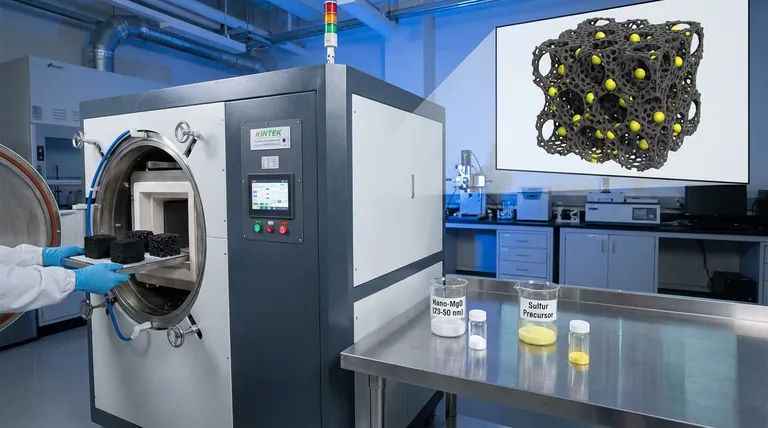
The primary purpose of using nano-magnesium oxide (nano-MgO) in the preparation of sulfur-doped porous carbon (ACS) is to act as a hard template agent. By integrating nano-MgO into the synthesis process, you induce the formation of a well-developed mesoporous structure, which significantly increases the specific surface area and provides essential reaction space for effective sulfur doping.
Core Takeaway Nano-MgO functions as a tunable architectural scaffold. By controlling the particle size of the oxide, you can precisely engineer the pore size distribution of the final carbon material, creating the optimal physical environment for chemical doping.
Engineering the Carbon Architecture
The Mechanism of Hard Templating
Nano-MgO serves as a physical placeholder during the carbonization process. It occupies specific volume within the precursor material as the carbon structure forms around it.
Once the synthesis is complete and the template is removed, it leaves behind a network of voids. This creates a mesoporous structure that mirrors the shape and distribution of the original MgO particles.
Precision Control of Pore Size
The structural properties of the final activated carbon are not arbitrary; they are directly determined by the template.
By adjusting the particle size of the nano-magnesium oxide—for instance, choosing between 20 nm or 50 nm particles—you can dictate the final pore size distribution.
This tunability allows you to strictly control the material's specific surface area, a critical factor in performance.
Facilitating Sulfur Doping
Expanding Reaction Space
The ultimate goal of creating this porous architecture is to enhance the material's chemical utility.
Sulfur doping requires physical space to occur effectively. The mesopores created by the nano-MgO template provide expanded reaction space.
This ensures that sulfur atoms can be integrated deeply and uniformly throughout the carbon matrix, rather than being limited to the exterior surface.
Understanding the Design Choices
Optimizing Particle Size
While nano-MgO allows for control, selecting the correct particle size involves balancing structural goals.
Using smaller particles (e.g., 20 nm) typically results in a denser network of smaller pores, driving up the total surface area.
Conversely, larger particles (e.g., 50 nm) create larger individual voids. Your choice must align with the specific spatial requirements of the sulfur doping process you are employing.
Making the Right Choice for Your Goal
To maximize the effectiveness of your sulfur-doped porous carbon, select your nano-MgO template based on your specific structural targets:
- If your primary focus is maximizing reaction sites: Utilize smaller nano-MgO particles (approx. 20 nm) to achieve the highest possible specific surface area.
- If your primary focus is distinct pore geometry: Select larger nano-MgO particles (approx. 50 nm) or a specific mix to tailor the pore size distribution to your exact specifications.
By treating nano-MgO as a precision tool rather than a generic additive, you can engineer carbon materials with superior doping efficiency.
Summary Table:
| Feature | Impact of Nano-MgO Template |
|---|---|
| Primary Role | Hard template agent/architectural scaffold |
| Structural Effect | Induces mesoporous formation & high surface area |
| Pore Control | Particle size (20-50nm) dictates final pore distribution |
| Chemical Benefit | Expands reaction space for uniform sulfur doping |
| Key Outcome | Precisely engineered carbon matrix for specific applications |
Elevate Your Material Research with KINTEK Precision
Unlock the full potential of your carbon synthesis with high-performance laboratory equipment. Backed by expert R&D and world-class manufacturing, KINTEK offers a comprehensive range of Muffle, Tube, Rotary, Vacuum, and CVD systems designed to provide the precise thermal environments required for advanced templating and doping processes.
Whether you are optimizing pore size with nano-MgO or scaling up sulfur-doped porous carbon production, our customizable high-temperature furnaces ensure the reliability and control your lab needs. Contact us today to discover how KINTEK can empower your next breakthrough in material science!
References
- Yaoping Guo, Rui Fang. Sulfur-doped activated carbon for the efficient degradation of tetracycline with persulfate: Insight into the effect of pore structure on catalytic performance. DOI: 10.1039/d3ra08958d
This article is also based on technical information from Kintek Furnace Knowledge Base .
Related Products
People Also Ask
- What are the advantages of using a condensing tube furnace for magnesium extraction? Achieve High Purity and Efficient Metal Recovery
- Why is the control of heating and cooling rates in a tube furnace critical for the thermal reduction of lithium niobate?
- How does a hydrogen reduction environment in an industrial tube furnace facilitate gold-copper alloy microspheres?
- Why are high-temperature laboratory furnaces necessary for Cu/In2O3 catalysts? Achieve Superior Catalyst Performance
- What other types of reactions can tube furnaces be used for? Explore Versatile Thermal Processes for Your Lab
