
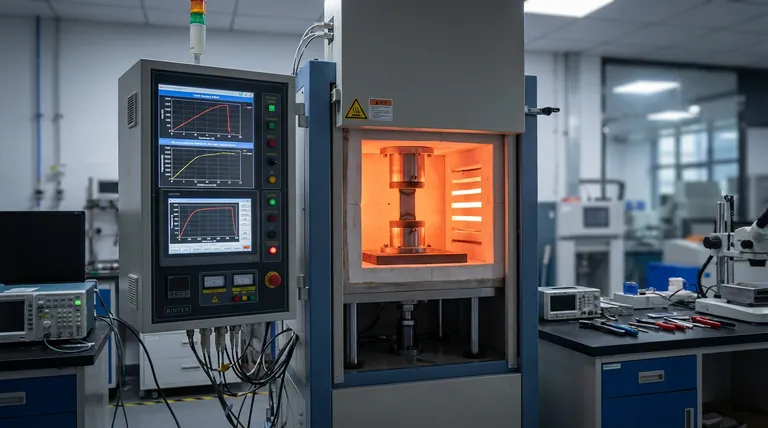
High-temperature thermal simulation systems function as the critical bridge between laboratory testing and industrial application. These systems utilize integrated high-precision heating and hydraulic loading to subject medium-manganese steel specimens to strictly controlled programmed environments. By monitoring load, displacement, and temperature in real-time, they accurately replicate the complex strain rates and thermal conditions encountered during actual manufacturing processes.
The primary value of these systems lies in their ability to generate raw stress-strain data. This data is the foundation for constructing constitutive models and thermal processing maps, which are essential for predicting how steel behaves during industrial thermal processing.
The Mechanics of Accurate Simulation
Integrated Control Systems
To understand medium-manganese steel, one cannot simply heat it or compress it in isolation. The simulation system integrates high-precision heating with hydraulic loading. This combination allows for the execution of complex, pre-programmed testing protocols that mimic real-world scenarios.
Real-Time Monitoring
Data collection is continuous and immediate. The system monitors critical variables—specifically load, displacement, and temperature—as the test progresses. This real-time feedback loop ensures that the conditions applied to the specimen remain within tight tolerances throughout the experiment.
Transforming Raw Data into Engineering Insight
Simulating Industrial Environments
The ultimate goal is to replicate the factory floor within a controlled setting. These systems simulate the specific strain rates and temperature fluctuations that steel undergoes during industrial thermal processing. This capability allows engineers to test processing strategies without the cost or risk of full-scale industrial trials.
Building Constitutive Models
The raw stress-strain data collected is not the end product; it is a raw material. Engineers use this data to construct constitutive models that mathematically describe the material's behavior under stress. These models are vital for predicting the structural integrity and deformability of the steel.
Creating Thermal Processing Maps
Beyond individual models, the data allows for the creation of thermal processing maps. These maps visualize the safe and unsafe processing zones for the material. They guide manufacturers on optimal temperature and strain combinations to avoid defects.
Understanding the Operational Dependencies
The Reliability of Input Parameters
While these systems are powerful, their output is only as reliable as the programmed parameters. If the simulated strain rates or heating curves do not accurately reflect the target industrial process, the resulting data will be misleading. Success requires a deep understanding of the actual manufacturing environment before programming the simulation.
Data Interpretation Challenges
The system provides raw data, but it does not interpret it. Constructing accurate constitutive models requires sophisticated analysis of the stress-strain curves. Misinterpreting the transition points in this data can lead to flawed processing maps.
Maximizing the Value of Thermal Simulation
To effectively utilize high-temperature thermal simulation for medium-manganese steel, align your testing protocols with your specific end goals.
- If your primary focus is material characterization: Prioritize the collection of high-resolution stress-strain data to build robust constitutive models that define the steel's fundamental mechanical behavior.
- If your primary focus is process optimization: Focus on generating comprehensive thermal processing maps to identify the ideal temperature and strain rate windows for industrial manufacturing.
By leveraging these systems to capture precise material responses, you transform theoretical material science into actionable industrial process control.
Summary Table:
| Key Feature | Functional Role | Strategic Benefit |
|---|---|---|
| Integrated Loading | Synchronizes high-precision heating with hydraulic compression | Mimics real-world industrial thermal processing environments |
| Real-time Monitoring | Tracks load, displacement, and temperature continuously | Ensures high-resolution, accurate stress-strain data collection |
| Data Modeling | Foundation for constitutive models and processing maps | Predicts material behavior and identifies optimal processing zones |
| Process Simulation | Replicates complex strain rates and thermal fluctuations | Reduces cost and risk by avoiding full-scale industrial trial failures |
Precision Thermal Simulation for Your Next Innovation
Bridge the gap between laboratory research and industrial success with KINTEK. As a leader in advanced thermal technology, we provide the precision equipment necessary to generate the high-resolution stress-strain data and constitutive models your projects demand.
Backed by expert R&D and manufacturing, KINTEK offers a comprehensive range of lab equipment including Muffle, Tube, Rotary, Vacuum, and CVD systems, as well as specialized high-temperature furnaces. All our systems are fully customizable to meet the unique testing requirements of medium-manganese steel and other advanced materials.
Ready to transform your material science into actionable industrial control?
Contact KINTEK Today to Discuss Your Custom Solution
References
- Guangshun Guo, Fucheng Zhang. Effects of C and Al Alloying on Constitutive Model Parameters and Hot Deformation Behavior of Medium-Mn Steels. DOI: 10.3390/ma17030732
This article is also based on technical information from Kintek Furnace Knowledge Base .
Related Products
- High Temperature Muffle Oven Furnace for Laboratory Debinding and Pre Sintering
- Molybdenum Vacuum Heat Treat Furnace
People Also Ask
- What thermal phenomena occur during polymer binder burnout in ceramic green bodies? Lab Furnace Guide
- What role does a high-temperature muffle furnace play in STFO synthesis? Achieve Pure Perovskite Results
- Why is controlled heat treatment in a muffle furnace necessary for calcined clay? Achieve Optimal Pozzolanic Activity
- How does a high-temperature muffle furnace facilitate the formation of LaNbxAl1−xO3+δ perovskite structures? Key Roles
- What role does a high-temperature muffle furnace play in the formation of biochar catalysts? Master Catalyst Synthesis

