
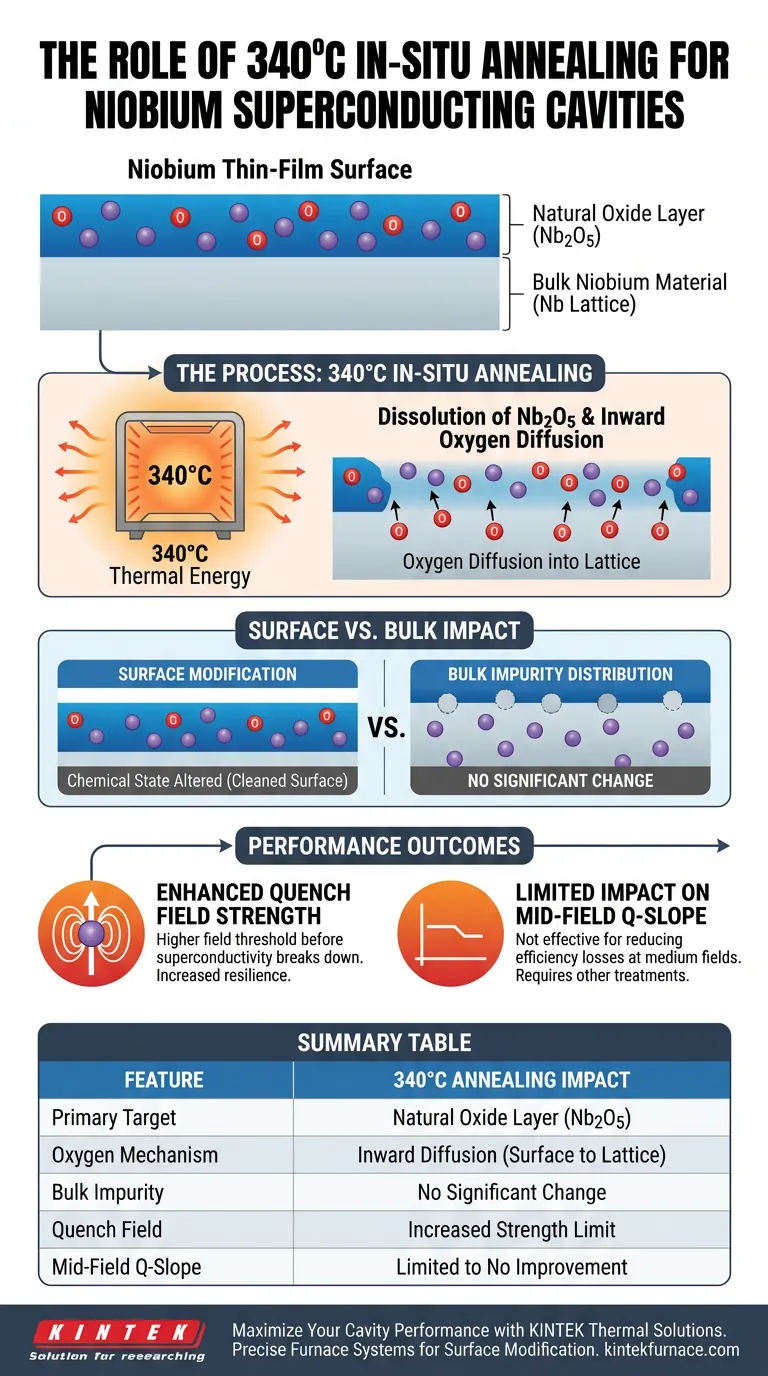
The primary purpose of 340°C in-situ annealing is to actively dissolve the natural oxide layer, specifically Nb2O5, residing on the surface of niobium thin films. This thermal treatment provides sufficient energy to facilitate the diffusion of oxygen atoms from the surface into the material's interior, fundamentally altering the surface chemical state.
By targeting surface oxides without altering the bulk impurity distribution, this specific annealing process serves as a method to increase the initial quench field strength of the cavity.
The Mechanism of Surface Modification
Dissolution of Nb2O5
The critical function of the 340°C set point is the breakdown of the natural oxide layer.
Niobium forms a stable oxide, Nb2O5, when exposed to air. This annealing process effectively "cleans" the surface by dissolving this specific compound.
Oxygen Diffusion Dynamics
Rather than removing the oxygen from the system entirely, the heat drives it inward.
The thermal energy allows oxygen atoms to migrate from the surface skin into the deeper lattice of the film. This redistribution changes the chemical composition of the surface layer.
Surface vs. Bulk Impact
It is vital to distinguish between surface treatment and bulk restructuring.
At 340°C, the thermal energy is insufficient to alter the bulk impurity distribution of the film. The changes are strictly confined to surface chemistry and near-surface diffusion.
Performance Outcomes
Enhancing Quench Field Strength
The direct benefit of dissolving the oxide layer is an improvement in the cavity's electromagnetic resilience.
The process contributes to an initial increase in the quench field strength. This allows the cavity to sustain higher accelerating fields before losing its superconducting state.
Understanding the Limitations
Limited Impact on Mid-Field Q-Slope
While effective for surface oxides, this technique is not a comprehensive solution for all performance metrics.
The primary reference indicates that 340°C annealing has a limited impact on reducing the mid-field Q-slope.
If your objective is to mitigate efficiency losses at medium field strengths, this specific thermal treatment may not yield significant results.
Making the Right Choice for Your Goal
When deciding whether to implement 340°C in-situ annealing, consider your specific performance targets:
- If your primary focus is increasing Quench Field Strength: Utilize this annealing temperature to dissolve surface oxides and improve the field threshold at which superconductivity breaks down.
- If your primary focus is reducing Mid-Field Q-Slope: Recognize that this method has limited efficacy for this specific metric and may need to be combined with or replaced by other treatments.
Understanding the distinction between surface oxide dissolution and bulk property modification is the key to predicting cavity performance.
Summary Table:
| Feature | 340°C In-Situ Annealing Impact |
|---|---|
| Primary Target | Natural oxide layer (Nb2O5) dissolution |
| Oxygen Mechanism | Inward diffusion from surface to lattice |
| Bulk Impurity | No significant change in distribution |
| Quench Field | Increased field strength limit |
| Mid-Field Q-Slope | Limited to no improvement |
Maximize Your Cavity Performance with KINTEK
Are you looking to optimize the electromagnetic resilience of your superconducting components? KINTEK provides industry-leading thermal solutions backed by expert R&D and manufacturing. Whether you need precise Muffle, Tube, or Vacuum furnace systems, our technology is customizable to meet the exacting 340°C requirements for niobium thin-film surface modification.
Don't let surface oxides limit your acceleration thresholds. Contact us today to discuss your unique lab high-temp furnace needs and see how our specialized equipment can enhance your material science outcomes!
Visual Guide
References
- Bektur Abdisatarov, Anna Grassellino. Optimizing superconducting Nb film cavities by mitigating medium-field <i>Q</i>-slope through annealing. DOI: 10.1088/1361-6668/ade635
This article is also based on technical information from Kintek Furnace Knowledge Base .
Related Products
- Controlled Inert Nitrogen Hydrogen Atmosphere Furnace
- High Temperature Muffle Oven Furnace for Laboratory Debinding and Pre Sintering
- Custom Made Versatile CVD Tube Furnace Chemical Vapor Deposition CVD Equipment Machine
- 1700℃ Controlled Inert Nitrogen Atmosphere Furnace
- 1400℃ Controlled Inert Nitrogen Atmosphere Furnace
People Also Ask
- How does hydrogen furnace annealing assist in preparing mechanically alloyed powders for compaction?
- How does atmospheric annealing in a controlled hydrogen furnace affect the cold compaction behavior of metal powders?
- What are the characteristics and uses of hydrogen atmosphere in furnaces? Achieve Superior Surface Purity and Bonding
- What are the characteristics and uses of hydrogen atmospheres in furnaces? Unlock Clean Metal Processing
- What controlled-atmosphere furnace conditions are required for sintering powder metallurgy copper alloy compacts? Ideal Setup

















