
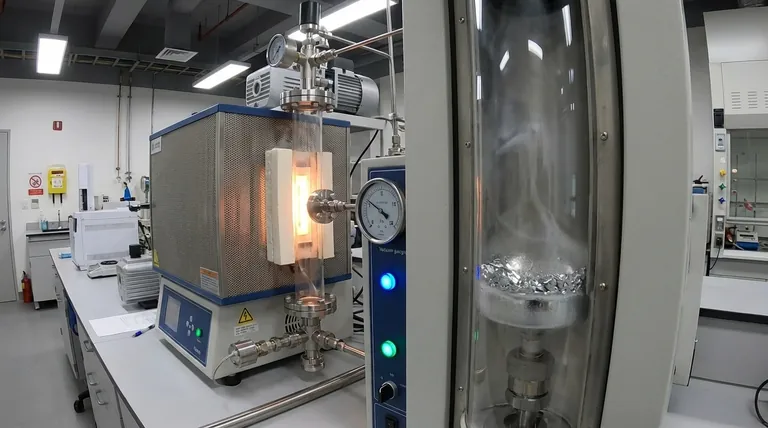
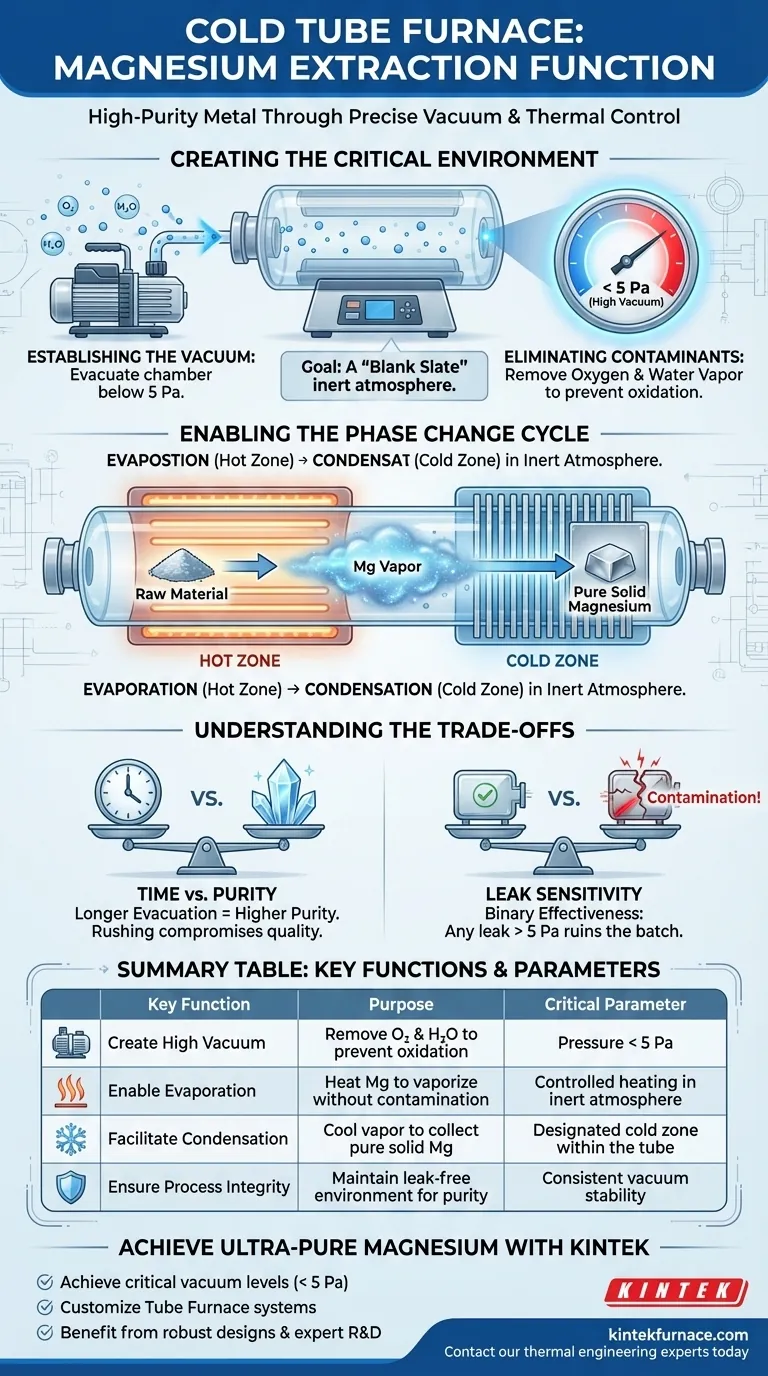
The function of a cold tube furnace for magnesium extraction is to facilitate the evaporation and subsequent condensation of magnesium within a strictly controlled, high-purity environment. Its operation hinges on an integrated vacuum pump system that evacuates the chamber to pressures below 5 Pa, ensuring the process occurs without the interference of atmospheric gases.
The device separates magnesium from raw materials by creating an ultra-clean vacuum loop. Its core value lies in preventing oxidation before it begins, ensuring the final magnesium product remains pure during the transition from solid to vapor and back to solid.
Creating the Critical Process Environment
To understand the furnace's function, one must look beyond the heating element and focus on the atmospheric control system. This is the mechanism that determines the success of the extraction.
Establishing the Vacuum
The initial phase of operation is the most critical. Before any heating occurs, the system utilizes a high-performance vacuum pump to evacuate the internal chamber.
The goal is to reach a vacuum level below 5 Pa. This is not merely about lowering pressure; it is about physically removing the medium in which chemical reactions typically occur.
Eliminating Contaminants
The primary adversaries in magnesium extraction are oxygen and water vapor. If these are present when the temperature rises, the magnesium will oxidize immediately rather than evaporate purely.
The furnace functions as a decontamination chamber. By removing residual air, it ensures the raw materials are processed in a "blank slate" environment, stripping away the potential for immediate chemical degradation.
Enabling the Phase Change Cycle
Once the environment is secured, the furnace facilitates an evaporation-condensation process.
Because the chamber is an inert atmosphere, magnesium can evaporate from the raw material without reacting with the air. It then travels to the "cold" zone of the tube, where it condenses back into a solid, purified metal.
Understanding the Trade-offs
While the cold tube furnace offers high purity, reliance on a vacuum system introduces specific operational constraints that must be managed.
Sensitivity to Leaks
The system's effectiveness is binary: it either holds the vacuum, or it fails. Even a microscopic leak that raises the pressure above 5 Pa introduces oxygen, which will contaminate the entire batch of magnesium.
Processing Time vs. Purity
Achieving a deep vacuum (below 5 Pa) requires time before the heating cycle can even begin.
Operators must trade production speed for quality. Rushing the evacuation phase to start heating sooner will leave residual water vapor in the chamber, compromising the integrity of the extraction.
Making the Right Choice for Your Goal
When utilizing a cold tube furnace, your operational parameters should be dictated by your specific requirements for the final material.
- If your primary focus is Maximum Purity: Prioritize the pre-heating evacuation phase, ensuring the vacuum stabilizes well below 5 Pa to eliminate all traces of water vapor.
- If your primary focus is Process Efficiency: Invest in high-capacity vacuum pumps that can reach the target pressure rapidly, reducing the downtime between the loading and heating phases.
A cold tube furnace is not just a heating device; it is a vacuum chamber that uses heat to isolate and purify metal at the molecular level.
Summary Table:
| Key Function | Purpose | Critical Parameter |
|---|---|---|
| Create High Vacuum | Remove oxygen & water vapor to prevent oxidation | Pressure < 5 Pa |
| Enable Evaporation | Heat magnesium to vaporize it without contamination | Controlled heating in inert atmosphere |
| Facilitate Condensation | Cool vapor to collect pure, solid magnesium | Designated cold zone within the tube |
| Ensure Process Integrity | Maintain a leak-free environment for batch purity | Consistent vacuum stability |
Need ultra-pure magnesium for your research or production?
The precise vacuum control and contamination-free environment of a cold tube furnace are essential for successful high-purity metal extraction. At KINTEK, we specialize in advanced thermal solutions for demanding applications.
Our expertise can help you:
- Achieve the critical vacuum levels (< 5 Pa) necessary for oxidation-free processing.
- Customize a Tube Furnace system tailored to your specific magnesium extraction parameters and throughput needs.
- Benefit from robust designs backed by expert R&D and manufacturing.
Let's discuss your project requirements. Contact our thermal engineering experts today to explore how a KINTEK solution can enhance your lab's capabilities and ensure the purity of your materials.
Visual Guide
Related Products
- Magnesium Extraction and Purification Condensing Tube Furnace
- 1200℃ Split Tube Furnace Laboratory Quartz Tube Furnace with Quartz Tube
- 1400℃ High Temperature Laboratory Tube Furnace with Alumina Tube
- 1700℃ High Temperature Laboratory Tube Furnace with Alumina Tube
- Vertical Laboratory Quartz Tube Furnace Tubular Furnace
People Also Ask
- What are the advantages of using a condensing tube furnace for magnesium extraction? Achieve High Purity and Efficient Metal Recovery
- What factors should be considered when selecting between a tube furnace and a box furnace? Optimize Your Lab's Thermal Processing
- What are the disadvantages of tube furnace cracking when processing heavy raw materials? Avoid Costly Downtime and Inefficiency
- What are the common applications of tube furnaces? Unlock Precision in Material Processing
- What role does a tube furnace play in evaluating modified birnessite catalysts? Optimize VOC Degradation Activity

















