
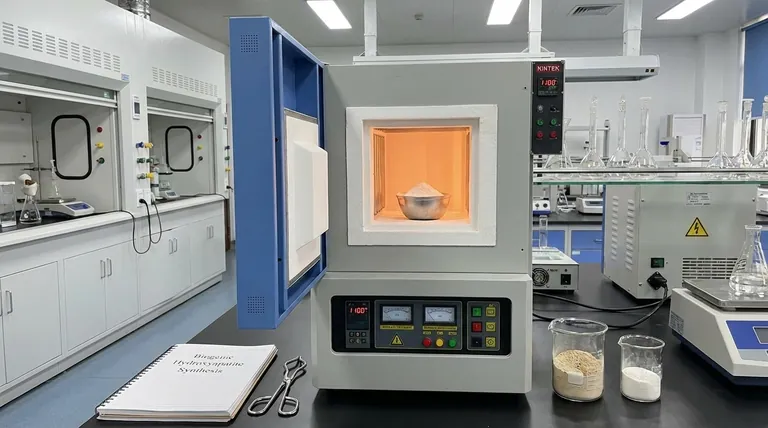
The primary function of a high-temperature box resistance furnace in synthesizing biogenic hydroxyapatite (HA) is to perform prolonged calcination. By maintaining temperatures between 1000 °C and 1100 °C for approximately 5 hours, the equipment facilitates the critical thermal treatment of bone and tooth powders. This process converts raw biological waste into a usable ceramic material.
In this context, the furnace acts as more than just a heat source; it is a purification and crystallization tool. It eliminates organic contaminants while simultaneously restructuring the mineral components to achieve the necessary Calcium/Phosphorus ratio and phase purity.
The Mechanism of Transformation
Elimination of Organic Contaminants
Biological raw materials, such as bone or tooth powders, naturally contain substances that are undesirable for final biomedical applications.
The high-temperature environment within the furnace chamber is essential for removing these impurities. It burns off organic matter, specifically fats and proteins, leaving behind only the inorganic mineral components.
Promotion of Recrystallization
Once the organics are removed, the heat drives a structural change known as recrystallization.
At temperatures around 1000 °C to 1100 °C, the mineral components of the raw material begin to reorganize. This process forms a specific crystal structure, resulting in a defined Calcium/Phosphorus (Ca/P) ratio that characterizes high-quality hydroxyapatite.
Determining Phase Purity
The ultimate quality of biogenic hydroxyapatite is measured by its crystallinity and phase purity.
The box resistance furnace is the critical equipment responsible for stabilizing these properties. By providing a consistent, high-thermal environment, it ensures the final product is chemically pure and structurally sound.
Understanding the Constraints and Requirements
While the primary reference highlights the success of calcination, it is important to understand the operational requirements that ensure these results.
The Importance of Heating Elements
The furnace relies on high-resistance alloy wires installed within the chamber to generate heat.
These elements must remain stable under high electrical loads to produce the required 1000 °C+ temperatures. If the elements degrade or fail to provide uniform resistance, the temperature inside the box may fluctuate, compromising the calcination process.
Thermal Control and Integrity
Although the primary goal for HA is calcination, principles from ceramic processing suggest that thermal control is vital.
In similar ceramic applications, heating rates must be controlled precisely to prevent micro-cracks caused by gases escaping too rapidly. While HA synthesis focuses on powder calcination, maintaining a stable thermal profile is essential to prevent incomplete combustion of organics or inconsistent crystallization.
Making the Right Choice for Your Goal
When configuring a high-temperature box resistance furnace for biogenic HA synthesis, focus on these parameters:
- If your primary focus is material purity: Ensure the furnace can sustain 1000–1100 °C for at least 5 hours to fully eliminate fats and proteins.
- If your primary focus is crystalline quality: Verify that the furnace provides excellent temperature uniformity to guarantee the correct Ca/P ratio and phase recrystallization.
By strictly controlling the temperature and duration of calcination, you transform biological raw materials into a pure, high-value ceramic ready for advanced application.
Summary Table:
| Process Step | Temperature & Duration | Key Function | Final Outcome |
|---|---|---|---|
| Organic Elimination | 1000°C - 1100°C | Burns off fats and proteins | High chemical purity |
| Recrystallization | Constant High Heat | Reorganizes mineral structure | Optimal Ca/P ratio |
| Phase Stabilization | ~5 Hours | Stabilizes mineral components | High-quality ceramic HA |
Elevate Your Material Synthesis with KINTEK Precision
Achieve uncompromising purity and crystalline excellence in your hydroxyapatite synthesis. Backed by expert R&D and world-class manufacturing, KINTEK offers a comprehensive range of Muffle, Tube, Rotary, Vacuum, and CVD systems, all fully customizable to meet your unique laboratory requirements.
Whether you need precise thermal profiles for calcination or robust performance for industrial ceramics, our high-temperature furnaces deliver the stability you demand.
Ready to optimize your thermal processing? Contact us today to discuss your custom solution!
References
- Sara Etminanrezaeiye, Reza Rafiee. Preparation and characterization of bio-waste derived chitosan/hydroxyapatite/pectin green biocomposite. DOI: 10.1038/s41598-025-07588-0
This article is also based on technical information from Kintek Furnace Knowledge Base .
Related Products
- 1700℃ High Temperature Laboratory Tube Furnace with Alumina Tube
- 1400℃ High Temperature Laboratory Tube Furnace with Alumina Tube
- Vertical Laboratory Quartz Tube Furnace Tubular Furnace
- 1700℃ Controlled Inert Nitrogen Atmosphere Furnace
- 1200℃ Split Tube Furnace Laboratory Quartz Tube Furnace with Quartz Tube
People Also Ask
- How does zone-melting in tube furnaces synthesize bismuth micro-wires? Master Single-Crystal Thermoelectric Growth
- How are high-temp tube furnaces used to measure diffusion coefficients per Fick's law? Master Precision Annealing
- How do high-temperature laboratory tube furnaces ensure environmental stability? Precision Thermal Reduction Tips
- How are high-temperature laboratory tube furnaces applied in long-term vacuum homogenization heat treatments for intermetallic samples?
- How are high-temperature tube furnaces applied in testing ceramic-supported alloy membranes? Insights



















