
In the synthesis of glass derived from rice husk ash, the muffle furnace serves as the primary vessel for high-temperature melting and refining. It generates a controlled environment capable of reaching temperatures up to 1500°C, transforming a mixture of silica-rich ash and fluxing agents into a homogeneous liquid state.
By utilizing multi-stage heating programs, the muffle furnace ensures not only the melting of raw materials but also the complete decomposition of chemical byproducts. Its precise thermal control is the deciding factor in producing a clear, defect-free glass matrix rather than a porous or impure solid.
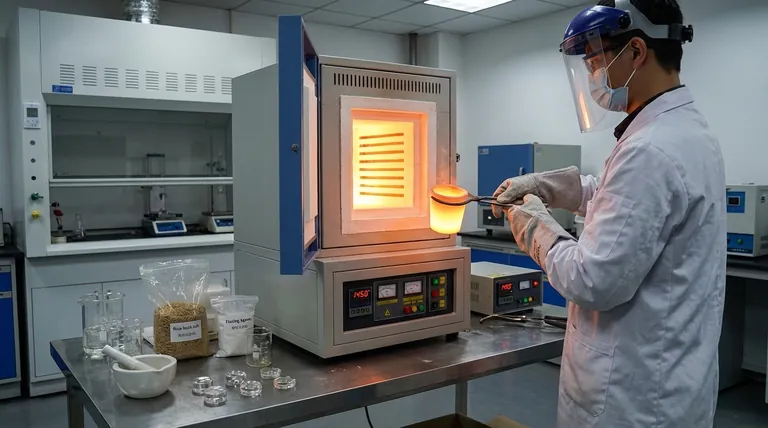
The Mechanism of Transformation
Reaching the Melting Point
Rice husk ash is primarily composed of silica ($SiO_2$), which has a very high melting point. To lower this point and create glass, the ash is mixed with fluxing agents like sodium carbonate, calcium carbonate, and borax.
The muffle furnace provides the intense, sustained heat required (often between 1200°C and 1500°C) to fuse these distinct powders. This transforms the solid mixture into a viscous liquid, initiating the vitrification process.
Decomposition and Degassing
During the heating phase, chemical reactions occur that release gases. Specifically, the decomposition of carbonates generates carbon dioxide.
If the glass solidifies before these gases escape, bubbles become trapped, ruining the clarity and strength of the material. The muffle furnace allows for a specific dwell time at peak temperature. This holding period ensures that the melt becomes fluid enough for bubbles to rise to the surface and escape, a process known as fining.
Preventing Contamination
A key feature of a muffle furnace is the isolation of the heating elements or fuel byproducts from the sample chamber.
In glass synthesis, purity is paramount. The muffle design ensures that the rice husk ash mixture is heated by radiation and convection without direct exposure to combustion contaminants. This is critical for maintaining the chemical integrity of the final glass product.
The Role of Thermal Precision
Multi-Stage Heating Programs
Glass synthesis is rarely a linear race to the top temperature. It requires a programmed thermal profile.
The furnace executes multi-stage heating to gradually increase the temperature. This prevents thermal shock to the crucible and ensures that lower-temperature reactions (such as the release of moisture) occur before higher-temperature melting begins.
Homogeneity of the Matrix
Uneven heating leads to "cords" or visible streaks in the glass, caused by materials having different indices of refraction.
The muffle furnace is designed to provide uniform heat distribution throughout the chamber. This uniformity ensures that the silica from the rice husk ash dissolves completely into the flux, creating a consistent, homogeneous structure throughout the batch.
Understanding the Trade-offs
Batch Processing Limitations
Most laboratory muffle furnaces operate as batch processors. This means you must heat, dwell, and cool a single batch before starting the next. This is excellent for research and small-scale synthesis but inefficient for high-volume mass production compared to continuous tank furnaces.
Thermal Lag and Cooling
While muffle furnaces are excellent at maintaining heat, their insulation can make rapid cooling difficult.
However, in glass making, rapid cooling (quenching) is sometimes desired to freeze the structure, while slow cooling (annealing) is needed to remove stress. You must understand the specific cooling curve capabilities of your furnace to prevent the glass from shattering due to thermal shock during the cool-down phase.
Making the Right Choice for Your Goal
To maximize the quality of glass synthesized from rice husk ash, align your furnace settings with your specific objectives:
- If your primary focus is optical clarity: Prioritize a longer dwell time at the peak temperature to allow complete degassing of carbon dioxide bubbles.
- If your primary focus is structural strength: focus on the cooling phase (annealing); program a slow, controlled temperature drop to relieve internal stresses.
- If your primary focus is compositional accuracy: Ensure your furnace provides a contamination-free environment to prevent external elements from altering the refractive index of the glass.
The muffle furnace converts raw potential into a stable solid through the precise management of heat, time, and atmosphere.
Summary Table:
| Stage | Function | Key Benefit |
|---|---|---|
| Melting | Reaches 1200°C–1500°C | Fuses silica and flux into a viscous liquid |
| Dwell Time | Holding at peak temperature | Enables degassing (fining) to remove bubbles |
| Isolation | Sealed muffle design | Prevents combustion contaminants from affecting purity |
| Programming | Multi-stage heating/cooling | Ensures homogeneity and stress-free annealing |
Elevate Your Material Research with KINTEK
Precision is the difference between a porous solid and a clear, high-quality glass matrix. At KINTEK, we understand that unique raw materials like rice husk ash require specific thermal profiles. Backed by expert R&D and manufacturing, we offer high-performance Muffle, Tube, Rotary, Vacuum, and CVD systems—all fully customizable to meet your laboratory's exacting high-temperature needs.
Ready to optimize your synthesis process? Contact us today to discuss your custom furnace solution.
Visual Guide

References
- I. M. Teixeira, J. W. Menezes. Transforming Rice Husk Ash into Road Safety: A Sustainable Approach to Glass Microsphere Production. DOI: 10.3390/ceramics8030093
This article is also based on technical information from Kintek Furnace Knowledge Base .
Related Products
- 1400℃ Muffle Oven Furnace for Laboratory
- 1700℃ High Temperature Muffle Oven Furnace for Laboratory
- 1800℃ High Temperature Muffle Oven Furnace for Laboratory
- 1200℃ Muffle Oven Furnace for Laboratory
- High Temperature Muffle Oven Furnace for Laboratory Debinding and Pre Sintering
People Also Ask
- How does a high-temperature laboratory muffle furnace affect material properties? Transform Anodic Oxide Films Fast
- What is the primary function of a high-temperature laboratory muffle furnace in chemical synthesis? Achieve Precision.
- What role does a laboratory high-temperature muffle furnace play in the treatment of highly contaminated waste glass?
- What are the primary objectives of using a muffle furnace in zirconia synthesis? Achieve precision phase control.
- What function does a muffle furnace perform in perovskite formation? Optimize Your Thermal Synthesis



















