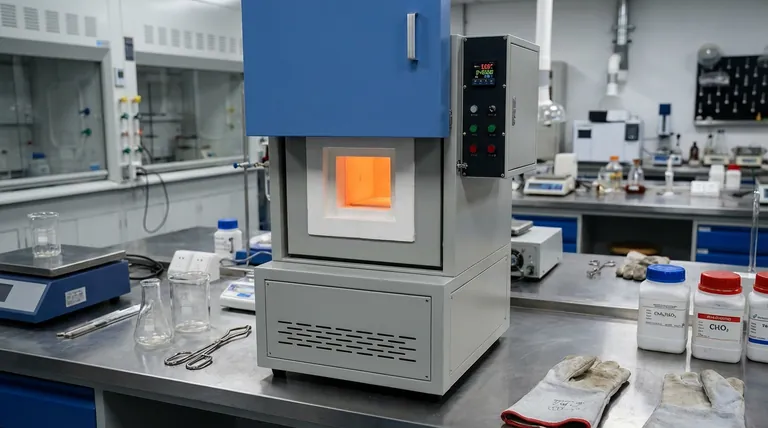
The high-temperature muffle furnace acts as the critical vessel for structural metamorphosis. It provides a stable, controlled thermal environment, specifically maintaining 500 °C for a duration of 4 hours, to facilitate the calcination of Mg-Zn-Al LDH clay. This process drives the dehydration and anion decomposition necessary to convert the precursor into a highly active Mixed Metal Oxide (MMO).
By strictly regulating temperature and time, the furnace transforms Layered Double Hydroxide (LDH) into Calcined Layered Double Hydroxide (CLDH). This structural shift is the key factor in significantly increasing the material's capacity to adsorb environmental pollutants.
The Mechanism of Thermal Transformation
Precise Temperature Regulation
The fundamental role of the muffle furnace is to establish a stable thermal field at 500 °C.
This specific temperature is the activation energy threshold required to alter the material without destroying it. It ensures that the heat energy is sufficient to trigger solid-state reactions within the Mg-Zn-Al structure.
Sustained Heat Exposure
The process typically requires a dwell time of 4 hours.
This duration allows for uniform heat penetration throughout the bulk of the clay. It ensures the reaction is not merely surficial but transforms the entire material matrix.
Dehydration and Decomposition
Inside the furnace, the thermal energy acts on the interlayer components of the LDH.
This induces dehydration, removing water molecules trapped between the layers. Simultaneously, it forces the decomposition of interlayer anions, effectively stripping the material of its original chemical stability to prepare it for a new phase.
From LDH to CLDH: The Phase Change
Creation of Mixed Metal Oxides (MMO)
The cumulative effect of this heating process is the conversion of LDH into Calcined Layered Double Hydroxide (CLDH).
In technical terms, the material transitions into a Mixed Metal Oxide (MMO) structure. This phase change implies a rearrangement of the crystal lattice, resulting in a material with different physical and chemical properties than the precursor.
Functional Enhancement
The ultimate purpose of using the furnace for this transformation is functional improvement.
The resulting CLDH structure exhibits a significantly increased adsorption capacity. This makes the processed material highly effective for environmental remediation tasks, such as capturing pollutants from water or air.
Operational Considerations and Trade-offs
The Role of Atmosphere
While temperature is the primary variable, the furnace atmosphere is a critical secondary factor.
As noted in broader material processing contexts, the atmosphere can either protect the material or induce specific modifications. Using an improper atmosphere could lead to unwanted surface reactions or oxidation, potentially compromising the purity of the MMO.
Balancing Reaction and Stability
The process relies on a "sweet spot" of thermal energy.
Insufficient heat will result in incomplete calcination, leaving behind unreacted LDH. Conversely, excessive heat or uncontrolled ramp rates can lead to sintering, which would reduce the surface area and negate the adsorption benefits gained from the transformation.
Making the Right Choice for Your Goal
To maximize the efficiency of your Mg-Zn-Al LDH transformation, consider these specific priorities:
- If your primary focus is Adsorption Capacity: Adhere strictly to the 500 °C and 4-hour parameters to ensure maximum conversion to the active CLDH/MMO phase.
- If your primary focus is Material Purity: carefully select the furnace atmosphere (inert vs. reactive) to prevent oxidation or contamination during the dehydration phase.
Precise control over the thermal environment is the defining factor in unlocking the full remediation potential of LDH materials.
Summary Table:
| Parameter | Specification | Transformation Role |
|---|---|---|
| Calcination Temp | 500 °C | Acts as activation energy threshold for solid-state reactions |
| Dwell Time | 4 Hours | Ensures uniform heat penetration and complete matrix transformation |
| Mechanism | Dehydration | Removes interlayer water molecules and decomposes anions |
| Resulting Phase | CLDH / MMO | Rearranges crystal lattice into highly active Mixed Metal Oxides |
| Goal | Adsorption | Maximizes capacity for environmental pollutant remediation |
Maximize Your Material Transformation with KINTEK
Precise thermal control is the difference between incomplete calcination and a high-performance Mixed Metal Oxide. KINTEK provides the advanced heating solutions required for sensitive material processing. Backed by expert R&D and manufacturing, we offer high-precision Muffle, Tube, Rotary, Vacuum, and CVD systems—all fully customizable to meet your specific temperature and atmospheric requirements.
Ready to enhance your lab's efficiency and material purity? Contact our specialists today to find the perfect furnace for your LDH research and industrial applications.
References
- Lehlogonolo Tabana, Shepherd M. Tichapondwa. Integrated study of antiretroviral drug adsorption onto calcined layered double hydroxide clay: experimental and computational analysis. DOI: 10.1007/s11356-024-33406-7
This article is also based on technical information from Kintek Furnace Knowledge Base .
Related Products
- 1700℃ High Temperature Muffle Oven Furnace for Laboratory
- 1800℃ High Temperature Muffle Oven Furnace for Laboratory
- 1200℃ Muffle Oven Furnace for Laboratory
- High Temperature Muffle Oven Furnace for Laboratory Debinding and Pre Sintering
- 1400℃ Muffle Oven Furnace for Laboratory
People Also Ask
- What is the primary function of a high-temperature laboratory muffle furnace in chemical synthesis? Achieve Precision.
- How does a high-temperature laboratory muffle furnace affect material properties? Transform Anodic Oxide Films Fast
- What role does a muffle furnace play in BCZY712 electrolyte powder production? Achieve Perfect Phase Purity
- What is the role of a high-temperature muffle furnace in guava leaf carbonization? Master Precise Pyrolysis Control
- How does the two-stage sintering process contribute to the synthesis of MeCuFeO3 perovskite? Optimize crystal purity.