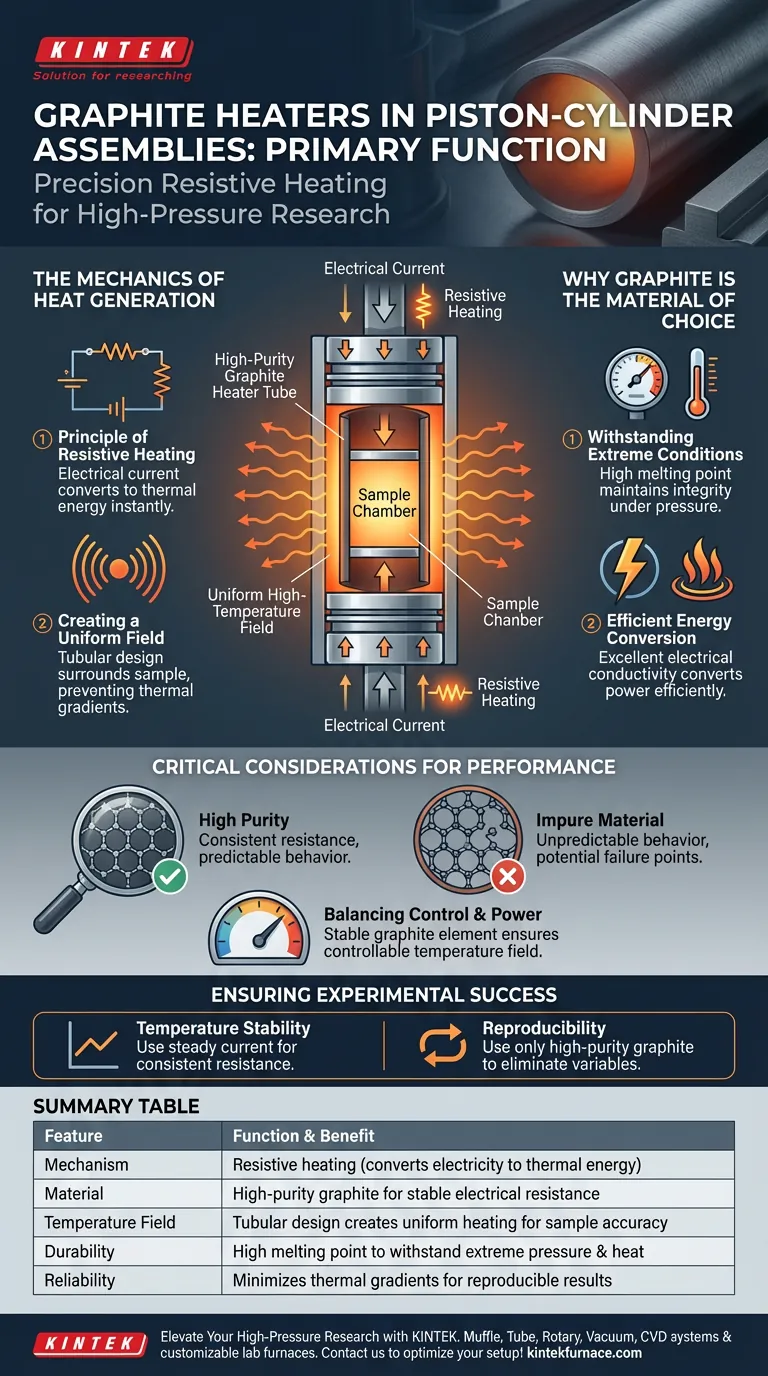
The primary function of a graphite heater within a piston-cylinder assembly is to act as a precision resistive heating element. When electrical current flows through a high-purity graphite tube, it converts electrical energy into heat, creating a stable and controllable high-temperature environment for the sample chamber.
Core Insight: Graphite is uniquely suited for this role because it combines excellent electrical conductivity with a high melting point. This allows it to generate uniform heat efficiently without structurally failing under the extreme pressures characteristic of piston-cylinder experiments.

The Mechanics of Heat Generation
The Principle of Resistive Heating
The assembly operates by passing an electrical current directly through the graphite tube. Because the graphite functions as a resistor, this flow of electricity is instantly converted into thermal energy.
Creating a Uniform Field
The physical design of the heater is critical for experimental accuracy. By utilizing a tubular shape, the graphite creates a uniform high-temperature field that surrounds the sample chamber. This ensures the sample is heated evenly from all sides, preventing thermal gradients that could skew results.
Why Graphite is the Material of Choice
Withstanding Extreme Conditions
In piston-cylinder apparatuses, components must survive crushing forces. Graphite possesses a high melting point, which allows it to maintain its structural integrity and function correctly even when subjecting the sample to extreme temperatures.
efficient Energy Conversion
To function as a heater, the material must be part of an electrical circuit. Graphite offers excellent electrical conductivity, making it an ideal medium for efficiently converting electrical input into the sustained heat required for high-pressure petrology or materials science experiments.
Critical Considerations for Performance
The Necessity of High Purity
It is not enough to simply use generic graphite; the reference explicitly highlights the need for high-purity graphite. Impurities in the material can alter its resistance properties, leading to unpredictable heating behavior or potential failure points under pressure.
Balancing Control and Power
The system is designed to provide a controllable temperature field. However, this relies on the stability of the graphite element. Any degradation in the tube's quality can compromise the precise control needed to maintain specific experimental conditions.
Ensuring Experimental Success
To maximize the effectiveness of your piston-cylinder assembly, match your operational protocols to the material properties of the heater.
- If your primary focus is Temperature Stability: Ensure your electrical source provides a steady current to leverage the consistent resistive properties of the graphite.
- If your primary focus is Reproducibility: Use only high-purity graphite tubes to eliminate variables caused by material impurities or inconsistent resistance.
By leveraging the robust thermal and electrical properties of graphite, you ensure a reliable and consistent foundation for your high-pressure research.
Summary Table:
| Feature | Function & Benefit |
|---|---|
| Mechanism | Resistive heating (converts electricity to thermal energy) |
| Material | High-purity graphite for stable electrical resistance |
| Temperature Field | Tubular design creates uniform heating for sample accuracy |
| Durability | High melting point to withstand extreme pressure and heat |
| Reliability | Minimizes thermal gradients for reproducible research results |
Elevate Your High-Pressure Research with KINTEK
Precision experiments demand uncompromising hardware. Backed by expert R&D and manufacturing, KINTEK offers high-performance Muffle, Tube, Rotary, Vacuum, and CVD systems, alongside customizable lab high-temp furnaces tailored to your unique specifications. Whether you are conducting petrology studies or advanced materials science, our high-purity graphite solutions ensure the stability and reproducibility your data depends on. Contact us today to optimize your laboratory setup!
Visual Guide
References
- Wanying Wang, Yuan Li. Redox control of the partitioning of platinum and palladium into magmatic sulfide liquids. DOI: 10.1038/s43247-024-01366-y
This article is also based on technical information from Kintek Furnace Knowledge Base .
Related Products
- 2200 ℃ Graphite Vacuum Heat Treat Furnace
- Silicon Carbide SiC Thermal Heating Elements for Electric Furnace
- Molybdenum Disilicide MoSi2 Thermal Heating Elements for Electric Furnace
People Also Ask
- Why are vacuum heat treating furnaces essential for aerospace? Ensure Superior Material Integrity for High-Stakes Applications
- What is the primary application of vacuum heat treating furnaces in aerospace? Enhance Component Performance with Precision
- What is the process of vacuum heat treating? Achieve Superior Metallurgical Properties
- How does vacuum heat treating work in terms of temperature and time control? Master Precise Material Transformations
- How does a vacuum heat treating furnace improve the condition of metal alloys? Achieve Superior Metal Performance