
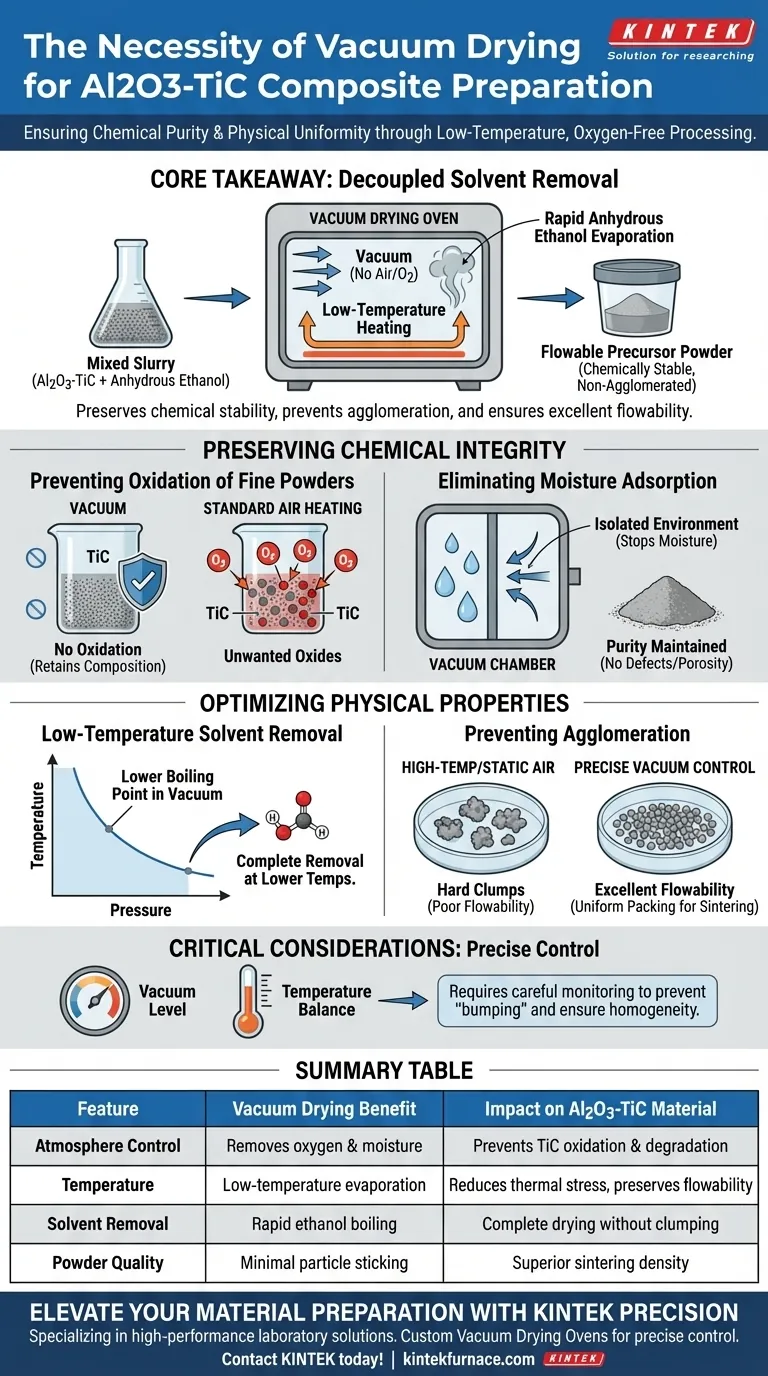
The use of a vacuum drying oven is a critical requirement in the preparation of Al2O3-TiC composite materials to ensure both chemical purity and physical uniformity. Its primary function is to completely remove anhydrous ethanol from the mixed slurry within a low-temperature environment, eliminating the risks associated with conventional heating methods.
Core Takeaway A vacuum drying oven decouples solvent removal from high heat, allowing anhydrous ethanol to evaporate rapidly without exposing the material to thermal stress or atmospheric oxygen. This preserves the chemical stability of the fine powders and prevents agglomeration, ensuring the precursor material has excellent flowability for subsequent processing.
Preserving Chemical Integrity
Preventing Oxidation of Fine Powders
The most significant danger during the drying phase of Al2O3-TiC preparation is oxidation. Titanium Carbide (TiC) and fine metallic powders are highly susceptible to reacting with oxygen, especially when heated.
By operating in a vacuum, the oven removes air from the chamber. This eliminates the presence of oxygen during the heating process, ensuring that the fine powders retain their intended chemical composition rather than converting into unwanted oxides.
Eliminating Moisture Adsorption
Standard atmospheric drying can leave materials vulnerable to ambient humidity.
A vacuum drying oven creates an isolated environment that stops moisture from adsorbing onto the powder surfaces. This is vital for maintaining the purity of the precursor powder, as adsorbed moisture can lead to defects or porosity in the final composite material.
Optimizing Physical Properties
Low-Temperature Solvent Removal
The preparation process involves a mixed slurry containing anhydrous ethanol.
A vacuum environment significantly lowers the boiling point of solvents. This allows the ethanol to be removed completely at much lower temperatures than would be required at standard atmospheric pressure.
Preventing Agglomeration
Drying at high temperatures or in static air often causes nanoparticles to stick together, forming hard clumps.
Precise vacuum control ensures the powder dries thoroughly without hard agglomeration. The result is a precursor powder with excellent flowability, which is essential for uniform packing and density during the subsequent shaping and sintering stages.
Critical Considerations and Trade-offs
The Necessity of Precise Control
While vacuum drying offers superior protection, it requires precise vacuum control to be effective.
Fluctuations in pressure can lead to uneven drying rates or incomplete solvent removal. Unlike simple convection ovens, a vacuum drying system demands careful monitoring to ensure the balance between temperature and pressure is maintained exactly right to prevent "bumping" (violent boiling) of the solvent, which could disrupt the homogeneity of the mixture.
Making the Right Choice for Your Goal
To maximize the quality of your Al2O3-TiC composites, align your drying strategy with your specific processing needs:
- If your primary focus is Chemical Purity: Prioritize the vacuum level to ensure absolute exclusion of oxygen, preventing the surface degradation of sensitive TiC particles.
- If your primary focus is Powder Processability: Focus on the temperature-pressure balance to ensure a gentle evaporation rate, which yields a loose, flowable powder that is easy to mold.
By controlling the atmosphere and temperature simultaneously, you transform a volatile slurry into a stable, high-quality precursor ready for sintering.
Summary Table:
| Feature | Vacuum Drying Benefit | Impact on Al2O3-TiC Material |
|---|---|---|
| Atmosphere Control | Removes oxygen & moisture | Prevents TiC oxidation and chemical degradation |
| Temperature | Low-temperature evaporation | Reduces thermal stress and preserves powder flowability |
| Solvent Removal | Rapid anhydrous ethanol boiling | Ensures complete drying without "bumping" or clumping |
| Powder Quality | Minimal particle sticking | Prevents agglomeration for superior sintering density |
Elevate Your Material Preparation with KINTEK Precision
Don’t compromise the integrity of your Al2O3-TiC composites with suboptimal drying. At KINTEK, we specialize in high-performance laboratory solutions backed by expert R&D and manufacturing. Our customizable Vacuum Drying Ovens, along with our specialized Muffle, Tube, Rotary, and CVD systems, are engineered to provide the precise temperature and atmosphere control required for sensitive lab high-temp processes.
Ready to achieve superior chemical purity and powder flowability?
Contact KINTEK today to discuss your unique laboratory needs!
Visual Guide
References
- Zara Cherkezova‐Zheleva, Radu Robert Piticescu. Green and Sustainable Rare Earth Element Recycling and Reuse from End-of-Life Permanent Magnets. DOI: 10.3390/met14060658
This article is also based on technical information from Kintek Furnace Knowledge Base .
Related Products
- Vacuum Heat Treat Sintering and Brazing Furnace
- Vacuum Heat Treat Sintering Furnace Molybdenum Wire Vacuum Sintering Furnace
- Dental Porcelain Zirconia Sintering Ceramic Vacuum Press Furnace
- Vacuum Hot Press Furnace Machine for Lamination and Heating
- Vacuum Hot Press Furnace Machine Heated Vacuum Press
People Also Ask
- How does vacuum heat treating affect the grain structure of metal alloys? Achieve Precise Microstructure Control
- What are the benefits of using vacuum heat treating furnaces for metal alloys? Achieve Superior Metal Properties and Performance
- What is one of the most important uses of vacuum heat treating furnaces in aerospace? Achieve Superior Strength in Aircraft Alloys
- What is the temperature of a vacuum furnace brazing? Optimize Your Joint Strength and Cleanliness
- What are the steps involved in a typical vacuum brazing treatment? Master the Process for Strong, Clean Joints







