
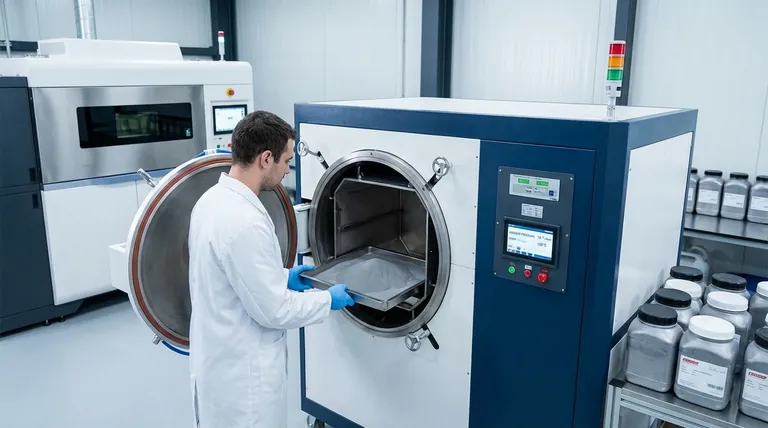
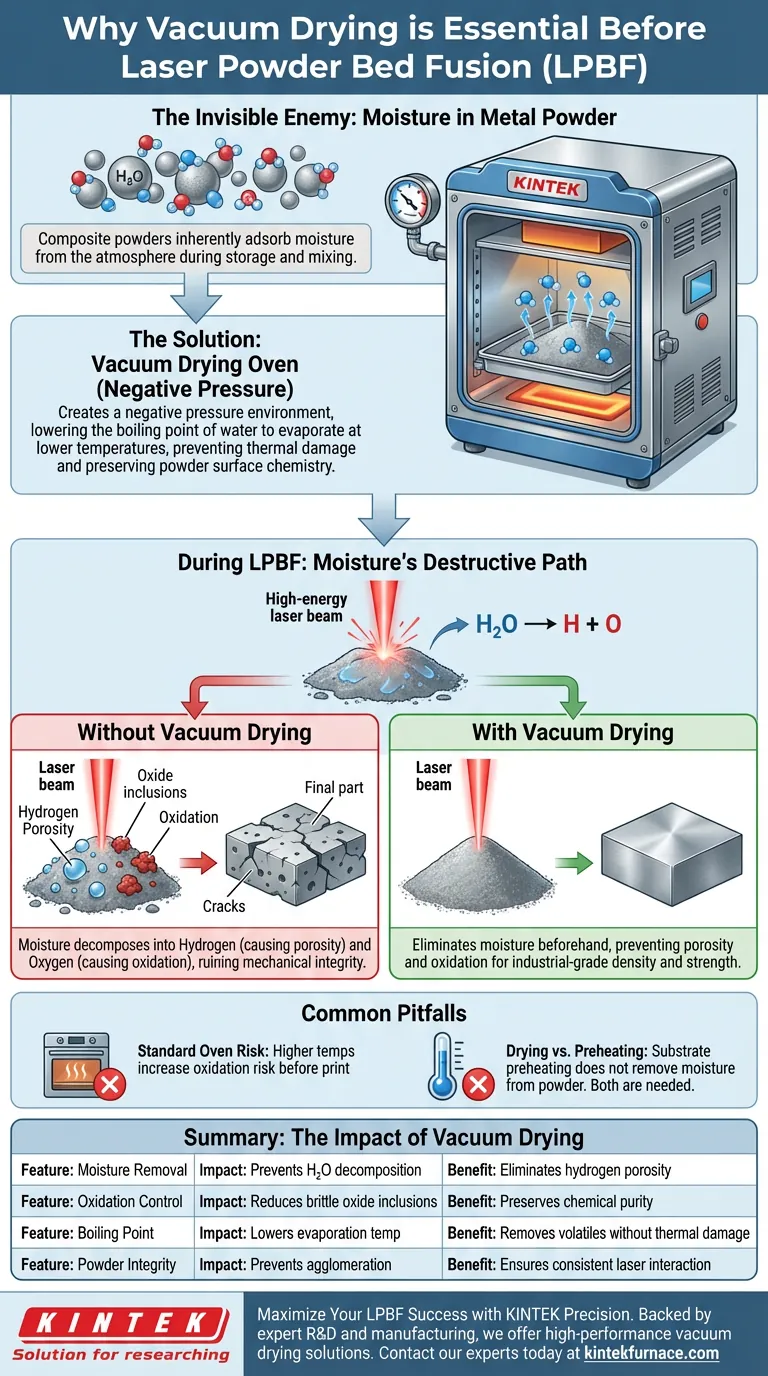
The necessity of using a vacuum drying oven before Laser Powder Bed Fusion (LPBF) lies in ensuring the chemical purity and structural density of the final part. Composite powders inherently adsorb trace amounts of moisture from the atmosphere during storage and mixing. By subjecting these powders to heat within a negative pressure environment, you remove this moisture effectively, preventing critical defects during the melting process.
Core Takeaway: Moisture is the invisible enemy of metal additive manufacturing. Vacuum drying eliminates water from powder surfaces before the laser strikes. This prevents the water from decomposing into oxygen and hydrogen during the melt, directly stopping the formation of porosity and oxidation that would otherwise ruin the mechanical integrity of the printed part.
The Physics of Moisture Removal
Eliminating Adsorbed Water
Metal and composite powders act like sponges on a microscopic level. During storage or mixing, they naturally adsorb moisture from the surrounding air. This water adheres to the surface of the powder particles and is difficult to remove through standard air drying alone.
The Vacuum Mechanism
A vacuum oven creates a negative pressure environment. This lowers the boiling point of water and other volatiles, allowing them to evaporate at significantly lower temperatures.
Preventing Thermal Damage
Because moisture can be removed at lower temperatures under vacuum, the powder is not exposed to excessive heat before printing. This preserves the surface chemistry of the powder, preventing premature oxidation or agglomeration that might occur if you attempted to "bake" the moisture out in a standard high-temperature oven.
Why Moisture Ruins LPBF Prints
The Decomposition Reaction
When the high-energy laser interacts with wet powder, the adsorbed water does not simply evaporate; it instantly decomposes. The intense heat splits the water molecules ($H_2O$) into their constituent elements: Hydrogen and Oxygen.
The Formation of Hydrogen Pores
The liberated hydrogen gas creates gas pockets within the molten pool. As the metal rapidly solidifies, this gas gets trapped, leading to hydrogen porosity. These microscopic voids significantly reduce the density of the part and act as crack initiation sites, weakening the component.
Oxidation and Structural Integrity
The oxygen released during decomposition reacts with the metal to form oxides. These oxide inclusions disrupt the material structure and reduce the inter-layer bonding strength. By removing the water beforehand, you ensure the laser interacts only with the intended alloy, preserving the structural integrity of the print.
Common Pitfalls and Considerations
Drying vs. Preheating
It is crucial to distinguish between vacuum drying the powder and preheating the substrate. While substrate preheating (e.g., to 200°C) reduces residual stress and thermal cracking, it does not solve the chemical issue of moisture in the powder. You must perform both steps to ensure a defect-free build.
The Risk of Standard Ovens
Using a standard air oven instead of a vacuum oven can be detrimental. Without the negative pressure, you must use higher temperatures to drive off moisture, which increases the risk of oxidizing the powder surface before the print even begins.
Making the Right Choice for Your Goal
If your primary focus is Structural Durability:
- Vacuum drying is mandatory to eliminate hydrogen porosity and ensure the part achieves near-100% density.
If your primary focus is Material Purity:
- Use vacuum drying to prevent oxide formation during the melt, ensuring the chemical composition of the alloy remains unaltered.
If your primary focus is Process Stability:
- Vacuum drying ensures consistent powder flow and laser interaction, reducing the variables that lead to failed prints.
Vacuum drying is not an optional step for high-performance parts; it is the baseline requirement for achieving industrial-grade density and strength.
Summary Table:
| Feature | Impact on LPBF Process | Benefit of Vacuum Drying |
|---|---|---|
| Moisture Removal | Prevents $H_2O$ decomposition into H and O | Eliminates hydrogen porosity and gas voids |
| Oxidation Control | Reduces formation of brittle oxide inclusions | Preserves chemical purity and interlayer bonding |
| Boiling Point | Lowers evaporation temp under negative pressure | Removes volatiles without thermal damage to powder |
| Powder Integrity | Prevents agglomeration and flow issues | Ensures consistent laser interaction and layer spread |
Maximize Your LPBF Success with KINTEK Precision
Don't let invisible moisture compromise the integrity of your additive manufacturing. Backed by expert R&D and manufacturing, KINTEK offers high-performance vacuum drying solutions, muffle furnaces, and CVD systems tailored for the rigorous demands of metal 3D printing. Whether you need to ensure structural durability or material purity, our customizable lab equipment provides the reliability your research demands.
Ready to eliminate porosity and oxidation in your prints? Contact our experts today to find the perfect vacuum drying system for your workflow.
Visual Guide
References
- Zhiheng Shu, Yunzhong Liu. Microstructure and Mechanical Properties of a Novel Al-Mg-Sc-Ti Alloy Fabricated by Laser Powder Bed Fusion. DOI: 10.3390/ma17030686
This article is also based on technical information from Kintek Furnace Knowledge Base .
Related Products
- Vacuum Heat Treat Sintering and Brazing Furnace
- Vacuum Heat Treat Sintering Furnace Molybdenum Wire Vacuum Sintering Furnace
- Dental Porcelain Zirconia Sintering Ceramic Vacuum Press Furnace
- Molybdenum Vacuum Heat Treat Furnace
- Vacuum Hot Press Furnace Machine Heated Vacuum Press
People Also Ask
- How does vacuum heat treating affect the grain structure of metal alloys? Achieve Precise Microstructure Control
- What are the benefits of using vacuum heat treating furnaces for metal alloys? Achieve Superior Metal Properties and Performance
- What is one of the most important uses of vacuum heat treating furnaces in aerospace? Achieve Superior Strength in Aircraft Alloys
- What is the temperature of a vacuum furnace brazing? Optimize Your Joint Strength and Cleanliness
- What are the steps involved in a typical vacuum brazing treatment? Master the Process for Strong, Clean Joints












