
The primary necessity of introducing an inert atmosphere like argon into a tube furnace is to create a controlled, oxygen-deficient environment during the annealing process. By excluding atmospheric oxygen, you force the titania nanotubes to undergo a reductive change, leading to the deliberate formation of structural imperfections known as oxygen vacancies.
Core Takeaway Introducing argon prevents the oxidation that would naturally occur in air, instead fostering a reductive environment that generates oxygen vacancy defects. These specific defects are the key to unlocking higher electronic conductivity and minimizing charge recombination, directly resulting in superior photoelectrochemical hydrogen production.
The Mechanism of Defect Engineering
Creating a Reductive Environment
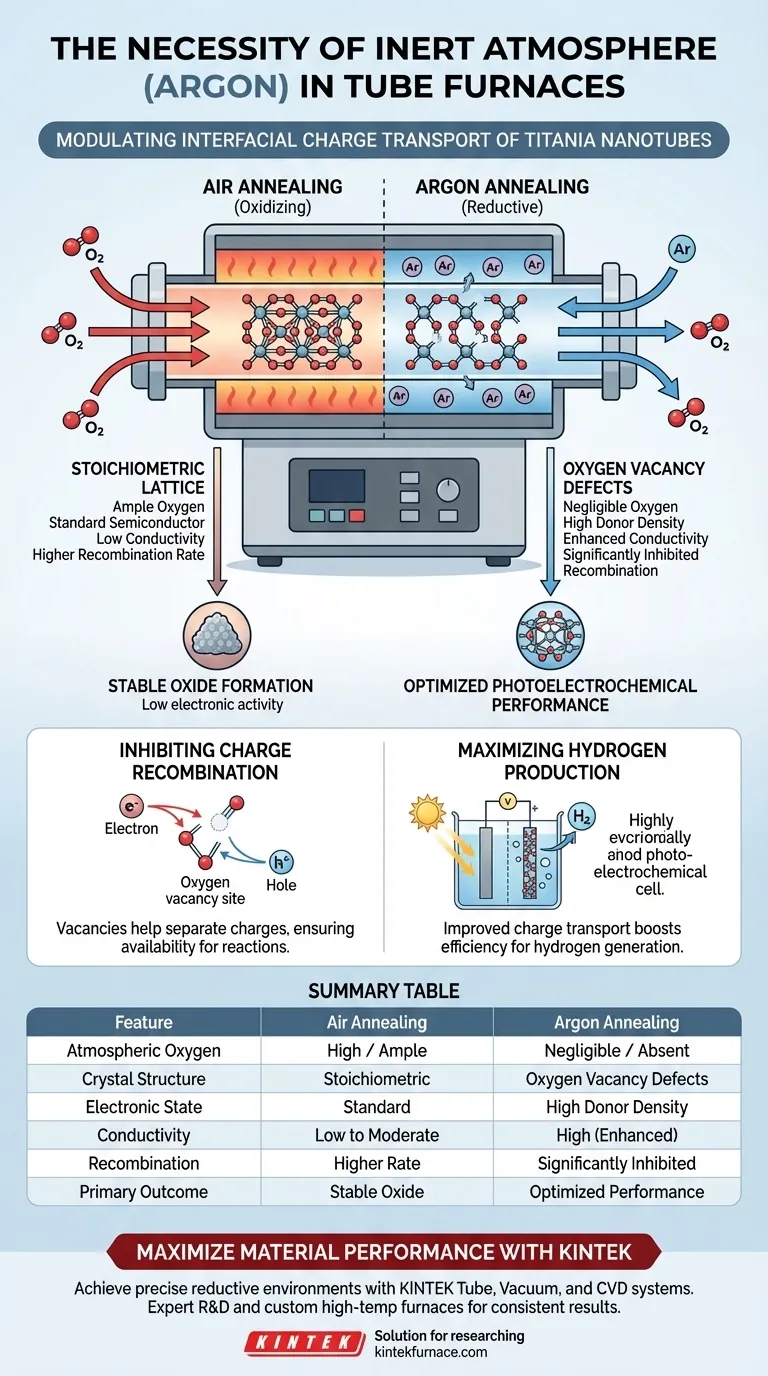
Standard annealing in air supplies ample oxygen to the material, creating a stoichiometric (perfectly balanced) crystal lattice.
To modulate charge transport, you must disrupt this balance. Introducing argon creates a reductive atmosphere, starving the environment of oxygen while the material is heated.
Generating Oxygen Vacancies
Under these inert conditions, oxygen atoms act to leave the titania crystal lattice.
This removal creates oxygen vacancy defects. These are not errors, but calculated structural modifications required to alter the electronic behavior of the nanotubes.
Modulating Electronic Properties
Increasing Donor Density
The introduction of oxygen vacancies fundamentally changes the electronic structure of the titania.
These vacancies act as electron donors. Consequently, the donor density of the material increases significantly compared to samples annealed in oxygen-rich environments.
Enhancing Electronic Conductivity
A direct result of increased donor density is improved conductivity.
The oxygen vacancies facilitate the movement of electrons through the material. This boosts the overall electronic conductivity, making the nanotubes more efficient at transporting charge carriers.
Improving Photoelectrochemical Performance
Inhibiting Charge Recombination
One of the greatest challenges in photoelectrochemical systems is the tendency for photogenerated electrons and holes to recombine before they can do useful work.
The oxygen vacancies generated by the argon atmosphere effectively inhibit this recombination. They help separate the charges, ensuring they remain available for chemical reactions.
Maximizing Hydrogen Production
The ultimate output of these modifications is a tangible increase in reaction efficiency.
Because charge transport is improved and recombination is suppressed, the system achieves a substantial increase in photoelectrochemical hydrogen production efficiency.
Understanding the Operational Trade-offs
The Cost of Atmospheric Control
The necessity of an inert atmosphere implies a trade-off between process complexity and material performance.
You cannot achieve these high-conductivity states in an open-air furnace. If oxygen is present, it will "heal" the vacancies, returning the material to a less conductive, stoichiometric state. Therefore, strict environmental control is the unavoidable cost of high-performance charge transport.
Making the Right Choice for Your Goal
To determine if an argon atmosphere is required for your specific application, consider your performance metrics:
- If your primary focus is maximizing conductivity: You must use an inert atmosphere to generate the oxygen vacancies that increase donor density.
- If your primary focus is efficient hydrogen production: You need the reductive environment to inhibit electron-hole recombination, which is the primary loss mechanism in these systems.
By controlling the atmosphere, you transition titania from a simple semiconductor into a highly efficient charge-transport material.
Summary Table:
| Feature | Air Annealing (Oxidizing) | Argon Annealing (Reductive) |
|---|---|---|
| Atmospheric Oxygen | High / Ample | Negligible / Absent |
| Crystal Structure | Stoichiometric (Perfect) | Oxygen Vacancy Defects |
| Electronic State | Standard Semiconductor | High Donor Density |
| Conductivity | Low to Moderate | High (Enhanced) |
| Recombination | Higher Rate | Significantly Inhibited |
| Primary Outcome | Stable Oxide Formation | Optimized Photoelectrochemical Performance |
Maximize Your Material Performance with KINTEK
Achieving the precise reductive environment for titania nanotube modulation requires uncompromising atmospheric control. KINTEK provides industry-leading Tube, Vacuum, and CVD systems designed to maintain high-purity inert environments, ensuring consistent oxygen vacancy generation for your research.
Backed by expert R&D and precision manufacturing, our lab high-temp furnaces are fully customizable to meet your unique experimental parameters. Don't let atmospheric interference compromise your results—partner with KINTEK to unlock superior electronic conductivity and hydrogen production efficiency.
Ready to elevate your thermal processing? Contact our experts today to find the perfect customized furnace solution for your laboratory.
Visual Guide
References
- Younggon Son, Kiyoung Lee. Interfacial Charge Transfer Modulation via Phase Junctions and Defect Control in Spaced TiO <sub>2</sub> Nanotubes for Enhanced Photoelectrochemical Water Splitting. DOI: 10.1002/solr.202500334
This article is also based on technical information from Kintek Furnace Knowledge Base .
Related Products
- 1200℃ Controlled Inert Nitrogen Atmosphere Furnace
- 1700℃ Controlled Inert Nitrogen Atmosphere Furnace
- 1400℃ Controlled Inert Nitrogen Atmosphere Furnace
- Mesh Belt Controlled Atmosphere Furnace Inert Nitrogen Atmosphere Furnace
- Controlled Inert Nitrogen Hydrogen Atmosphere Furnace
People Also Ask
- What controlled-atmosphere furnace conditions are required for sintering powder metallurgy copper alloy compacts? Ideal Setup
- What are the operational advantages of using a controlled atmosphere furnace? Boost Quality and Efficiency in Heat Treatment
- What are the operational considerations for a controlled atmosphere furnace? Master Key Factors for Material Processing
- How does a vacuum or controlled atmosphere furnace facilitate sessile-drop experiments? Optimize Alloy Wetting Analysis
- How does a controlled atmosphere furnace prevent oxidation and decarburization? Master Precision Heat Treatment



















