
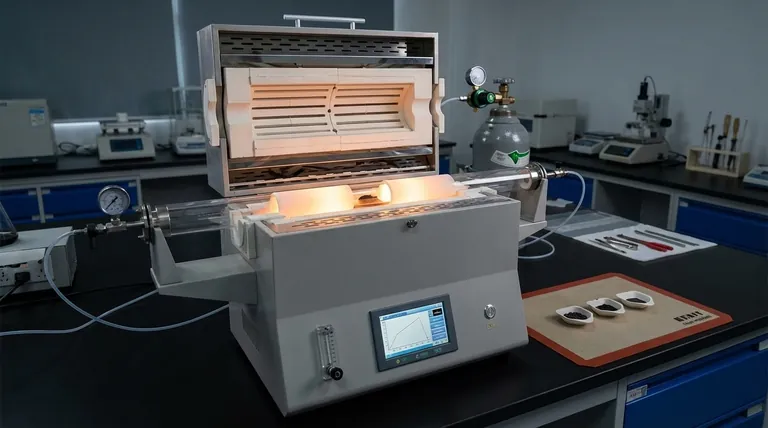
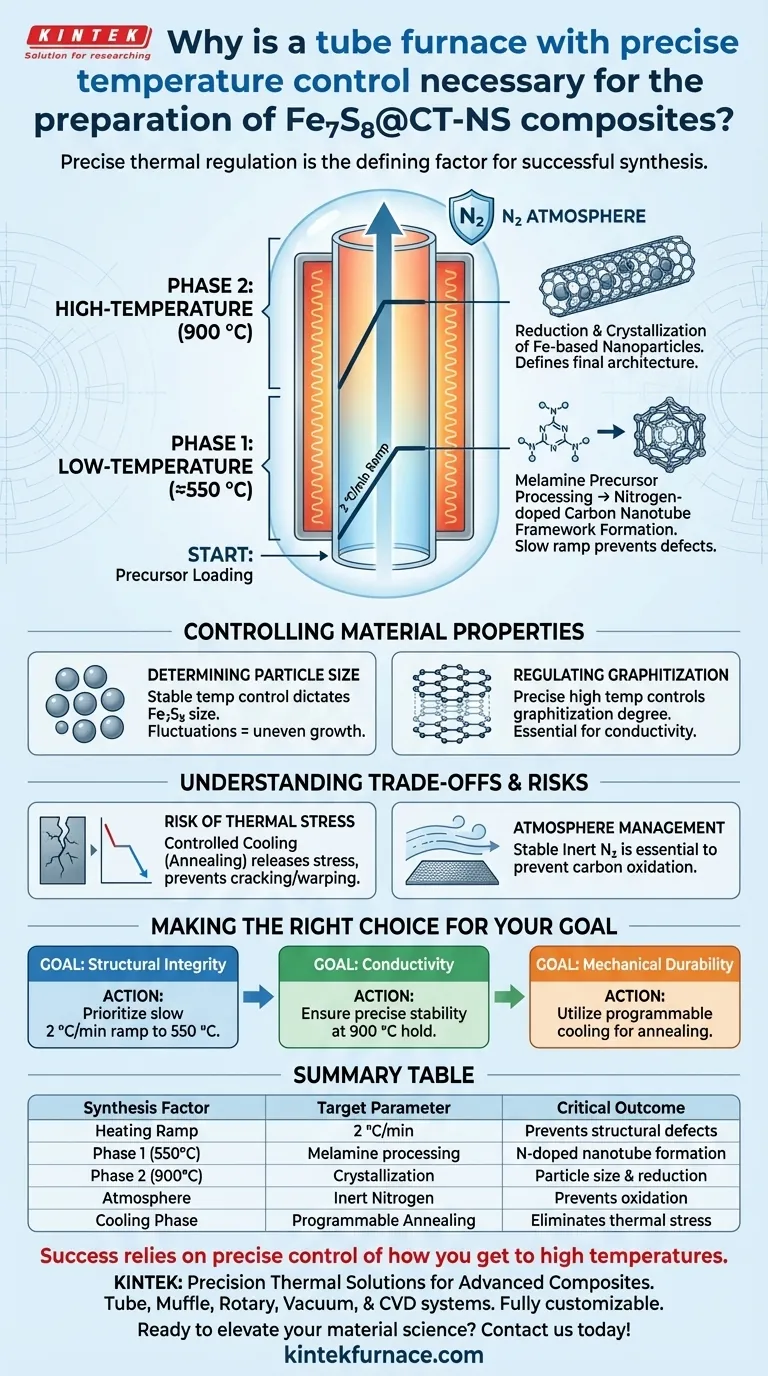
Precise thermal regulation is the defining factor in the successful synthesis of Fe7S8@CT-NS composites. A tube furnace is strictly necessary to execute a specific programmable heating ramp—typically 2 °C/min—which facilitates a complex, multi-stage chemical transformation under a protective nitrogen atmosphere.
The tube furnace acts as a programmable reactor that separates distinct chemical phases. It ensures the carbon framework is built at lower temperatures before the iron-based core crystallizes at higher temperatures, defining the material's final architecture.
Managing the Dual-Stage Synthesis
The Low-Temperature Phase (550 °C)
The preparation of this composite is not a single-step reaction. You must first reach an intermediate temperature of roughly 550 °C to process the melamine precursor.
At this specific stage, the precise heating rate ensures the melamine is directionally converted into a nitrogen-doped carbon nanotube framework. If the temperature ramps too quickly, this structural framework may fail to form correctly.
The High-Temperature Phase (900 °C)
Once the framework is established, the furnace must ramp up to 900 °C. This higher tier is required for the reduction and crystallization of the iron-based nanoparticles.
The tube furnace allows these two distinct processes—framework formation and metal crystallization—to occur sequentially in the same reactor without manual intervention.
Controlling Material Properties
Determining Particle Size
The ultimate size of the Fe7S8 nanoparticles is dictated by the stability of the temperature control.
Fluctuations in heat or ramp rates can lead to uneven particle growth, which compromises the composite's consistency.
Regulating Graphitization
The degree to which the carbon matrix becomes graphitized is directly controlled by the precision of the furnace at high temperatures.
Proper graphitization is essential for the electrical conductivity and mechanical stability of the final composite material.
Understanding the Trade-offs
The Risk of Thermal Stress
While the primary focus is often on heating, controlled cooling is equally critical.
Rapid temperature drops can create residual thermal stresses due to differences in thermal expansion coefficients between material layers. Programmable cooling (annealing) helps release this stress, preventing the finished product from cracking or warping.
Atmosphere Management
A standard oven cannot provide the necessary environment for this synthesis.
The tube furnace is essential for maintaining a stable inert atmosphere (Nitrogen) throughout the entire 2 °C/min ramp. Without this protection, the carbon components would oxidize and degrade rather than form a nanotube framework.
Making the Right Choice for Your Goal
To optimize your synthesis of Fe7S8@CT-NS, adjust your furnace parameters based on your specific performance targets:
- If your primary focus is Structural Integrity: Prioritize a slow, steady ramp rate (2 °C/min) through the 550 °C phase to ensure the carbon nanotube framework forms without defects.
- If your primary focus is Conductivity: Ensure precise temperature stability at the 900 °C hold time to maximize the degree of graphitization in the carbon matrix.
- If your primary focus is Mechanical Durability: utilize programmable cooling to anneal the material and relieve internal thermal stresses before reaching room temperature.
Success in this synthesis relies not just on reaching high temperatures, but on the precise control of how you get there.
Summary Table:
| Synthesis Factor | Target Parameter | Critical Outcome |
|---|---|---|
| Heating Ramp | 2 °C/min | Prevents structural defects in carbon framework |
| Phase 1 (550°C) | Melamine processing | Formation of Nitrogen-doped carbon nanotubes |
| Phase 2 (900°C) | Crystallization | Particle size control & reduction of Fe7S8 |
| Atmosphere | Inert Nitrogen | Prevents oxidation of the carbon matrix |
| Cooling Phase | Programmable Annealing | Eliminates thermal stress and prevents cracking |
Precision Thermal Solutions for Advanced Composites
Unlock the full potential of your Fe7S8@CT-NS synthesis with KINTEK’s high-precision thermal equipment. Backed by expert R&D and world-class manufacturing, we provide high-performance Tube, Muffle, Rotary, Vacuum, and CVD systems tailored for researchers who demand perfection.
Whether you need strictly controlled 2 °C/min ramps or stable inert environments, our furnaces are fully customizable to meet your unique laboratory needs.
Ready to elevate your material science? Contact us today to find your custom furnace solution!
Visual Guide
References
- Xingyun Zhao, Tiehua Ma. Fe<sub>7</sub>S<sub>8</sub> Nanoparticles Embedded in Sulfur–Nitrogen Codoped Carbon Nanotubes: A High‐Performance Anode Material for Lithium‐Ion Batteries with Multilevel Confinement Structure. DOI: 10.1002/celc.202500066
This article is also based on technical information from Kintek Furnace Knowledge Base .
Related Products
- Vacuum Sealed Continuous Working Rotary Tube Furnace Rotating Tube Furnace
- 1400℃ High Temperature Laboratory Tube Furnace with Alumina Tube
- 1700℃ High Temperature Laboratory Tube Furnace with Alumina Tube
- Magnesium Extraction and Purification Condensing Tube Furnace
- High Pressure Laboratory Vacuum Tube Furnace
People Also Ask
- What is the purpose of rotary tube furnaces? Achieve Uniform Heat Treatment for Powders and Granules
- What are the key advantages of using a rotary tube furnace? Achieve Dynamic, Uniform Heating for Powders
- How does the amount of material processed vary between batch and continuous rotary tube furnaces? Scale Your Production Efficiently
- What are the advantages of rotary tube furnaces in fuel compatibility? Boost Efficiency and Cut Costs
- What is the temperature range of some rotary tube furnaces? Achieve Uniform Heating Up to 1200°C



















