
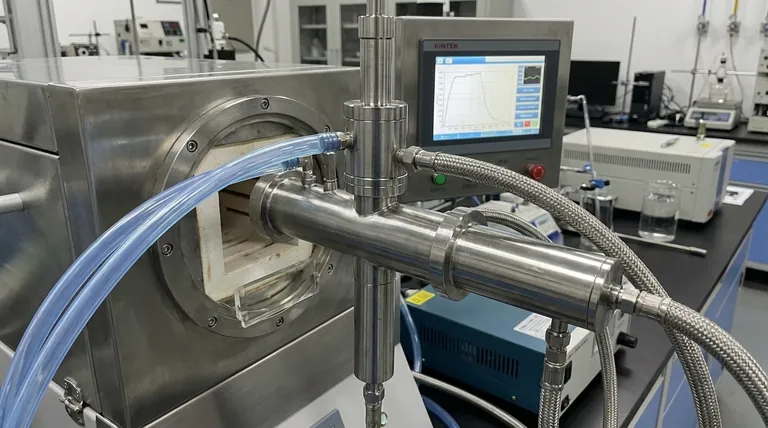
A water-cooled injector acts as the definitive "start line" for your experimental timeline. In Drop Tube Furnace (DTF) experiments, the accuracy of ignition delay data hinges entirely on knowing exactly when the particle was introduced to the heat. This device circulates water to shield the sample from the furnace’s heat until the precise moment of injection, preventing any chemical reactions from occurring before the test officially begins.
By maintaining particles at ambient temperature right up to the nozzle tip, the water-cooled injector eliminates the variable of thermal creep. This ensures that the ignition delay you measure is a property of the fuel, not an artifact of the injection hardware.
The Physics of Measurement Precision
Establishing a Precise Time Zero
To measure a delay, you must have an exact starting point. In combustion kinetics, this "Time Zero" ($t_0$) represents the moment a particle transitions from a stable state to a reactive environment.
A water-cooled injector establishes this boundary physically. It ensures the particle remains at its initial ambient temperature while traveling through the delivery tube. Without this thermal barrier, the "clock" would essentially start running before the particle ever leaves the nozzle.
Preventing Premature Pyrolysis
Solid particles are chemically sensitive to rising temperatures. If they heat up slowly while moving down the injector, they may undergo premature pyrolysis.
This means the fuel begins to degrade and release volatiles before entering the main combustion zone. A water-cooled system prevents this early chemical breakdown, ensuring the particle enters the reaction zone intact and chemically unaltered.
Achieving Instantaneous Exposure
Accurate modeling relies on the assumption of a "step change" in temperature. The data analysis assumes the particle goes instantly from room temperature to the high-temperature furnace atmosphere.
The water-cooled injector makes this theoretical assumption a reality. By preventing gradual heating inside the tube, it forces the particle to experience the high-temperature atmosphere instantaneously upon exit. This sharp thermal transition is critical for validating theoretical models against experimental data.
Common Pitfalls to Avoid
The Danger of Thermal Bleed
If the cooling system is insufficient or absent, heat from the furnace will conduct up the injector probe. This creates a temperature gradient inside the delivery tube.
Under these conditions, particles are "pre-baked" as they travel. This shortens the observed ignition delay artificially, leading to data that suggests the fuel is more reactive than it actually is.
Misinterpreting "Ignition Delay"
Without a water-cooled injector, you are measuring a mix of physical heating time inside the tube and chemical ignition delay outside the tube.
This conflation makes it impossible to isolate the chemical kinetics of the fuel. The water-cooled injector effectively removes the hardware's thermal influence from the equation, isolating the fuel's behavior.
Making the Right Choice for Your Goal
To ensure your Drop Tube Furnace data is publication-ready, consider your specific experimental needs:
- If your primary focus is kinetic modeling: You must use water cooling to guarantee that the boundary condition for temperature is a true step function.
- If your primary focus is comparative fuel analysis: You need the injector to ensure that differences in ignition times are caused by the fuel chemistry, not by variations in injector temperature.
Precision in measuring time begins with absolute control over temperature.
Summary Table:
| Feature | Impact on Accuracy | Benefit to Researcher |
|---|---|---|
| Precise Time Zero | Defines the exact start of ignition | Eliminates timing uncertainty in kinetics |
| Thermal Shielding | Prevents premature pyrolysis | Ensures fuel enters reaction zone intact |
| Instantaneous Heat Exposure | Creates a true thermal 'step change' | Validates theoretical combustion models |
| Water Circulation | Eliminates thermal bleed and pre-heating | Isolates fuel chemistry from hardware artifacts |
Elevate Your Combustion Research with Precision Engineering
Inaccurate ignition delay data can compromise months of research. KINTEK provides the high-performance thermal solutions you need to ensure every measurement is publication-ready. Backed by expert R&D and manufacturing, we offer high-precision Muffle, Tube, Rotary, Vacuum, and CVD systems, all customizable for your unique lab requirements.
Whether you are refining kinetic models or performing comparative fuel analysis, KINTEK’s advanced heating and cooling technologies provide the control necessary for reliable results.
Ready to optimize your Drop Tube Furnace experiments? Contact us today to discuss your custom furnace needs with our technical team!
Visual Guide

Related Products
- Slide PECVD Tube Furnace with Liquid Gasifier PECVD Machine
- Custom Made Versatile CVD Tube Furnace Chemical Vapor Deposition CVD Equipment Machine
- Inclined Rotary Plasma Enhanced Chemical Deposition PECVD Tube Furnace Machine
- Inclined Rotary Plasma Enhanced Chemical Deposition PECVD Tube Furnace Machine
- Vacuum Sealed Continuous Working Rotary Tube Furnace Rotating Tube Furnace
People Also Ask
- What are the main advantages of PECVD tube furnaces compared to CVD tube furnaces? Lower Temp, Faster Deposition, and More
- What is plasma in the context of PECVD? Unlock Low-Temperature Thin Film Deposition
- What are the typical conditions for plasma-enhanced CVD processes? Achieve Low-Temperature Thin Film Deposition
- What plasma source is used in PE-CVD tube furnaces? Unlock Low-Temperature, High-Quality Deposition
- What are the advantages of using a tube furnace CVD system for Cu(111)/graphene? Superior Scalability and Quality















