
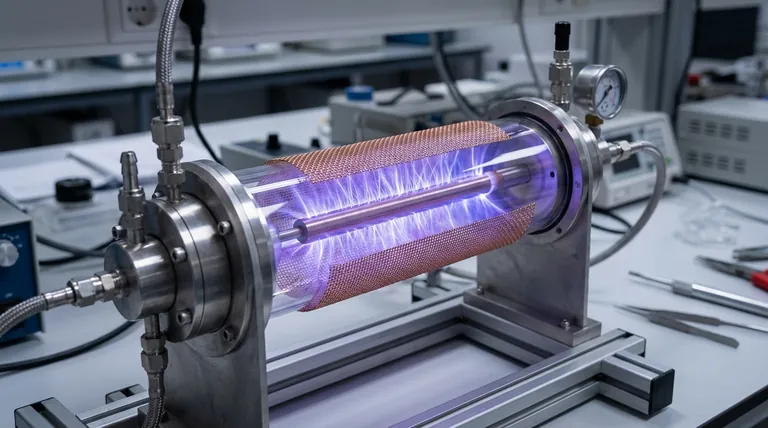
The quartz glass tube functions as the primary dielectric barrier within a coaxial Dielectric Barrier Discharge (DBD) reactor. It serves as an electrical insulator that physically separates the internal high-voltage electrode from the external grounded electrode, such as a copper mesh, while defining the volume where plasma is generated.
In a DBD system, the quartz tube is the defining component that prevents catastrophic electrical arcing; it forces the energy to dissipate as uniform micro-discharges, creating a stable non-thermal plasma environment suitable for complex chemical reactions.
The Role of the Dielectric Barrier
Electrical Isolation
The fundamental purpose of the quartz tube is physical isolation. It sits between the high-voltage source inside the tube and the ground electrode wrapped around the outside.
Without this barrier, the voltage would simply arc directly to the ground, creating a short circuit similar to a lightning strike.
Preventing Arc Breakdown
Quartz is selected for its high dielectric performance. It resists the flow of electrical current even under high voltage.
This resistance prevents "arc breakdown," stopping the formation of hot, thermal sparks that would damage the electrodes and fail to sustain a useful plasma.
Facilitating Plasma Generation
Formation of Micro-Discharges
Instead of a single large arc, the quartz tube forces the electrical discharge to split into thousands of tiny filaments known as uniform micro-discharges.
The dielectric surface accumulates charge, which momentarily chokes the current at a specific point, causing the discharge to move to a new location. This rapid shifting creates a diffuse and uniform plasma field.
Creating a Stable Discharge Zone
The tube defines the discharge zone. By confining the electrical field and the gas flow within a specific geometry, it ensures the plasma remains stable over time.
This stability is essential for consistent operation, preventing fluctuations that could disrupt the chemical process.
Enabling Chemical Reactions
A Controlled Reaction Space
The quartz tube acts as the vessel for the process, providing a stable reaction space. It contains the gas stream (volatiles) as they pass through the active plasma region.
Because quartz is chemically inert, it does not contaminate the reaction, ensuring that the byproducts are strictly the result of the plasma-gas interaction.
Catalyst Interaction
In many DBD configurations, the reactor is used for catalysis. The quartz tube provides the necessary environment for the interaction between volatiles and catalysts.
It allows the plasma to interact with catalyst materials packed inside the tube, enhancing the efficiency of pollutant removal or chemical synthesis.
Understanding the Trade-offs
Thermal Management
While quartz has excellent thermal properties, it acts as a thermal insulator. This can trap heat inside the discharge zone, which may be undesirable if the specific chemical reaction requires low temperatures.
Dielectric Heating
Ideally, the dielectric barrier stores energy without consuming it. However, at very high frequencies or voltages, the quartz itself can heat up due to dielectric loss, potentially reducing the overall energy efficiency of the reactor.
Mechanical Fragility
Despite its importance, the quartz tube remains a brittle component. It requires careful handling and precise mechanical tolerances to prevent cracking under the stress of thermal expansion or physical vibration.
Optimizing Reactor Design
To ensure your DBD reactor operates efficiently, consider how the quartz tube aligns with your specific objectives:
- If your primary focus is process stability: Ensure the quartz wall thickness is perfectly uniform to maintain consistent dielectric strength across the entire length of the reactor.
- If your primary focus is catalytic efficiency: Verify that the inner surface of the quartz is clean and that the tube diameter allows for optimal packing density of the catalyst material.
The quartz tube is not merely a container; it is an active electrical component that dictates the quality and safety of your plasma generation.
Summary Table:
| Feature | Primary Function | Impact on Plasma Generation |
|---|---|---|
| Dielectric Barrier | Electrical Isolation | Prevents arcing and short circuits by blocking direct current flow. |
| Micro-discharge Formation | Uniform Distribution | Splits discharge into thousands of filaments for a stable plasma field. |
| Chemical Inertness | Controlled Environment | Ensures no contamination during chemical synthesis or pollutant removal. |
| Structural Vessel | Discharge Zone Definition | Confines gas flow and electric fields to a precise reaction space. |
| Thermal Resistance | Heat Management | Maintains structural integrity under high-temperature plasma conditions. |
Optimize Your Plasma Research with KINTEK Precision
Maximize the stability and efficiency of your CVD systems and plasma reactors with high-quality components designed for rigorous laboratory standards. KINTEK provides expert R&D and manufacturing of specialized equipment, including Muffle, Tube, Rotary, and Vacuum furnaces, all fully customizable to meet your unique chemical synthesis and material processing needs.
Ready to enhance your lab’s capabilities with precision-engineered solutions? Contact our experts today to discuss your custom reactor requirements and see how our expertise can drive your results forward.
Visual Guide

References
- Maryam Khatibi, Paul T. Williams. Pyrolysis/Non-thermal Plasma/Catalysis Processing of Refuse-Derived Fuel for Upgraded Oil and Gas Production. DOI: 10.1007/s12649-024-02866-w
This article is also based on technical information from Kintek Furnace Knowledge Base .
Related Products
- Slide PECVD Tube Furnace with Liquid Gasifier PECVD Machine
- Laboratory Quartz Tube Furnace RTP Heating Tubular Furnace
- Custom Made Versatile CVD Tube Furnace Chemical Vapor Deposition CVD Equipment Machine
- Vertical Laboratory Quartz Tube Furnace Tubular Furnace
- Inclined Rotary Plasma Enhanced Chemical Deposition PECVD Tube Furnace Machine
People Also Ask
- What are the main advantages of PECVD tube furnaces compared to CVD tube furnaces? Lower Temp, Faster Deposition, and More
- What is plasma in the context of PECVD? Unlock Low-Temperature Thin Film Deposition
- What are the typical conditions for plasma-enhanced CVD processes? Achieve Low-Temperature Thin Film Deposition
- What plasma source is used in PE-CVD tube furnaces? Unlock Low-Temperature, High-Quality Deposition
- What are the advantages of using a tube furnace CVD system for Cu(111)/graphene? Superior Scalability and Quality












