
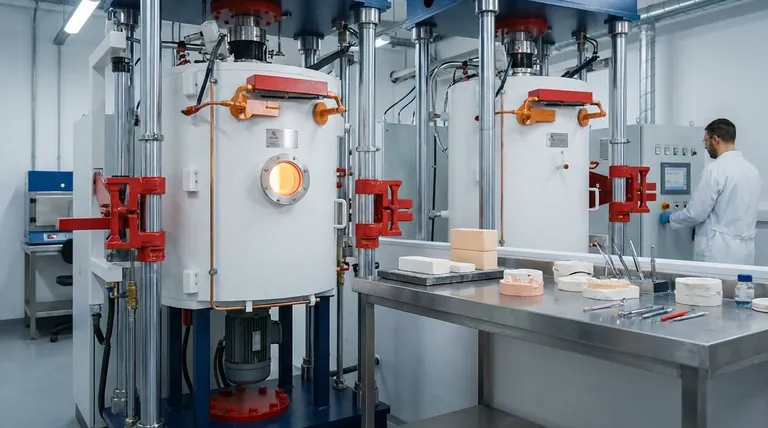
Automated pressure sintering furnaces function as the critical delivery system in the pressable ceramics workflow, specifically utilizing the lost-wax technique. These devices heat ceramic ingots to their precise softening point and apply controlled mechanical pressure to inject the viscous material into an investment mold.
By synchronizing extreme heat with mechanical pressure, these furnaces achieve full material densification and complex mold filling, resulting in restorations with superior structural integrity and uniform aesthetics compared to pressureless methods.
The Mechanics of the Process
Thermal Processing and Injection
The fundamental role of the furnace is to transform the ceramic material from a solid ingot to a semi-molten state.
Once the ingot reaches its specific softening point, the furnace engages a plunger mechanism. This applies consistent force to drive the material into the negative space of the investment mold.
Achieving High Density
Pressure is the variable that differentiates this process from standard firing.
By applying mechanical stress during the heating phase, the furnace forces the material to fill microscopic gaps between particles. This eliminates residual pores and ensures the ceramic achieves maximum density.
Impact on Material Quality
Uniform Crystal Distribution
The automated control of heat and pressure regulates how the ceramic's internal structure forms.
This process ensures a uniform distribution of crystal phases within the glass matrix. This uniformity is essential for minimizing internal stress and preventing crack propagation.
Enhancing Aesthetic Properties
The structural homogeneity achieved by the furnace directly translates to optical performance.
A consistent crystal structure improves translucency and shade accuracy. This allows the restoration to mimic natural tooth structure more effectively than materials with irregular internal densities.
Complex Morphology Replication
The degree of automation in the furnace governs the precision of the injection.
High-level automation monitors the resistance and flow of the material in real-time. This allows for the complete filling of restorations with intricate shapes or thin margins that would otherwise be prone to miscasting.
Understanding the Trade-offs
The Necessity of Precision
While effective, these furnaces rely heavily on the accuracy of the automation software and sensor feedback.
If the automation fails to calculate the exact pressure required for a specific viscosity, it can lead to incomplete pressing (short margins).
Equipment Complexity
Unlike simple gravity casting or standard firing, pressure sintering introduces mechanical complexity.
The synergy between the heating element and the pressure loading system must be perfectly calibrated. A variance in either can lead to abnormal grain growth or insufficient densification.
Making the Right Choice for Your Goal
To leverage automated pressure sintering effectively, align the equipment's capabilities with your specific restoration requirements:
- If your primary focus is complex morphology: Ensure your equipment features high-level flow automation to navigate thin walls and intricate anatomical details.
- If your primary focus is structural durability: Prioritize systems that offer precise pressure controls to maximize density and eliminate porosity.
- If your primary focus is aesthetic consistency: Rely on the furnace’s ability to maintain uniform pressure to ensure an even distribution of crystal phases.
Ultimately, the function of this technology is to remove the variables of manual processing, delivering a repeatable standard of density and strength.
Summary Table:
| Feature | Function in Pressable Ceramics | Benefit to Final Restoration |
|---|---|---|
| Thermal Processing | Heats ingots to precise softening points | Ensures optimal viscosity for injection |
| Mechanical Pressure | Injects material into investment molds | Eliminates porosity and ensures high density |
| Automated Control | Real-time monitoring of flow and resistance | Accurately replicates complex morphologies |
| Crystal Regulation | Ensures uniform phase distribution | Enhances translucency and structural integrity |
Elevate Your Dental Laboratory Precision with KINTEK
Don't settle for inconsistent results in your ceramic workflows. KINTEK provides industry-leading thermal solutions, including Muffle, Tube, Vacuum, and CVD systems, all customizable to meet the rigorous demands of modern material science. Backed by expert R&D and world-class manufacturing, our furnaces ensure the precise heat and pressure control necessary for superior structural integrity and aesthetic perfection.
Ready to optimize your production? Contact us today to find the perfect high-temperature furnace for your unique needs.
References
- Nestor Washington Solís Pinargote, Pavel Peretyagin. Materials and Methods for All-Ceramic Dental Restorations Using Computer-Aided Design (CAD) and Computer-Aided Manufacturing (CAM) Technologies—A Brief Review. DOI: 10.3390/dj12030047
This article is also based on technical information from Kintek Furnace Knowledge Base .
Related Products
- Dental Porcelain Zirconia Sintering Ceramic Vacuum Press Furnace
- Chairside Dental Porcelain Zirconia Sintering Furnace with Transformer for Ceramic Restorations
- Vacuum Dental Porcelain Sintering Furnace for Dental Laboratories
- Vacuum Heat Treat Sintering Furnace with Pressure for Vacuum Sintering
- Spark Plasma Sintering SPS Furnace
People Also Ask
- What factors determine the quality of sintered zirconia restorations? Master Material, Equipment, and Technique
- How do conventional vs rapid sintering in dental furnaces affect zirconia? Optimize Efficiency Without Sacrificing Strength
- What is the purpose of dental sintering furnaces? Transform Zirconia into Durable, High-Quality Dental Restorations
- What precautions should be taken when sintering zirconia in the Fast Slow Dental Sintering Furnace? Master Key Steps for Perfect Results
- What temperature range is used for sintering zirconia ceramics? Achieve Optimal Strength and Translucency


















