
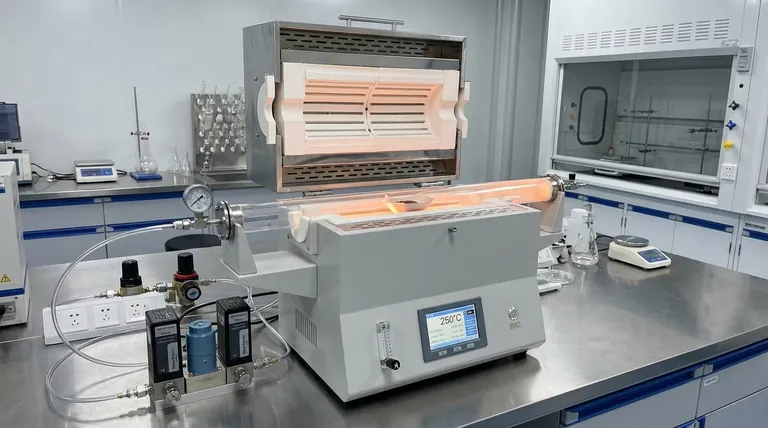
The primary function of the tube atmosphere furnace in this context is to establish a strictly controlled reducing environment using a Nitrogen/Hydrogen (N2/H2) gas mixture at 250 °C. This specific setup is essential to strip ligands from metal precursors without causing the manganese atoms to cluster or over-oxidize.
Core Takeaway The tube atmosphere furnace is not merely a heating element; it is a precision tool for ligand stripping and structural stabilization. Its role is to facilitate a "charge-transfer-driven strategy" that locks manganese into a single-atom topological structure, preventing the aggregation that typically ruins catalyst efficiency.
Controlling the Physicochemical Environment
Precise Gas Atmosphere Regulation
For Mn1/CeO2 fabrication, the furnace must introduce a specific mixture of nitrogen and hydrogen (N2/H2).
This is not a generic heating step; the presence of hydrogen creates the necessary reducing conditions. The furnace ensures this gas flows uniformly over the sample, enabling consistent chemical reactions across the entire catalyst batch.
Thermal Stability at 250 °C
The reduction process requires a stable temperature of 250 °C.
The tube furnace maintains this specific thermal set point with high precision. This moderate temperature is critical because it is high enough to drive the reaction but low enough to prevent thermal damage to the delicate single-atom structure.
Facilitating the Charge-Transfer Strategy
Controlled Ligand Stripping
The core chemical function of the furnace during this step is ligand stripping.
The reducing atmosphere removes organic ligands attached to the metal precursors. Because the furnace creates a controlled environment, this stripping occurs gradually and predictably, rather than chaotically.
Preventing Over-Oxidation
A major risk in catalyst fabrication is the uncontrolled reaction of metal atoms with oxygen.
By maintaining a reducing N2/H2 atmosphere, the furnace actively prevents over-oxidation. This ensures the manganese remains in the desired chemical state necessary for its catalytic activity.
Ensuring Single-Atom Topology
The ultimate goal of this process is the precise construction of a manganese single-atom topological structure.
If the environment were uncontrolled, manganese atoms would naturally migrate and clump together (aggregate). The tube atmosphere furnace provides the exact physicochemical conditions required to stabilize these atoms individually via a charge-transfer mechanism.
Understanding the Trade-offs
Sensitivity to Gas Composition
The effectiveness of the tube furnace is entirely dependent on the accuracy of the gas mixture.
If the hydrogen concentration fluctuates or oxygen leaks into the tube, the reduction will fail. This can lead to either incomplete ligand stripping or immediate oxidation of the manganese.
Thermal Uniformity Risks
While the furnace targets 250 °C, gradients can exist within the tube if not properly calibrated.
Uneven heating can result in a heterogeneous sample where some manganese atoms aggregate while others remain properly dispersed. This highlights the need for precise placement of the sample within the furnace's "hot zone."
Making the Right Choice for Your Goal
To achieve the best results with your Mn1/CeO2 catalyst fabrication, align your furnace operation with your specific structural goals.
- If your primary focus is Single-Atom Dispersion: Prioritize the stability of the N2/H2 gas flow, as this prevents the aggregation of manganese atoms.
- If your primary focus is Ligand Removal: Ensure strict adherence to the 250 °C temperature set point to ensure complete stripping without inducing thermal degradation.
Success in this step relies on treating the furnace as a chemical reactor, where atmosphere and temperature are variables as critical as the catalyst ingredients themselves.
Summary Table:
| Feature | Function in Mn1/CeO2 Fabrication | Impact on Catalyst Structure |
|---|---|---|
| Gas Environment | N2/H2 reducing atmosphere | Prevents over-oxidation and aggregation |
| Temperature | Precise 250 °C set point | Enables controlled ligand stripping |
| Mechanism | Charge-transfer-driven strategy | Stabilizes single-atom topological structure |
| Thermal Uniformity | Consistent heating across batch | Ensures homogeneous catalytic activity |
Optimize Your Catalyst Fabrication with KINTEK
Precision is the difference between aggregation and single-atom stability. Backed by expert R&D and manufacturing, KINTEK offers high-performance Tube, Muffle, Rotary, Vacuum, and CVD systems designed to meet the rigorous demands of material science. Whether you require strict atmosphere control for ligand stripping or uniform thermal profiles for structural stabilization, our lab high-temp furnaces are fully customizable to your unique research needs.
Ready to elevate your lab's efficiency? Contact KINTEK today for a custom furnace solution!
Visual Guide

References
- Weibin Chen, Ruqiang Zou. Designer topological-single-atom catalysts with site-specific selectivity. DOI: 10.1038/s41467-025-55838-6
This article is also based on technical information from Kintek Furnace Knowledge Base .
Related Products
- 1200℃ Controlled Inert Nitrogen Atmosphere Furnace
- Mesh Belt Controlled Atmosphere Furnace Inert Nitrogen Atmosphere Furnace
- 1400℃ Controlled Inert Nitrogen Atmosphere Furnace
- 1700℃ Controlled Inert Nitrogen Atmosphere Furnace
- Controlled Inert Nitrogen Hydrogen Atmosphere Furnace
People Also Ask
- Why is uniform atmosphere flow important in a controlled atmosphere furnace? Ensure Consistent Results and Avoid Costly Failures
- What are the key benefits of precise temperature control in a controlled atmosphere furnace? Unlock Superior Quality and Efficiency
- What are the operational advantages of using a controlled atmosphere furnace? Boost Quality and Efficiency in Heat Treatment
- What are the advantages of a controlled atmosphere furnace over tube furnaces? Superior Process Control for Sensitive Materials
- How do surface oxide layers on ceramic powders like silicon nitride affect sintering? Master Atmosphere Control



















