
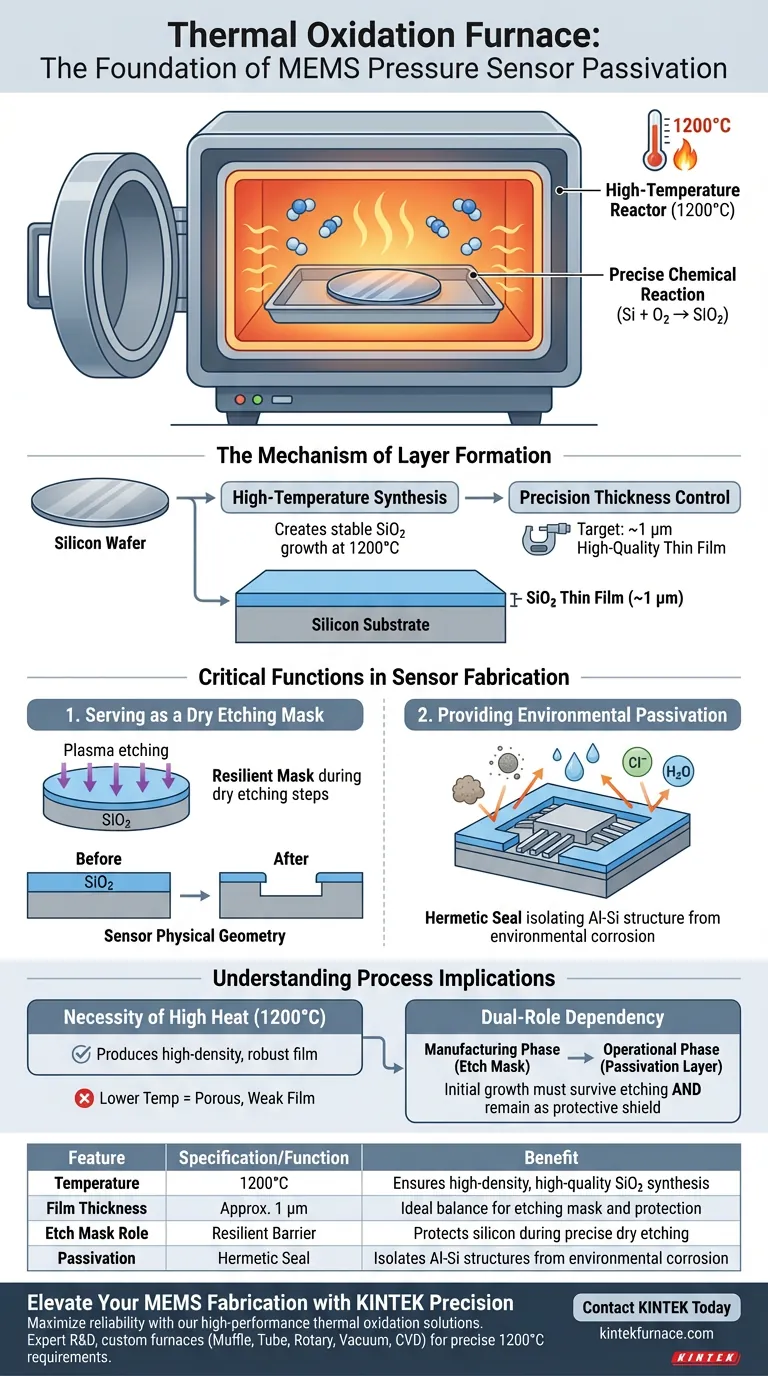
A thermal oxidation furnace functions as a high-temperature reactor, facilitating a precise chemical reaction between silicon and oxygen at 1200°C. This process grows a high-quality silicon dioxide ($\text{SiO}_2$) thin film, approximately 1 μm thick, which serves as both a manufacturing tool and a critical protective shield for MEMS pressure sensors.
By subjecting the wafer to extreme heat, the furnace creates a dual-purpose layer that acts as a robust mask during dry etching and a permanent passivation barrier, sealing the aluminum-silicon structure against environmental degradation.
The Mechanism of Layer Formation
High-Temperature Synthesis
The core function of the furnace is to create an environment where silicon can chemically bond with oxygen.
This reaction occurs at a temperature of 1200°C, ensuring a stable and uniform growth process.
Precision Thickness Control
The goal of this thermal cycle is to grow a specific thickness of silicon dioxide.
For MEMS pressure sensors, the target is a thin film of approximately 1 μm. This specific thickness is calculated to provide adequate structural integrity without compromising the sensor's mechanical properties.
Critical Functions in Sensor Fabrication
Serving as a Dry Etching Mask
Before the sensor becomes a finished product, it must undergo shaping processes.
The silicon dioxide layer grown in the furnace serves as a resilient mask during subsequent dry etching steps. It protects specific areas of the wafer while allowing others to be machined, defining the sensor's physical geometry.
Providing Environmental Passivation
Once fabrication is complete, the oxide layer transitions to its long-term role.
It acts as a passivation layer, effectively isolating the sensitive aluminum-silicon hybrid structure. This prevents environmental factors, such as moisture or contaminants, from corroding or altering the device's electrical characteristics.
Understanding the Process Implications
The Necessity of High Heat
The 1200°C requirement is not arbitrary; it is necessary to produce a "high-quality" film.
Lower temperatures might result in porous or mechanically weak oxides that fail to protect the underlying aluminum-silicon structure.
The Dual-Role Dependency
There is a critical dependency between the manufacturing phase and the operational phase.
Because the film acts as an etch mask first, the initial growth must be sufficient to survive the etching process and still leave enough material behind to serve as a protective passivation layer. If the initial growth is too thin, the device may lack adequate isolation in the field.
Ensuring Sensor Reliability
If your primary focus is Fabrication Efficiency: Ensure the oxide layer is grown to the full 1 μm thickness to withstand the aggression of dry etching processes without failing.
If your primary focus is Long-Term Reliability: Prioritize the high-temperature (1200°C) consistency to ensure the aluminum-silicon structure is hermetically sealed from environmental influences.
The thermal oxidation furnace is the foundational tool that transforms raw silicon into a durable, environment-resistant sensor interface.
Summary Table:
| Feature | Specification/Function | Benefit |
|---|---|---|
| Temperature | 1200°C | Ensures high-density, high-quality SiO2 synthesis |
| Film Thickness | Approx. 1 μm | Ideal balance for etching mask and protection |
| Etch Mask Role | Resilient Barrier | Protects silicon during precise dry etching |
| Passivation | Hermetic Seal | Isolates Al-Si structures from environmental corrosion |
Elevate Your MEMS Fabrication with KINTEK Precision
Maximize sensor reliability and fabrication yields with high-performance thermal oxidation solutions. Backed by expert R&D and manufacturing, KINTEK offers Muffle, Tube, Rotary, Vacuum, and CVD systems, along with customizable high-temp lab furnaces designed for the precise 1200°C requirements of MEMS passivation.
Whether you need a specialized atmosphere for thin-film growth or a robust furnace for bulk processing, our engineering team is ready to tailor a solution to your unique research or production needs.
Contact KINTEK Today to Optimize Your Thermal Processes
Visual Guide
References
- Min Li, Wenhao Hua. Development of Highly Sensitive and Thermostable Microelectromechanical System Pressure Sensor Based on Array-Type Aluminum–Silicon Hybrid Structures. DOI: 10.3390/mi15091065
This article is also based on technical information from Kintek Furnace Knowledge Base .
Related Products
- Laboratory Quartz Tube Furnace RTP Heating Tubular Furnace
- Multi Heating Zones CVD Tube Furnace Machine for Chemical Vapor Deposition Equipment
- 1700℃ High Temperature Laboratory Tube Furnace with Alumina Tube
- 1200℃ Controlled Inert Nitrogen Atmosphere Furnace
- Vacuum Heat Treat Sintering Furnace with Pressure for Vacuum Sintering
People Also Ask
- What physical conditions does a laboratory Tube Furnace provide for SOEC? Precision Heat for Solid Oxide Characterization
- What are the main features and functions of a laboratory tube furnace? Unlock Precise High-Temp Control for Your Lab
- What conditions do tube furnaces provide for Au-Seeded TiO2 nanowires? Master Precision Thermal Synthesis
- What conditions does a tube furnace provide for post-ion-implantation? Achieve Precise Microstructural Repair
- Why is control of heating rate and gas flow in a lab tube furnace critical for EM wave absorption materials?



















