
The primary function of introducing a reducing atmosphere, such as hydrogen, into modified hot pressing sintering equipment is to actively eliminate oxide films from the surface of metal powder particles. By chemically removing these oxides—specifically on metals like iron, copper, nickel, and cobalt—the process effectively "cleans" the particle surfaces to prepare them for bonding.
By stripping away oxidation layers, a reducing atmosphere activates the material at the atomic level. This promotes rapid diffusion and strong "sintering neck" formation, resulting in a final product with superior mechanical integrity and sharpness.
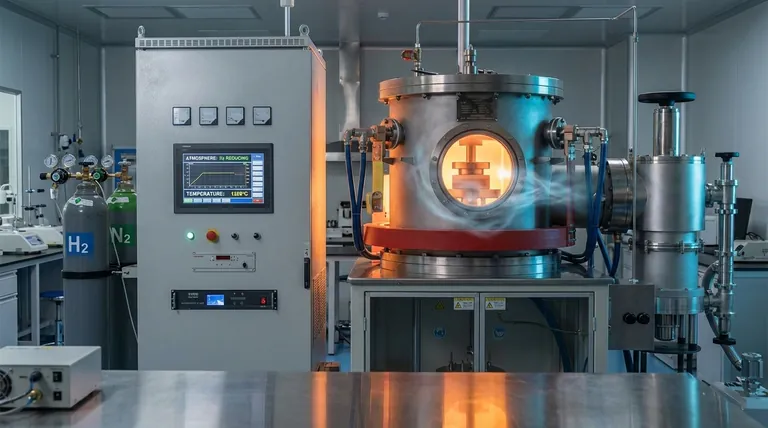
Mechanisms of Surface Activation
Eliminating the Oxide Barrier
Metal powders naturally develop a thin layer of oxidation when exposed to air. In a standard sintering environment, this layer acts as a barrier that hinders particles from fusing together.
The introduction of hydrogen actively reduces these films, converting metal oxides back into pure metal. This exposes the "fresh" surface of the material, which is chemically more reactive and ready to bond.
Promoting Atomic Diffusion
Once the oxide film is removed, the surface energy of the particles increases. This state is often referred to as surface activation.
Activated surfaces facilitate atomic diffusion, allowing atoms to move freely between adjacent particles. This migration is the driving force behind the creation of sintering necks—the physical bridges that turn loose powder into a solid mass.
Enhancing Product Performance
Strengthening Diamond Tools
In the context of manufacturing diamond tools, the quality of the bond between the metal matrix and the diamond is paramount. The primary reference highlights that removing oxides substantially enhances this bond.
The result is a significant improvement in mechanical strength. Furthermore, the optimized sintering process contributes to the sharpness of the tool, extending its operational life and cutting efficiency.
Optimizing Internal Structure
Beyond surface cleaning, a reducing atmosphere influences the internal structure of the material. As noted in ferrite production, hydrogen can improve wettability between particles.
This reduction in surface tension helps minimize internal voids and porosity. A denser structure translates to higher durability and better performance in demanding applications.
Understanding the Trade-offs
Process Safety and Complexity
While beneficial, introducing hydrogen requires rigorous safety protocols due to its flammability. Modified hot pressing equipment must feature advanced sealing and gas control systems to manage the risk of combustion or explosion.
Chemical Sensitivity
There is a risk of over-reduction if the atmosphere is not precisely controlled. For complex materials like ferrites, an excessive reducing environment can alter the cation distribution or crystal lattice too aggressively, potentially degrading the material's magnetic or electrical properties rather than enhancing them.
Making the Right Choice for Your Goal
The decision to utilize a reducing atmosphere depends on the specific material properties you need to unlock.
- If your primary focus is Diamond Tools and Metal Alloys: Prioritize this process to strip oxide films and maximize mechanical strength and cutting sharpness.
- If your primary focus is Electronic Ferrites: Use the reducing atmosphere to optimize cation distribution and minimize porosity for high-frequency magnetic performance.
A properly controlled atmosphere transforms sintering from a simple heating process into a precise chemical treatment that defines the ultimate quality of your material.
Summary Table:
| Feature | Function in Reducing Atmosphere |
|---|---|
| Oxide Removal | Chemically strips oxide films from metal powder surfaces to expose 'fresh' metal. |
| Surface Activation | Increases surface energy to promote rapid atomic diffusion and sintering neck formation. |
| Mechanical Impact | Enhances bonding strength, improves tool sharpness, and reduces internal porosity. |
| Safety Focus | Requires precision gas control and sealing systems to manage flammability risks. |
Elevate Your Material Integrity with KINTEK
Unlock the full potential of your sintering processes with KINTEK’s advanced laboratory solutions. Backed by expert R&D and world-class manufacturing, we provide high-performance Muffle, Tube, Rotary, Vacuum, and CVD systems designed for precise atmosphere control. Whether you are manufacturing diamond tools or high-frequency ferrites, our customizable high-temperature furnaces ensure the chemical purity and structural density your materials demand.
Ready to optimize your sintering workflow? Contact us today to consult with our experts on a custom solution tailored to your unique research or production needs.
Visual Guide

Related Products
- 600T Vacuum Induction Hot Press Vacuum Heat Treat and Sintering Furnace
- Vacuum Heat Treat Sintering Furnace with Pressure for Vacuum Sintering
- Mesh Belt Controlled Atmosphere Furnace Inert Nitrogen Atmosphere Furnace
- Controlled Inert Nitrogen Hydrogen Atmosphere Furnace
- 9MPa Air Pressure Vacuum Heat Treat and Sintering Furnace
People Also Ask
- Why use Vacuum Hot Press (VHP) for ZnS Ceramics? Achieve Superior IR Transparency and Mechanical Strength
- How does a vacuum hot press sintering furnace mitigate copper sintering swelling? Solve Fe-Cu Expansion Issues
- What are the key advantages of vacuum hot press sintering furnaces? Achieve Superior Density and Purity in Materials
- What are the benefits of using a vacuum hot press sintering furnace for the preparation of SiCw/2024 aluminum matrix composites? Achieve High-Performance Aerospace Materials
- How does the vacuum environment in a vacuum hot press sintering furnace protect chromium-containing ceramics? Find out.



















