
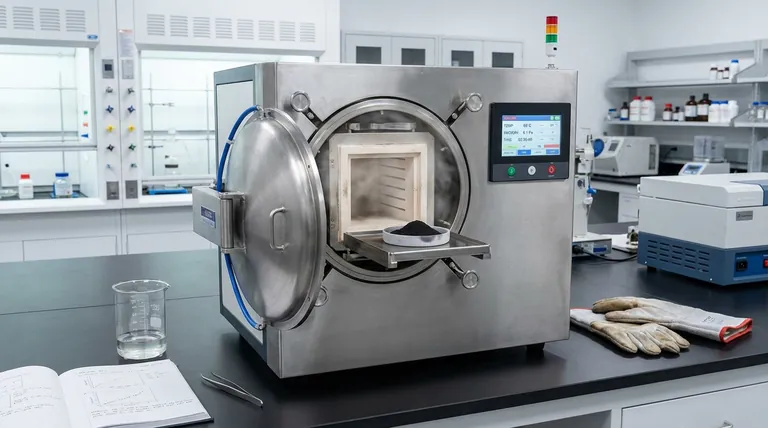
A laboratory vacuum drying oven functions by lowering ambient pressure to facilitate the rapid evaporation of washing solvents at significantly reduced temperatures. This specialized environment is critical for processing Fe-N-C catalysts after the washing phase, as it removes solvents like ethanol or water without subjecting the material to the destructive thermal stress of standard drying methods.
Core Takeaway The vacuum drying process decouples evaporation from high heat, effectively preventing the collapse of the catalyst's nanoporous structure. By avoiding high-temperature oxidation and minimizing agglomeration, this method preserves the high specific surface area and chemical stability necessary for the catalyst's active sites to function.
Preserving the Physical Structure
The most immediate risk during the drying phase of Fe-N-C catalysts is the degradation of their physical morphology. Vacuum drying addresses this through controlled evaporation.
Preventing Nanoporous Collapse
Fe-N-C catalysts rely on a complex nanoporous structure to maximize the exposure of active sites. The primary reference indicates that standard high-temperature drying can cause these delicate pores to collapse. Vacuum drying mitigates this by allowing solvents to leave the structure gently, maintaining the catalyst's internal architecture.
Avoiding Hard Agglomeration
When solvents evaporate at high temperatures under standard pressure, particles often clump together tightly, a phenomenon known as hard agglomeration. This reduces the usable surface area. By operating under vacuum, the process preserves the "loose" and porous nature of the powder, ensuring it remains fine and uniform for subsequent processing.
Maintaining Surface Uniformity
As solvents evaporate, they generate migration forces that can pull active metal salts to the surface, creating an uneven "eggshell" distribution. Vacuum drying minimizes these forces. This ensures the metal components remain uniformly distributed throughout the support, rather than concentrating on the outer shell.
Protecting Chemical Integrity
Beyond physical structure, the chemical viability of the Fe-N-C catalyst is highly sensitive to the drying environment.
Mitigating Thermal Oxidation
Active sites within the catalyst are susceptible to damage when exposed to high temperatures in an oxygen-rich environment. By reducing the pressure, the boiling point of solvents like ethanol drops significantly. This allows the material to dry at temperatures (e.g., 40°C - 80°C) low enough to prevent oxidative deterioration.
Stabilizing Active Sites
The chemical coordination between Iron (Fe), Nitrogen (N), and Carbon (C) creates the active sites responsible for catalysis. High-temperature exposure can disrupt these bonds or decompose organic components. Vacuum drying maintains the chemical stability of these sites, ensuring the final product retains its intended physicochemical activity.
Common Pitfalls to Avoid
While vacuum drying is superior for this application, understanding the comparative risks of alternative methods clarifies why it is non-negotiable.
The Risk of Standard Oven Drying
Using a standard laboratory drying oven (without vacuum) typically requires higher temperatures (e.g., 105°C) to remove moisture effectively. While this removes physically adsorbed water, it increases the risk of pore structure collapse and oxidation. If the goal is high-performance catalysis, standard thermal drying is often too aggressive for the final washing stage.
The Danger of Residual Solvents
Failure to achieve a sufficient vacuum level can leave residual solvents, such as dilute hydrochloric acid or water, deep within the pores. If these are not removed at the low-temperature stage, they can cause bursting or cracking of particles during later high-temperature calcination steps. The vacuum function is essential to ensure thorough solvent removal without thermal shock.
Making the Right Choice for Your Goal
To maximize the performance of your Fe-N-C catalyst, align your drying parameters with your specific structural and chemical targets.
- If your primary focus is Maximizing Surface Area: Prioritize vacuum drying to prevent pore collapse and hard agglomeration, ensuring the material retains a loose, high-surface-area morphology.
- If your primary focus is Chemical Stability: Utilize the vacuum environment to lower the drying temperature, thereby shielding sensitive active sites from oxidative damage and thermal decomposition.
By controlling pressure to lower evaporation temperatures, you protect the microscopic architecture that defines your catalyst's performance.
Summary Table:
| Feature | Vacuum Drying Oven Impact | Resulting Catalyst Benefit |
|---|---|---|
| Evaporation Temp | Significantly reduced boiling points | Prevents thermal oxidation of active sites |
| Pore Integrity | Gentle solvent removal at low pressure | Prevents collapse of nanoporous structures |
| Particle Form | Minimizes hard agglomeration | Maintains high specific surface area |
| Distribution | Reduces solvent migration forces | Ensures uniform distribution of active metals |
| Environment | Oxygen-depleted atmosphere | Stabilizes Fe-N-C chemical coordination |
Optimize Your Fe-N-C Catalyst Performance with KINTEK
Don’t let standard drying methods compromise your material’s active sites or pore structure. Backed by expert R&D and manufacturing, KINTEK offers high-performance laboratory vacuum drying ovens and customizable high-temp furnace systems (Muffle, Tube, Rotary, CVD) designed to meet your precise laboratory needs.
Ready to preserve your catalyst’s chemical integrity and surface area? Contact our technical team today to find the perfect drying solution for your unique research requirements.
References
- Yumei Liu, Quanquan Pang. Integrated energy storage and CO2 conversion using an aqueous battery with tamed asymmetric reactions. DOI: 10.1038/s41467-023-44283-y
This article is also based on technical information from Kintek Furnace Knowledge Base .
Related Products
- Vacuum Heat Treat Sintering and Brazing Furnace
- Vacuum Heat Treat Sintering Furnace Molybdenum Wire Vacuum Sintering Furnace
- Dental Porcelain Zirconia Sintering Ceramic Vacuum Press Furnace
- Molybdenum Vacuum Heat Treat Furnace
- Vacuum Hot Press Furnace Machine Heated Vacuum Press
People Also Ask
- What is one of the most important uses of vacuum heat treating furnaces in aerospace? Achieve Superior Strength in Aircraft Alloys
- How does vacuum heat treating affect the grain structure of metal alloys? Achieve Precise Microstructure Control
- What are the benefits of using vacuum heat treating furnaces for metal alloys? Achieve Superior Metal Properties and Performance
- What is the temperature of a vacuum furnace brazing? Optimize Your Joint Strength and Cleanliness
- What are the steps involved in a typical vacuum brazing treatment? Master the Process for Strong, Clean Joints












