
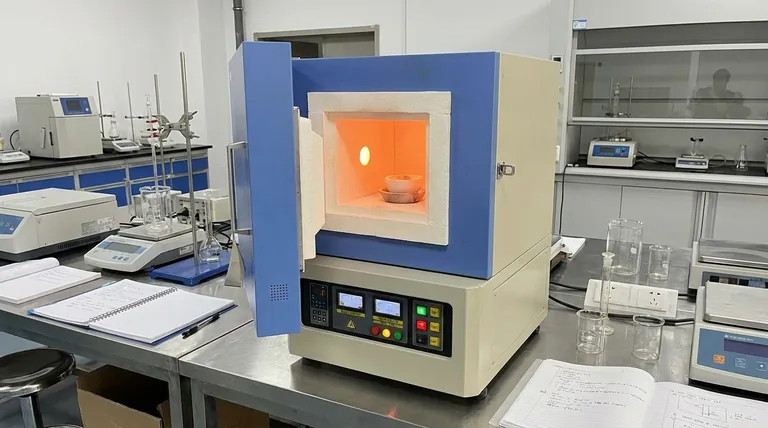
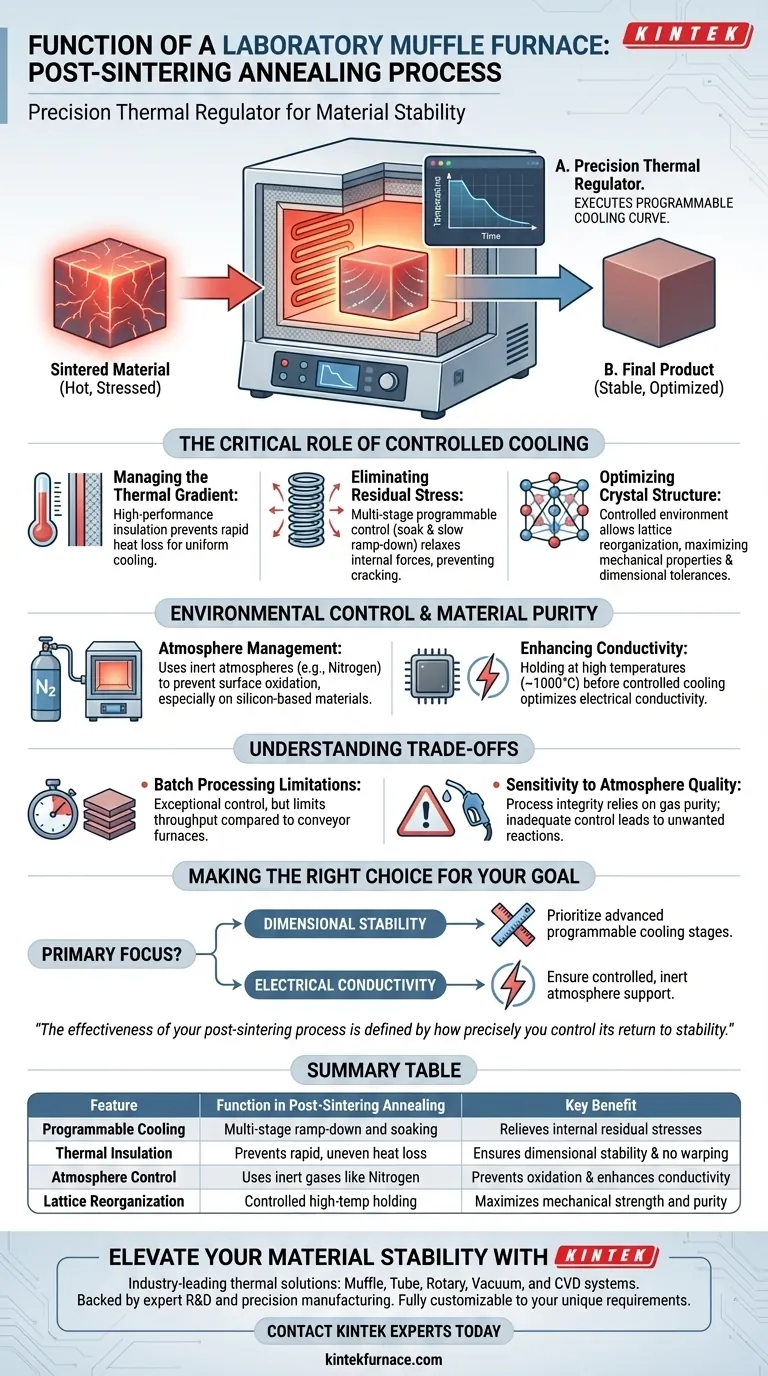
A laboratory muffle furnace serves as a precision thermal regulator during the post-sintering annealing phase, specifically designed to manage the material's return to ambient temperature. Its primary function is to execute a multi-stage, programmable cooling curve that gradually relieves internal residual stresses generated during the initial sintering process.
While sintering creates the solid mass, annealing defines its longevity. The muffle furnace utilizes high-performance insulation and logic-controlled heating elements to ensure the cooling rate is slow and uniform, thereby locking in dimensional stability and mechanical strength.
The Critical Role of Controlled Cooling
Managing the Thermal Gradient
The transition from high sintering temperatures to room temperature is critical. A muffle furnace uses high-performance insulation to prevent rapid heat loss, ensuring the material does not cool unevenly.
Eliminating Residual Stress
Materials often emerge from sintering with significant internal tension. The furnace’s multi-stage programmable control allows for a specific "soak" and slow ramp-down, which relaxes these internal forces and prevents future cracking or warping.
Optimizing Crystal Structure
Beyond simple stress relief, this controlled environment allows for the reorganization of the material's atomic lattice. This structural optimization is essential for maximizing mechanical properties and ensuring the final product meets precise dimensional tolerances.
Environmental Control and Material Purity
Atmosphere Management
Annealing often requires isolation from standard air to prevent degradation. Muffle furnaces can maintain specific atmospheres, such as using nitrogen to prevent surface oxidation on silicon-based materials during the cooling phase.
Enhancing Conductivity
For semiconductor materials, the annealing function is vital for electrical performance. By holding the material at temperatures around 1000°C before controlled cooling, the furnace helps optimize electrical conductivity effectively.
Understanding the Trade-offs
Batch Processing Limitations
Muffle furnaces are typically designed for batch processing rather than continuous flow. While this offers exceptional control for research and high-precision parts, it effectively limits throughput speed compared to conveyor-style industrial furnaces.
Sensitivity to Atmosphere Quality
While these furnaces can utilize protective atmospheres, the integrity of the process relies heavily on the purity of the gas used. Inadequate atmosphere control during the annealing phase can lead to unwanted surface reactions, such as oxidation, negating the benefits of the thermal treatment.
Making the Right Choice for Your Goal
To maximize the utility of a muffle furnace in your post-sintering workflow, consider your specific material requirements:
- If your primary focus is Dimensional Stability: Prioritize a furnace with advanced programmable cooling stages to ensure gradual stress relief and prevent warping.
- If your primary focus is Electrical Conductivity: Ensure your furnace supports a controlled, inert atmosphere (like nitrogen) to prevent oxidation during the annealing cycle.
The effectiveness of your post-sintering process is defined not by how hot you can get the material, but by how precisely you can control its return to stability.
Summary Table:
| Feature | Function in Post-Sintering Annealing | Key Benefit |
|---|---|---|
| Programmable Cooling | Multi-stage ramp-down and soaking | Relieves internal residual stresses |
| Thermal Insulation | Prevents rapid, uneven heat loss | Ensures dimensional stability & no warping |
| Atmosphere Control | Uses inert gases like Nitrogen | Prevents oxidation & enhances conductivity |
| Lattice Reorganization | Controlled high-temp holding | Maximizes mechanical strength and purity |
Elevate Your Material Stability with KINTEK
Don't let residual stress compromise your research or production. KINTEK provides industry-leading thermal solutions, including Muffle, Tube, Rotary, Vacuum, and CVD systems, all backed by expert R&D and precision manufacturing. Whether you need to optimize electrical conductivity or ensure perfect dimensional tolerances, our furnaces are fully customizable to meet your unique laboratory requirements.
Ready to refine your annealing process? Contact KINTEK experts today to find the perfect high-temperature furnace for your needs!
Visual Guide
References
- Dimple Dimple, Priyanka Verma. Visible‐NIR Light‐Driven Hydrogen Evolution from Ammonia Borane Using Defect‐Engineered Pd/WO<sub>3‐x</sub> Catalyst. DOI: 10.1002/cctc.202500795
This article is also based on technical information from Kintek Furnace Knowledge Base .
Related Products
- Laboratory Muffle Oven Furnace with Bottom Lifting
- 1400℃ Muffle Oven Furnace for Laboratory
- 1800℃ High Temperature Muffle Oven Furnace for Laboratory
- 1200℃ Muffle Oven Furnace for Laboratory
- 1700℃ High Temperature Muffle Oven Furnace for Laboratory
People Also Ask
- What function does a muffle furnace perform in Ba0.75Ca0.25TiO3 calcination? Ensure Phase Purity & Synthesis
- Why is a high-temperature muffle furnace required for FeOx-MOx/TiO2? Engineering High-Performance Nanocomposites
- Why is a high-temperature laboratory muffle furnace essential for the alkali fusion process in zeolite synthesis?
- What is the importance of the calcination process? Master High-Purity Calcium Phosphate Nanopowder Production
- What are the primary functions of a high-temperature laboratory muffle furnace in the preparation of biosorbent materials?



















