
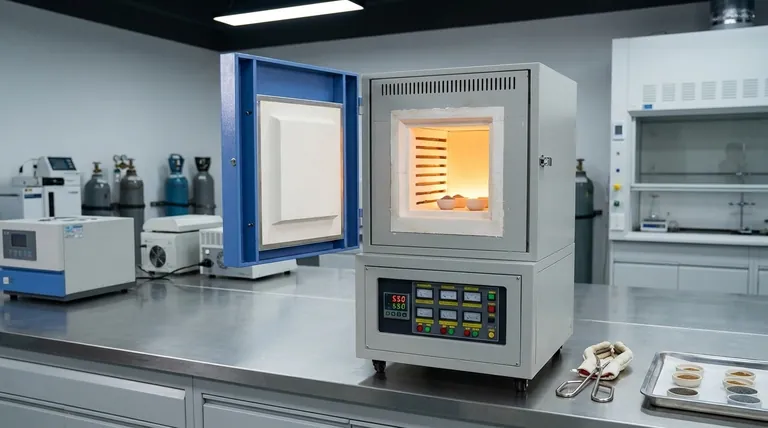
The high-temperature muffle furnace acts as the critical vessel for chemical phase transformation, converting raw precursors into active catalytic material. Specifically, at 550 degrees Celsius, this equipment facilitates the thermal decomposition of loaded metal nitrates into their oxide forms while simultaneously engineering the catalyst's structural integrity.
The primary function of this thermal treatment is to induce a transition from unstable nitrate precursors to robust metal oxides. Beyond simple decomposition, this process drives solid-phase reactions that anchor active metals to the support, significantly enhancing the catalyst's resistance to thermal degradation.
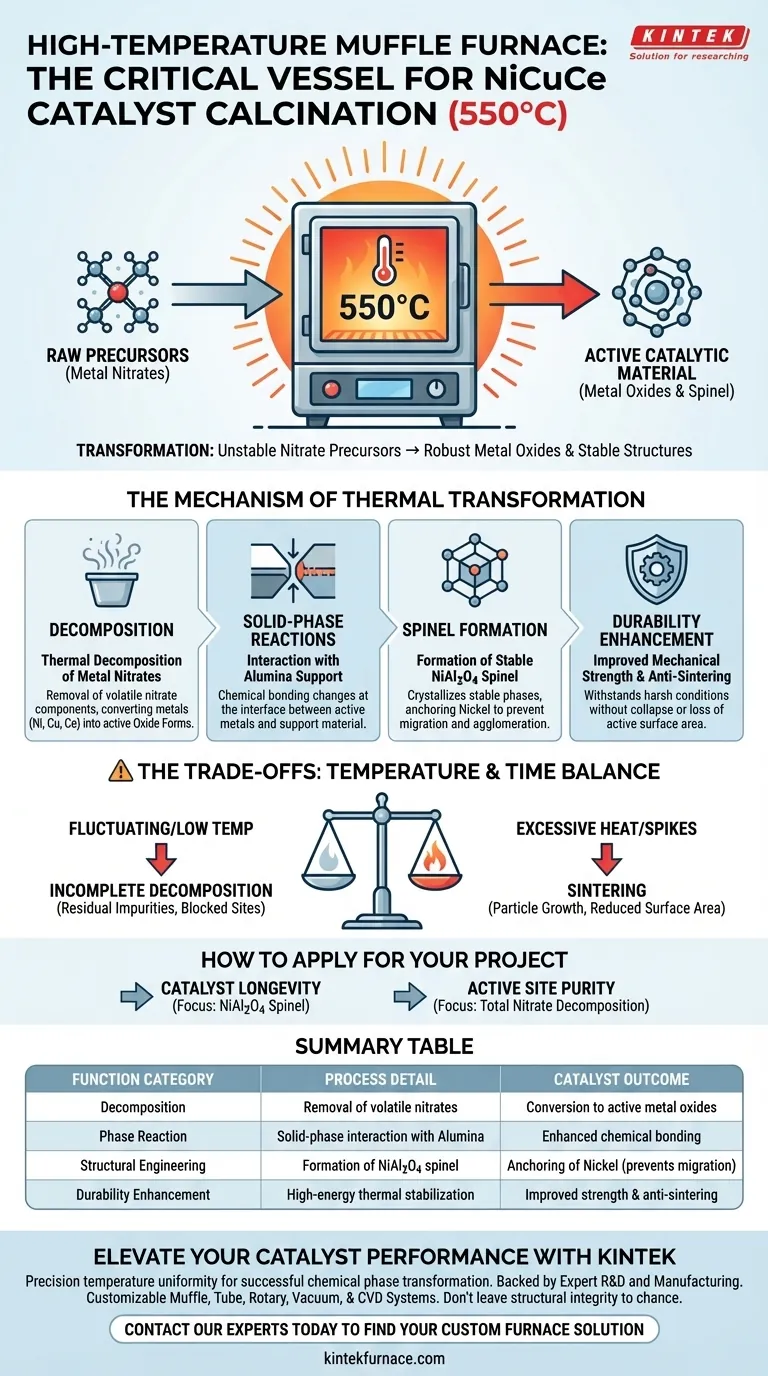
The Mechanism of Thermal Transformation
Decomposition of Metal Precursors
The immediate function of the muffle furnace at this temperature is to drive the thermal decomposition of metal nitrates.
By maintaining a consistent 550°C environment, the furnace ensures that volatile nitrate components are fully removed. This converts the loaded metals (Nickel, Copper, and Cerium) from their precursor salt forms into their respective, chemically active oxide forms.
Inducing Solid-Phase Reactions
Beyond decomposition, the heat treatment initiates essential solid-phase reactions between the active metals and the support material.
In the context of NiCuCe catalysts, this thermal energy allows the metal species to interact chemically with the alumina support. This interaction is not merely physical; it changes the chemical bonding at the interface of the materials.
Formation of Stable Spinel Structures
A critical outcome of these solid-phase reactions is the formation of stable crystalline structures, specifically NiAl2O4 spinel.
The muffle furnace provides the sustained energy required to crystallize these phases. The formation of the NiAl2O4 spinel structure is vital because it anchors the Nickel, preventing it from migrating or agglomerating during operation.
Enhancing Catalyst Durability
The ultimate functional goal of this high-temperature treatment is the improvement of mechanical strength and anti-sintering capabilities.
By converting precursors to oxides and forming stable spinels, the furnace ensures the catalyst can withstand harsh operating conditions without structurally collapsing or losing active surface area.
Understanding the Trade-offs
The Balance of Temperature and Time
While 550°C is targeted for these specific reactions, deviations in the furnace environment can lead to suboptimal results.
If the temperature fluctuates or is too low, incomplete decomposition of the nitrates may occur, leaving residual impurities that block active sites. Conversely, excessive heat or uncontrolled spikes can accelerate sintering, causing metal particles to grow too large and reducing the overall surface area available for catalysis.
How to Apply This to Your Project
To maximize the efficacy of your NiCuCe catalyst preparation, consider the following strategic focus areas:
- If your primary focus is catalyst longevity: Prioritize the precise maintenance of 550°C to ensure the complete formation of the NiAl2O4 spinel, which provides the necessary anti-sintering resistance.
- If your primary focus is active site purity: Ensure adequate airflow and duration within the muffle furnace to guarantee the total thermal decomposition of all nitrate precursors into oxides.
The muffle furnace is not just a heating element; it is the tool that determines the structural destiny and long-term viability of your catalytic material.
Summary Table:
| Function Category | Process Detail | Catalyst Outcome |
|---|---|---|
| Decomposition | Removal of volatile nitrate components | Conversion of precursors to active metal oxides |
| Phase Reaction | Solid-phase interaction with Alumina support | Enhanced chemical bonding at material interfaces |
| Structural Engineering | Formation of NiAl2O4 spinel crystalline structure | Anchoring of Nickel to prevent migration/agglomeration |
| Durability Enhancement | High-energy thermal stabilization | Improved mechanical strength and anti-sintering capability |
Elevate Your Catalyst Performance with KINTEK
Precision is the difference between a successful chemical phase transformation and a failed batch. At KINTEK, we understand that your research depends on exact temperature uniformity and reliability.
Backed by expert R&D and manufacturing, KINTEK offers Muffle, Tube, Rotary, Vacuum, and CVD systems, all fully customizable for your unique NiCuCe catalyst synthesis or high-temp lab needs. Don't leave your structural integrity to chance—partner with the leaders in lab thermal processing.
Contact Our Experts Today to Find Your Custom Furnace Solution
Visual Guide
References
- Yankun Jiang, Siqi Li. Sustainable Hydrogen from Methanol: NiCuCe Catalyst Design with CO2-Driven Regeneration for Carbon-Neutral Energy Systems. DOI: 10.3390/catal15050478
This article is also based on technical information from Kintek Furnace Knowledge Base .
Related Products
- 1700℃ High Temperature Muffle Oven Furnace for Laboratory
- 1800℃ High Temperature Muffle Oven Furnace for Laboratory
- 1200℃ Muffle Oven Furnace for Laboratory
- 1400℃ Muffle Oven Furnace for Laboratory
- High Temperature Muffle Oven Furnace for Laboratory Debinding and Pre Sintering
People Also Ask
- What is the primary function of a high-temperature laboratory muffle furnace in chemical synthesis? Achieve Precision.
- How does a high-temperature laboratory muffle furnace affect material properties? Transform Anodic Oxide Films Fast
- What role does a muffle furnace play in BCZY712 electrolyte powder production? Achieve Perfect Phase Purity
- What is the role of a high-temperature muffle furnace in guava leaf carbonization? Master Precise Pyrolysis Control
- How does the two-stage sintering process contribute to the synthesis of MeCuFeO3 perovskite? Optimize crystal purity.



















