
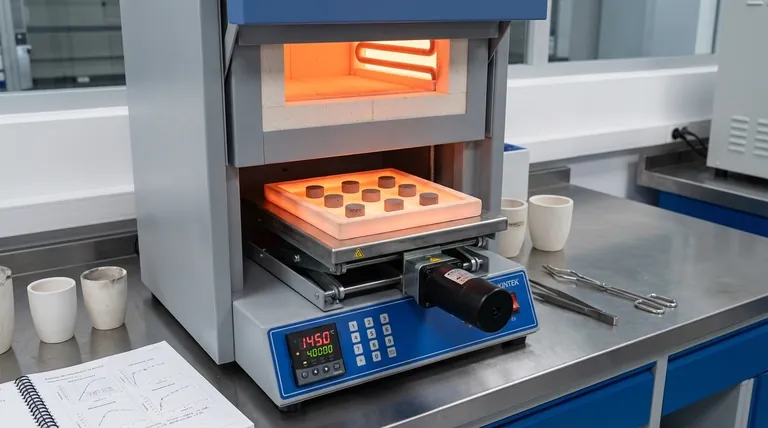
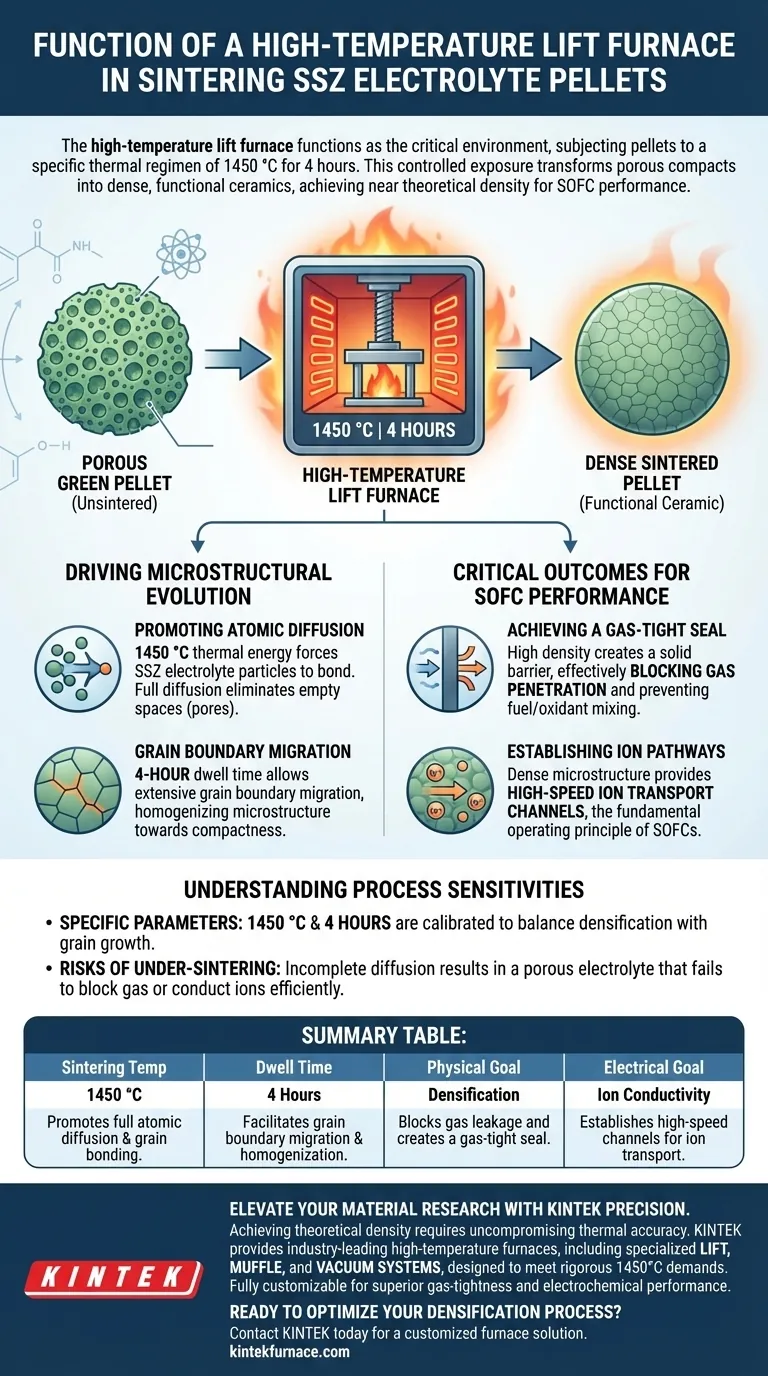
The high-temperature lift furnace functions as the critical environment for sintering SSZ electrolyte pellets, subjecting them to a specific thermal regimen of 1450 °C for 4 hours. This controlled exposure promotes full diffusion and grain boundary migration, transforming the material from a porous compact into a dense, functional ceramic.
The core objective of this process is achieving densification near the theoretical density. This state is essential to create a component that physically blocks gas leakage while simultaneously acting as a high-speed conductor for ions in Solid Oxide Fuel Cells (SOFC).
Driving Microstructural Evolution
Promoting Atomic Diffusion
The furnace provides an ultra-high temperature environment of 1450 °C. This thermal energy is the catalyst that forces SSZ electrolyte particles to bond.
At this temperature, the material undergoes full diffusion. The individual particles merge, effectively eliminating the empty spaces (pores) that exist in the "green" (unsintered) state.
Grain Boundary Migration
The sintering process is not instant; it requires a sustained duration of 4 hours. This dwell time allows for extensive grain boundary migration.
As grain boundaries move and settle, the microstructure of the SSZ pellet homogenizes. This migration is the mechanism that drives the material toward its most compact, solid form.
Critical Outcomes for SOFC Performance
Achieving a Gas-Tight Seal
The primary physical result of this heating process is densification. The furnace ensures the pellets reach a density very close to the theoretical maximum for the material.
This high density is non-negotiable for SOFC operation. It creates a solid barrier that effectively blocks gas penetration, preventing fuel and oxidant gases from mixing directly.
Establishing Ion Pathways
Beyond physical sealing, the furnace treatment dictates the electrochemical properties of the pellet. The dense microstructure provides high-speed ion transport channels.
These channels allow oxygen ions to move freely through the electrolyte. This transport capability is the fundamental operating principle of a Solid Oxide Fuel Cell.
Understanding the Process Sensitivities
The Necessity of Specific Parameters
The specific combination of 1450 °C and 4 hours is not arbitrary. This recipe is calibrated to balance densification with grain growth.
Risks of Under-Sintering
If the furnace fails to maintain the target temperature or duration, diffusion will be incomplete. This results in a porous electrolyte that fails to block gas or conduct ions efficiently.
Optimizing Your Sintering Strategy
To ensure your SSZ electrolytes perform correctly in a fuel cell stack, you must prioritize strict adherence to the thermal profile.
- If your primary focus is safety and sealing: Ensure the furnace reliably reaches 1450 °C to maximize density and prevent gas leakage.
- If your primary focus is electrical efficiency: Verify the 4-hour dwell time is fully met to establish the continuous grain structure required for high-speed ion transport.
The high-temperature lift furnace is not just a heater; it is the tool that defines the structural and electrochemical integrity of the final fuel cell.
Summary Table:
| Parameter | Specification | Function/Impact |
|---|---|---|
| Sintering Temp | 1450 °C | Promotes full atomic diffusion & grain bonding |
| Dwell Time | 4 Hours | Facilitates grain boundary migration & homogenization |
| Physical Goal | Densification | Blocks gas leakage and creates a gas-tight seal |
| Electrical Goal | Ion Conductivity | Establishes high-speed channels for ion transport |
Elevate Your Material Research with KINTEK Precision
Achieving the theoretical density of SSZ electrolyte pellets requires uncompromising thermal accuracy. KINTEK provides industry-leading high-temperature furnaces, including specialized lift, muffle, and vacuum systems, designed to meet the rigorous 1450°C demands of SOFC manufacturing. Backed by expert R&D and manufacturing, our systems are fully customizable to ensure your sintering protocols yield superior gas-tightness and electrochemical performance.
Ready to optimize your densification process? Contact KINTEK today for a customized furnace solution.
Visual Guide
References
- Hao Dong, Zhaotong Wei. Study on Performance and Preparation of Lanthanum-Strontium-Iron-Chromium Electrodes for Using in Symmetric SOFC. DOI: 10.54097/8d6pg665
This article is also based on technical information from Kintek Furnace Knowledge Base .
Related Products
- Laboratory Muffle Oven Furnace with Bottom Lifting
- 1400℃ High Temperature Laboratory Tube Furnace with Alumina Tube
- 1700℃ High Temperature Laboratory Tube Furnace with Alumina Tube
- 1700℃ High Temperature Muffle Oven Furnace for Laboratory
- 1800℃ High Temperature Muffle Oven Furnace for Laboratory
People Also Ask
- Why is a high-temperature laboratory muffle furnace essential for the alkali fusion process in zeolite synthesis?
- What is the importance of the calcination process? Master High-Purity Calcium Phosphate Nanopowder Production
- What function does a muffle furnace perform in Ba0.75Ca0.25TiO3 calcination? Ensure Phase Purity & Synthesis
- Why is a high-temperature muffle furnace required for FeOx-MOx/TiO2? Engineering High-Performance Nanocomposites
- What are the primary functions of a high-temperature laboratory muffle furnace in the preparation of biosorbent materials?



















